


Complete Water Bottling Line
The name 3-in-1 filling machine can refer to different equipment. A water-bottling block may combine rinsing, filling and capping. A small-bottle monoblock may combine dosing, inserting an inner plug and tightening a cap.
The number of functions in the name does not tell you which process is included. List the required operations before requesting a machine.
What the small-bottle machine does
The small-bottle equipment in the supplied material doses liquid, places the specified plug or insert and caps the bottle. Bottles move through indexed positions so the filling and closure stations act at the correct point in the cycle.
The dosing mechanism and closure handling must suit the liquid and packaging. The supplied family includes small-volume applications, but its usable range must be confirmed against the actual bottle, insert and cap.
A machine for essential oils with a dropper insert is therefore a different selection from a water rinser-filler-capper, even though both may carry the 3-in-1 label.
Compare the operations directly
| Requirement | Small-bottle plugging arrangement | Water-bottling arrangement |
|---|---|---|
| Main filling task | Metering a defined small dose | Filling the specified water bottle |
| Distinctive operation to verify | Inner-plug or insert handling in the relevant design | Bottle rinsing in the relevant design |
| Closure details to supply | Bottle neck, insert and cap as a matched set | Bottle neck and water cap specification |
| Key change parts | Bottle holders, guides and closure-handling parts as required | Bottle-handling and filling-block change parts as required |
Confirm the actual sequence in the quotation. Some machines include additional stations, so the marketing name remains insufficient as a specification.
How plugging affects the line
An insert must arrive in the correct orientation and enter the bottle consistently. Neck dimensions, insert tolerances and bottle support influence that action.
If the insert sits too high, the cap may not seat correctly. If the bottle moves during insertion, the closure can be damaged or the machine can stop. Inspect the assembled package rather than judging each station independently.
Use production samples from the intended packaging supplier. A few carefully selected samples may not represent the dimensional variation in a normal shipment.
Select the dosing arrangement for the liquid
Viscosity, temperature, foaming, volatility and compatibility with wetted materials affect the choice. Ask which pump or dosing mechanism is included and how it handles the required fill range.
The smallest dose can require a different setup from the largest dose. A wide catalog range does not establish equal performance at every point. Request trial results at the actual low, normal and high fills you intend to sell.
Capping needs an acceptance definition
Specify how closure quality will be assessed: seating height, leakage, required opening behaviour and any defined torque measurement. A cap that looks straight may still have an incorrect seal or damage beneath it.
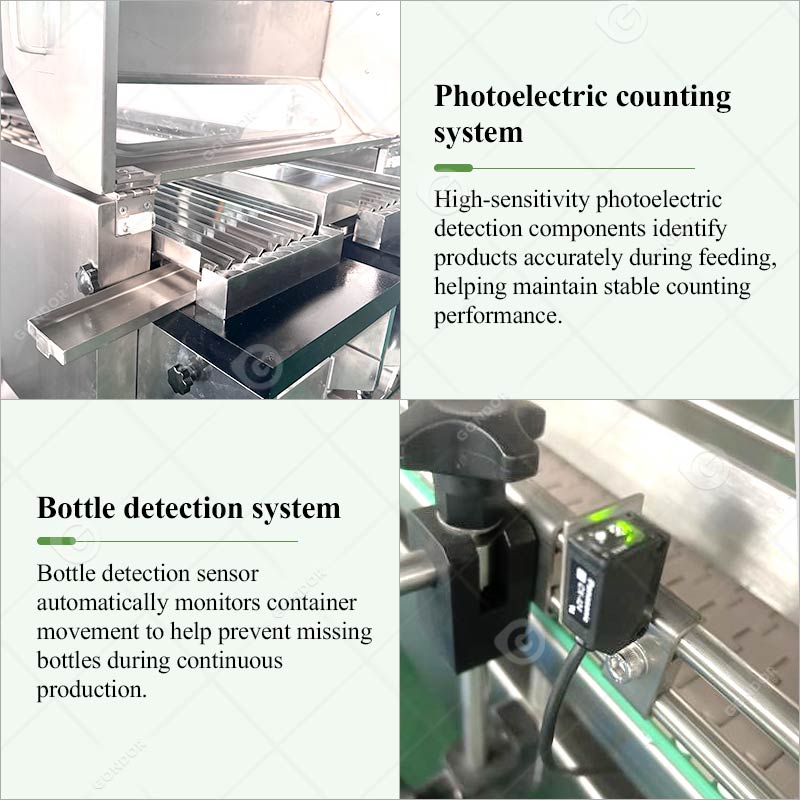
Check whether missing-bottle, missing-insert or missing-cap detection is included, and what happens to a rejected unit. Detection and automatic rejection are separate functions that should be listed explicitly.
Does a small-bottle monoblock make an aseptic line?
The filling, plugging and capping mechanism alone does not establish aseptic performance. Any product requiring sterile processing needs a separately defined process and installation. Do not infer that capability from a general application list or an enclosure.
Specify the assembled closure before evaluating individual stations
Give the supplier a complete bottle, insert and cap set in the combination intended for sale. Include drawings where available and identify the packaging suppliers and material lots used in the trial.
The bottle neck receives the insert and then the cap, so their tolerances interact. A machine may place one component correctly in isolation while the assembled package still fails its seating or leakage requirement.
Ask which bottle surfaces locate the container and which features support it during insertion and capping. The proposed holding arrangement should be evaluated with the normal variation in production bottles rather than one specially selected example.
Examine small doses at the actual product condition
For a small fill, the residual product associated with a nozzle drip can represent a meaningful part of the dose. Record whether the nozzle closes cleanly and whether product remains on the bottle neck before the insert arrives.
Provide viscosity and temperature at the point of filling, along with any relevant changes during holding. A low-viscosity demonstration fluid does not establish how a thicker oil or another formulation will dispense through the proposed system.
Use an agreed net-content measurement and enough consecutive samples to show variation. Record both steady production and the first bottles after a normal interruption. An average alone can hide intermittent short fills or an unstable restart.
Define what happens when a component is missing
Ask the supplier to demonstrate the stated detection functions with the relevant missing-component conditions. Record whether the machine stops, suppresses an operation, marks a bottle or automatically rejects it.
These responses have different operating consequences. A sensor that identifies a missing insert does not automatically remove that bottle from saleable output unless a defined rejection or handling step follows.
Clarify how operators reconcile interrupted or rejected bottles. The acceptance discussion should explain where they go and how they are prevented from being mixed with accepted packages. Keep the proposed arrangement proportionate to the product and project requirements.
Understand the bottleneck created by indexed handling
Several stations can work during the same machine cycle, but one operation may need more time than the others. Insert placement, liquid delivery or closure handling can therefore constrain the cycle for a particular package.
Provide the complete SKU list with intended dose and closure configuration. Ask for a sustainable rate for each main combination. The fastest demonstrated package should not be used as the rate for all other formats without evidence.
If a supplier proposes a different dosing system for the smallest and largest fills, identify the parts and adjustments required. Include the time until accepted production resumes after the change.
Connect the monoblock to the surrounding equipment
The liquid-packaging route guide distinguishes this small-bottle sequence from bottle rinsing and other closure routes. Use that distinction to list any preparation, bottle supply, inspection or labeling equipment needed outside the monoblock.
A compact central machine can still require space for component feeders, product supply and access for changeover. Check these items on the room layout rather than comparing only the machine's main frame dimensions.
Judge the whole package in the acceptance trial
Use production components and the intended liquid. Check dose, insert position, cap seating and the agreed package-integrity result. Record rejects by cause so a closure-feed problem is not hidden inside the filling figures.
Request a configuration list and trial record with the quotation. A statement that the machine performs three operations becomes useful when it names those operations, shows the actual packaging set and defines the accepted output achieved under the specified conditions.
The [3-in-1 filling and capping machine page](/product/three-in-one-filling-capping-machine/) describes the small-bottle system. For a packaging trial, [send the liquid properties, fill volumes and complete bottle-insert-cap samples](/contact/). State explicitly whether you need rinsing, plugging, dropper assembly or another operation so the proposed sequence can be checked.
Related guides
Related Products


Sizing equipment for your line?
Send the product, the batch size and the utilities you have. We reply with the model, the cycle time and what the cooling side needs.



