


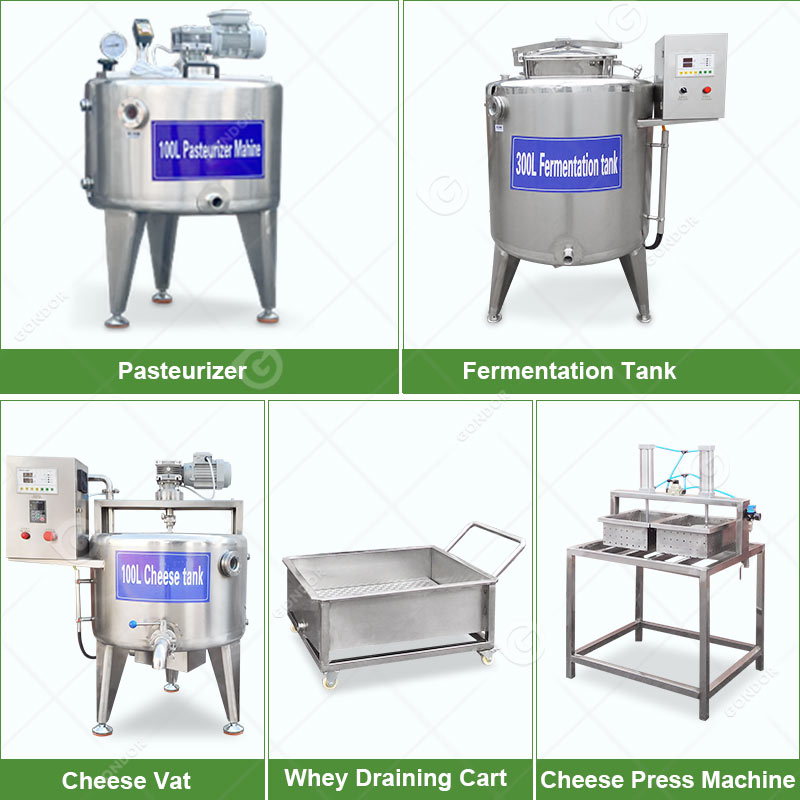
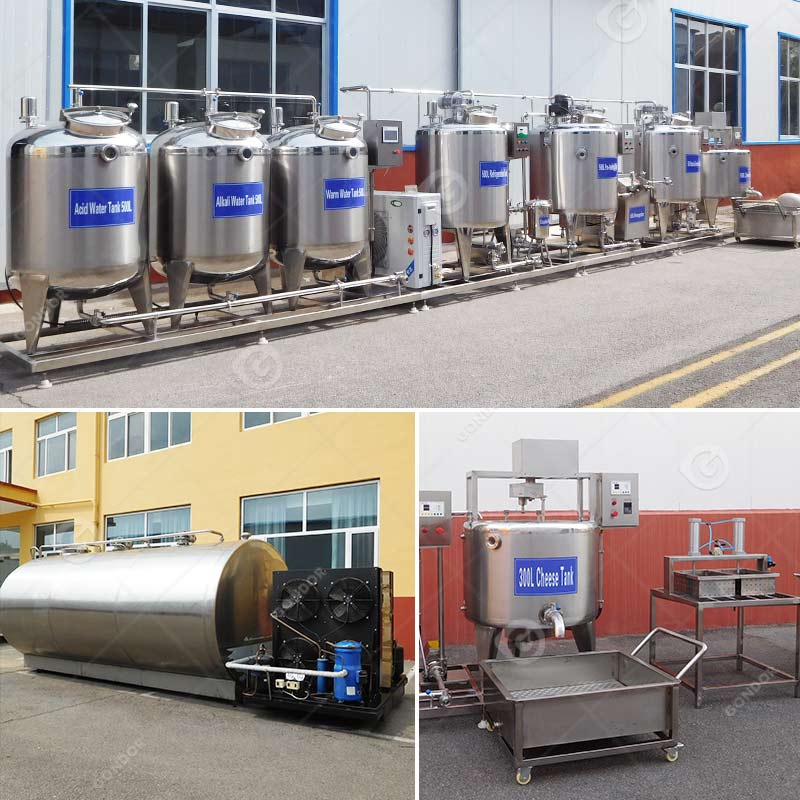
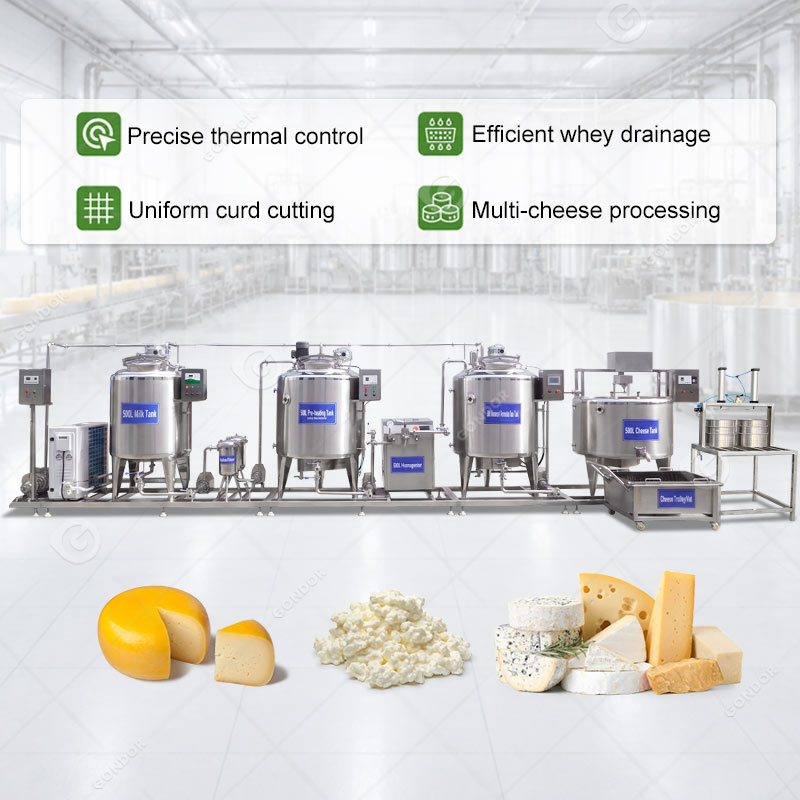
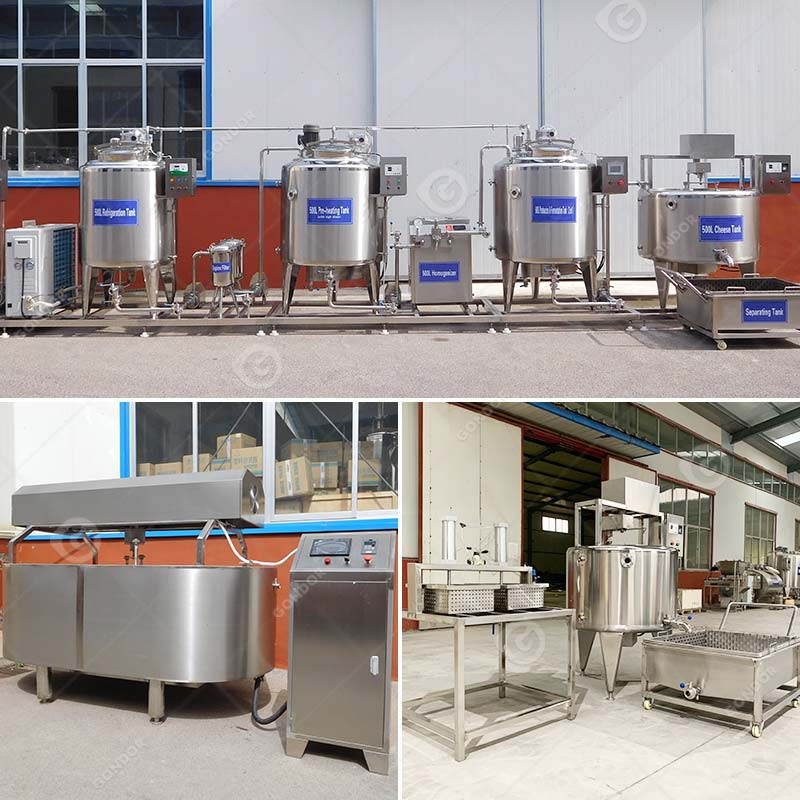
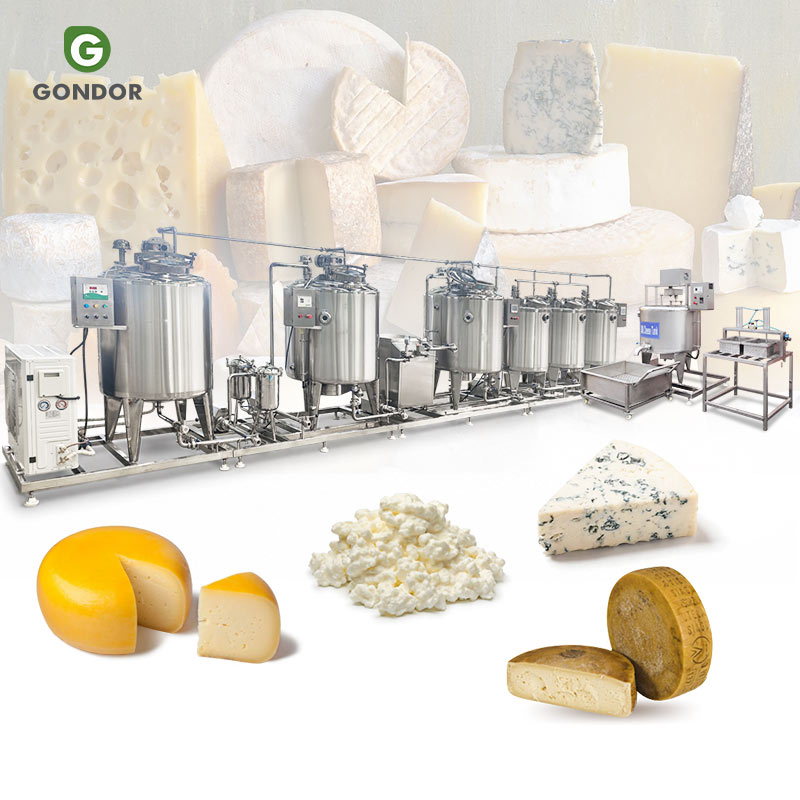
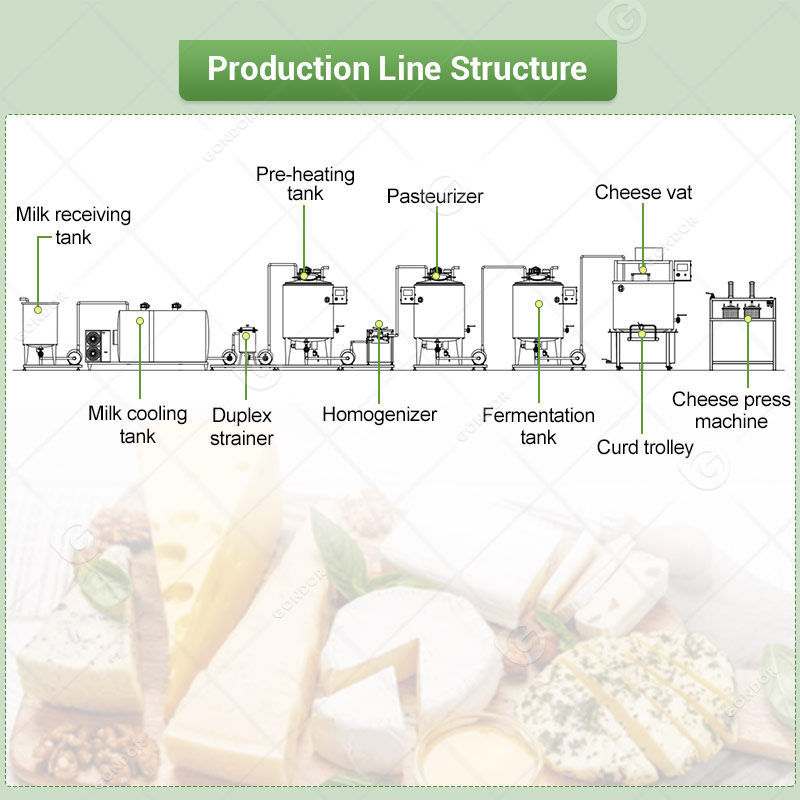
Ten stations from raw milk to formed cheese on one 4 t/day baseline, with cycle times matched so no station idles waiting for the next.
What a Cheese Processing Line Includes, Stage by Stage
People in cheese know this well: buying good machines one by one means nothing if they do not add up to a smooth line. Milk arrives with nowhere to go. The pasteurizer runs at a tempo the fermentation tanks cannot follow. The curd is cut and only then you find the draining carts are short. Every station looks acceptable on its own; connected, they stall. For a customer moving from workshop to factory, the hard part is not buying machines. It is arranging a dozen process steps into a line that never clogs.
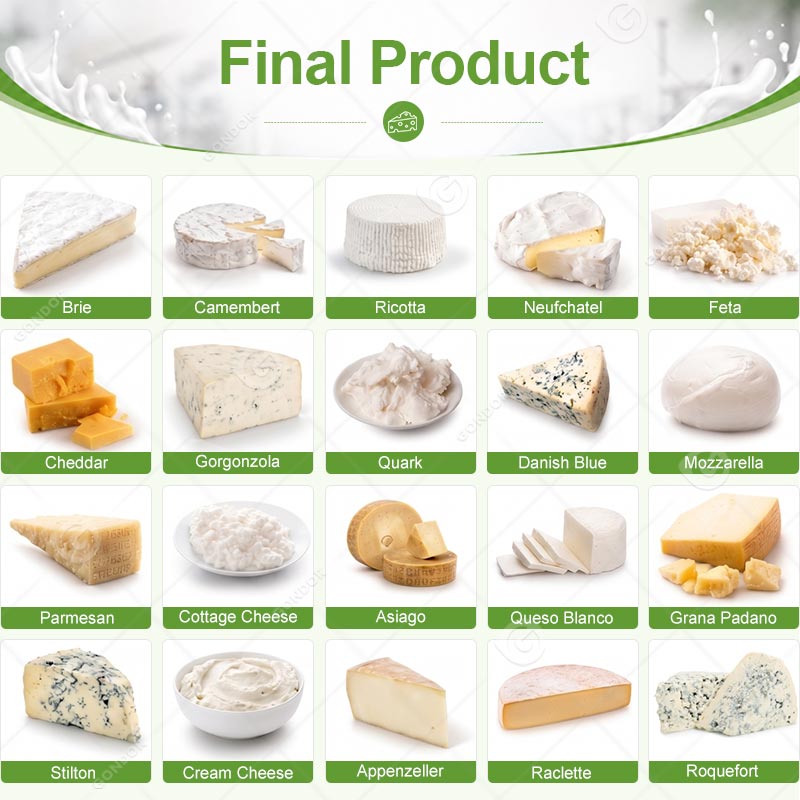
This cheese processing production line connects ten stations from raw milk receiving through low-temperature holding, impurity removal, pre-heating, high-pressure homogenization, pasteurization, acidification fermentation, curd formation, whey separation and pressing into one integrated system, rated at 4 t/day. Mozzarella, cheddar, fresh soft cheese and specialty varieties share the same line; a change of variety mainly means new process parameters and molds. Two to three trained operators run the whole line per shift, with a multi-language touch screen for export markets.
Cheese Processing Line Specifications and Throughput
Line overview
| Item | Specification |
|---|---|
| Series code | GD-GCHE |
| Line type | Integrated cheese line from raw milk receiving to pressing |
| Base capacity | 4 t/day (customizable) |
| Batch size | 100-5000 L (reference configuration 500 L) |
| Installed power | Approx. 100 kW |
| Voltage | 380 V / 440 V, 50-60 Hz |
| Heating | Steam / electric |
| Layout | Custom, 2D/3D design provided |
| Operator interface | Multi-language touch screen (language customizable) |
| Product-contact material | SUS304 stainless steel |
| Final products | Mozzarella, cheddar, fresh soft cheese, butter, yogurt, etc. |
| Operators | 2-3 per shift |
| Certification | ISO 9001, ISO 14001, ISO 45001, CE, BSCI, ETL |
| OEM / ODM | Accepted |
Station specifications (500 L batch reference configuration)
| No. | Station | Voltage | Capacity/Output | Power | Material |
|---|---|---|---|---|---|
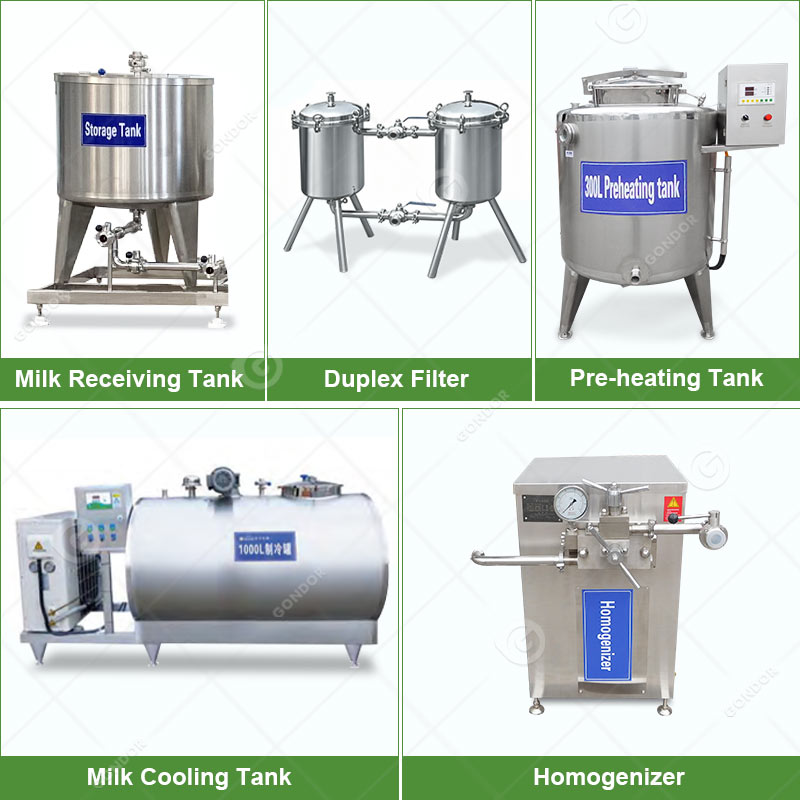
| 1 | Milk Receiving Tank | 380 V | 200 L | n-a | SUS304 |
| 2 | Milk Cooling Tank | 380 V | 5000 L | 11 kW | SUS304 |
| 3 | Duplex Filter | n-a | 500 kg/h | n-a | SUS304 |
| 4 | Pre-heating Tank | 380 V | 500 L | 24.37 kW | SUS304 |
| 5 | Homogenizer | 380 V | 500 kg/h | 7.5 kW | SUS304 |
| 6 | Pasteurizer | 380 V | 500 L | 24.37 kW | SUS304 |
| 7 | Fermentation Tank | 380 V | 500 L | 24.37 kW | SUS304 |
| 8 | Cheese Vat | 380 V | 500 L | 24.55 kW | SUS304 |
| 9 | Whey Draining Cart | n-a | n-a | n-a | SUS304 |
| 10 | Cheese Press Machine | n-a | Single mold 30×40 cm | n-a | SUS304 |
Note: the table above reflects the 500 L batch reference configuration. When capacity scales up, station volumes and power are re-matched to the cycle. Voltage and power for the draining cart and press are not given in the source material and follow the contract technical agreement.
How a Cheese Processing Line Runs From Milk Intake to Packing
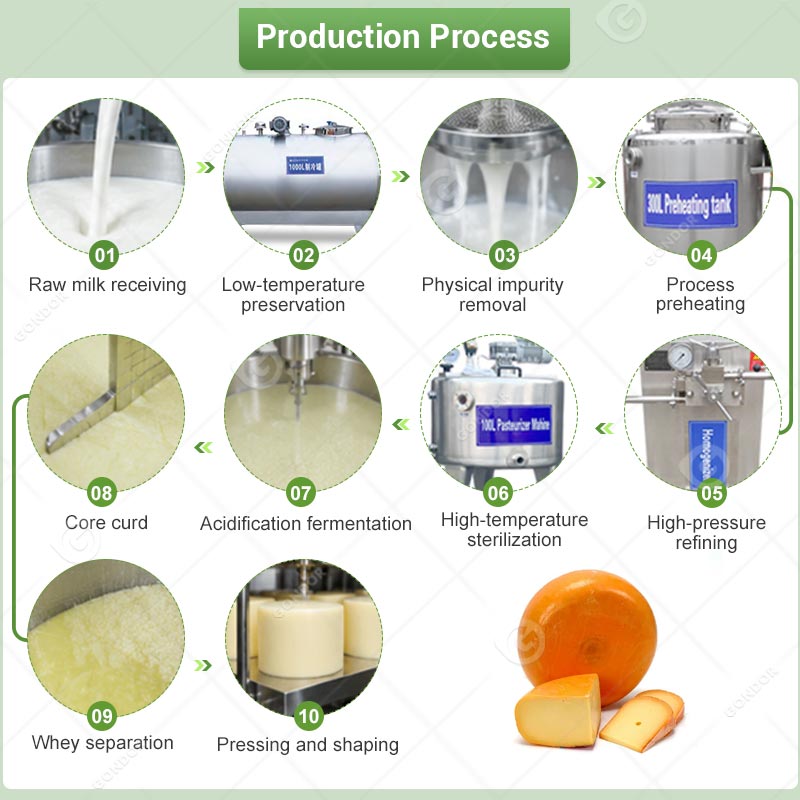
In short. Milk moves through ten steps in process order: into the receiving tank, chilled to 4 ℃ in the cooling tank, physically filtered in the duplex strainer, warmed to homogenization temperature, refined under high pressure, pasteurized at 72 to 85 ℃, inoculated and acidified in the fermentation tank, coagulated with rennet in the cheese vat, drained on the whey cart, and pressed into shape. Milk flows through pipework and pumps from vessel to vessel while staff monitor parameters and transfer points.
- Raw milk receiving (receiving tank). Fresh milk arrives by tanker or pipe into the receiving tank for collection and transfer, connecting bulk raw material to the automated process smoothly and hygienically. This is the start of the line and of traceability.
- Chilled holding (cooling tank). Milk moves to the cooling tank for temporary storage at around 4 ℃, holding microbial growth in check and protecting raw material quality. The 5000 L buffer gives downstream stations room to breathe.
- Impurity removal (duplex filter). A dual-line filtration system intercepts particles, hair and other impurities at 500 kg/h, matched to the upstream chilling duty. One line in service while the other is cleaned keeps the line running.
- Process pre-heating (pre-heating tank). Milk is heated evenly to 50 to 55 ℃, the ideal window for homogenization. This step directly shapes how well the fat globules break up downstream.
- High-pressure refining (homogenizer). A 500 kg/h homogenizer breaks large milk fat globules down and disperses them evenly. Much of the finished cheese’s fine texture and structural stability is decided here.
- Pasteurization (pasteurizer). High-temperature short-time treatment at 72 to 85 ℃ eliminates pathogenic organisms while keeping nutrients and flavour compounds. This is the food safety gate of the whole line.
- Acidification and fermentation (fermentation tank). Cooled milk is inoculated with starter culture and acidifies under precise temperature control, creating the acidity curd formation needs. Whether fermentation lands on target decides how firm and cuttable the curd will be.
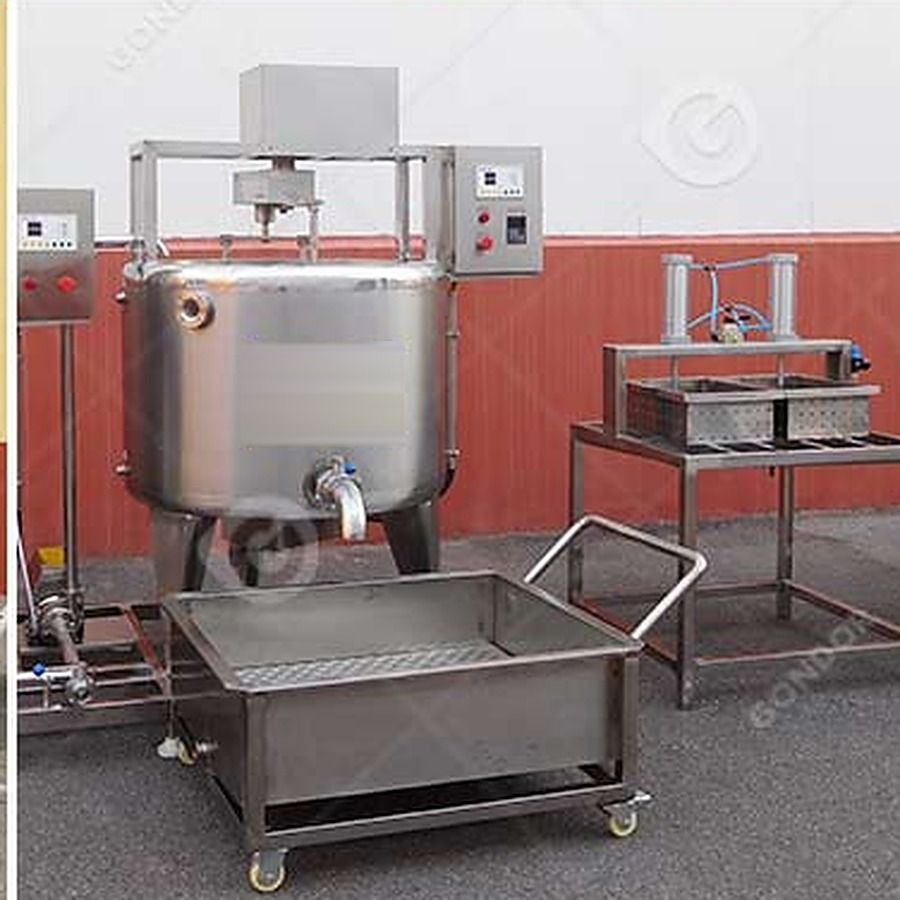
- Curd formation (cheese vat). Rennet is added, and milk proteins cross-link into curd under controlled temperature. This is the core reaction vessel for cheese forming, and its temperature accuracy decides curd quality.
- Whey separation (draining cart). Cut curd moves to the draining cart, where gravity and compression release the whey and the curd firms up. The drained whey is collected centrally for recovery as a by-product.
- Pressing and forming (cheese press). Molded curd is pressed under steady mechanical force to shape and drain further, producing firm, standard-shaped commercial cheese that then moves to salting and aging.
Product Performance Advantages
- Ten stations as one line, with bottlenecks engineered out at the design stage. Receiving, pasteurizing, fermenting, coagulating, draining and pressing are matched by throughput, connected by pipework, with no intermediate haulage. What the buyer receives is a line that runs, not ten machines that have never met.
- 4 t/day base capacity, scalable either way. Batch sizes from 100 to 5000 L let a producer start small, prove the market, then scale up while carrying the process parameters across.
- Multiple varieties on one line. Switching among mozzarella, cheddar and fresh soft cheese mainly means new temperature curves and molds, with the equipment untouched. For dairy plants with many SKUs at moderate volume, this beats a one-variety line.
- Two to three people watch the whole line. A multi-language touch screen on PLC control lets operators monitor parameters and transfers, and the labor saving per shift is substantial.
- Hygiene built to export standards. Every part contacting milk or cheese is SUS304 stainless steel, with CIP-ready vessels and pipework and a dead-corner-free design, the first item auditors check during a plant visit.
- Plant layout drawings at no charge. 2D/3D layout design arranges stations to the actual building, so the buyer sees the line’s footprint before anything ships.
Station Design and Engineering Notes
Pre-treatment section (receiving tank, cooling tank, duplex filter, pre-heating tank). This section turns incoming milk into clean, temperature-stable, homogenization-ready process milk. The 5000 L cooling buffer absorbs receiving fluctuations. The duplex filter runs one line while the other is cleaned. The pre-heating tank holds milk in the homogenization window so the homogenizer downstream sees a steady load.
Heat treatment and homogenization section (homogenizer, pasteurizer). Homogenization comes before pasteurization on this line. Fat globules are broken up first, then the raised microbial load is knocked down by the 72 to 85 ℃ short-time treatment, protecting both flavour and shelf life.
Fermentation and curd section (fermentation tank, cheese vat). Running fermentation and coagulation in separate vessels is the key to variety flexibility. The fermentation tank manages acidity while the cheese vat manages the coagulation reaction, so temperature and time curves for different varieties never interfere. A variety change is a program recall.
Separation and forming section (draining cart, cheese press). The draining cart handles whey release, and the press handles mechanical setting. The press works with 30×40 cm single molds; paralleling several molds scales hourly output to match the upstream curd rate.
What a Cheese Processing Line Handles Across Cheese Types
Dairy processing plants. The standard customer profile: upgrading from selling raw milk to selling mozzarella and cheddar, adding value at the source.
Central kitchens and catering supply chains. Stable supply of private-label cheese, where batch consistency and traceability are hard requirements in line audits.
New dairy projects. Turnkey needs: layout design, installation, process parameters and operator training delivered as one package, suiting first-time cheese investors.
Specialty cheese workshops scaling up. Moving from a few vessels to a continuous line while keeping the flexibility for small varieties.
Agricultural industrialization projects. Regional milk pooling and local processing, with line capacity customized to the county-level milk supply.
Sizing and Selection of a Cheese Processing Line
Four steps to define a line.
- Count the milk. The daily raw milk supply sets the line size. The 4 t/day base corresponds to a raw milk supply on the order of 40,000 L, scaled to the actual supply.
- Fix the varieties. The lead variety shapes the fermentation and curd section details. For multi-variety running, list every variety up front so stations are checked against the most demanding one.
- Check utilities. Three-phase power, a steam generator or boiler, and a clean water source are the three prerequisites. Confirm capacity and pipework before layout talks.
- Send drawings. Provide the building plan and we return a 2D/3D layout with station spacing, maintenance aisles and the CIP room settled in one pass.
Limits worth stating plainly. The line ends at pressing. Salting, aging rooms and packing are outside its scope and need separate configuration. Milk-to-cheese yield depends on the milk’s fat and protein, with roughly 10 L of raw milk to 1 kg of hard cheese. Plan output from actual milk test data. Batch capacity spans a wide range, and pricing follows the final configuration.
Customization
OEM and ODM are both accepted. Capacity, station combination, heating method, control language and layout form are all built to order, with 2D/3D plant layout design provided. Retooling and expansion are planned against the line, with the schedule and the MOQ confirmed in the offer. Export orders are configured for the target market voltage, 380 V or 440 V at 50-60 Hz, and its certification requirements.
Commercial Information
- Minimum order quantity (MOQ): one line
- Standard lead time: 30 to 45 days from deposit, set by the station count in your configuration
- Packaging: each machine wrapped in waterproof film and crated separately; the full line ships under a container loading plan
- Trade terms: FOB, CIF or DAP as agreed, loading port confirmed with the booking
Quality Inspection and After-sales
A pre-shipment video inspection is provided, a mechanical test report ships with each unit, and the line runs a linked no-load test before dispatch. Core components carry a 12-month warranty. A spare parts list with part numbers ships with the manual and the machine case. After-sales runs mainly on online support. Engineers can be dispatched for on-site installation, commissioning and operator training, and basic cheese recipes and parameters are provided with the project.
Cheese Processing Line Questions Buyers Ask
1. What is the capacity of this cheese production line?
The base configuration runs 4 t/day, with batch sizes from 100 to 5000 L selectable against your production targets and budget. Station parameters under the 500 L reference configuration are listed in the specification table.
2. How many cheeses can one line produce?
Mozzarella, cheddar and fresh soft cheese run on the same line. A variety change mainly adjusts process temperature, fermentation time and pressing molds, with the equipment untouched.
3. How many operators does the line need?
PLC with a multi-language touch screen automates the cycle. Two to three trained operators per shift are enough for normal production.
4. What material contacts the milk and cheese?
All contact parts are food-grade SUS304 stainless steel. Vessels and pipework follow sanitary design and support CIP cleaning without dead corners.
5. What utilities does the plant need to prepare?
Industrial three-phase power, a steam generator or boiler for the pasteurizer and heating sections, and a clean water source. Once capacity is confirmed, we issue a utility requirement list for plant preparation.
6. What is the milk-to-cheese yield?
It depends on the milk’s fat and protein. A common guide is 10 L of raw milk to 1 kg of hard cheese. Precise cutting and pressing help recover the curd as completely as possible.
7. Can you issue a layout for my building dimensions?
Yes. Send the floor plan and our engineering team returns a 2D/3D layout, optimizing station placement and material flow for confirmation before shipment.
8. How are installation, commissioning and training arranged?
Engineers can be dispatched for on-site installation, linked commissioning and operator training, or the installation can be guided remotely. Basic cheese recipes and process parameters are provided with the project to get a new operation started.
Getting Started on a Cheese Processing Line Project
Send three items: the daily milk supply, the target variety list, and the plant floor plan, a sketch is fine. We will return a capacity-matched proposal, layout drawings and an itemized quotation. To validate the process, arrange a factory visit or send milk samples for trial production.
Contact
Henan Gondor Machine Co., Ltd. Website inquiry form, WhatsApp or email. Replies within 24 hours on working days.
Related Equipment
- Cheese Making Machine — the vat at the centre of this line, available on its own for smaller volumes.
- Cheese Cutting Machine — cuts the pressed blocks to the size your packing line needs.
- Fermentation Tank — the acidification station upstream of the cheese vat.
Ask for Cheese Processing Line Pricing
Send us the daily volume, the product and the container or pack format you are working with, and we will come back with a model recommendation, a utility list and a price.





