

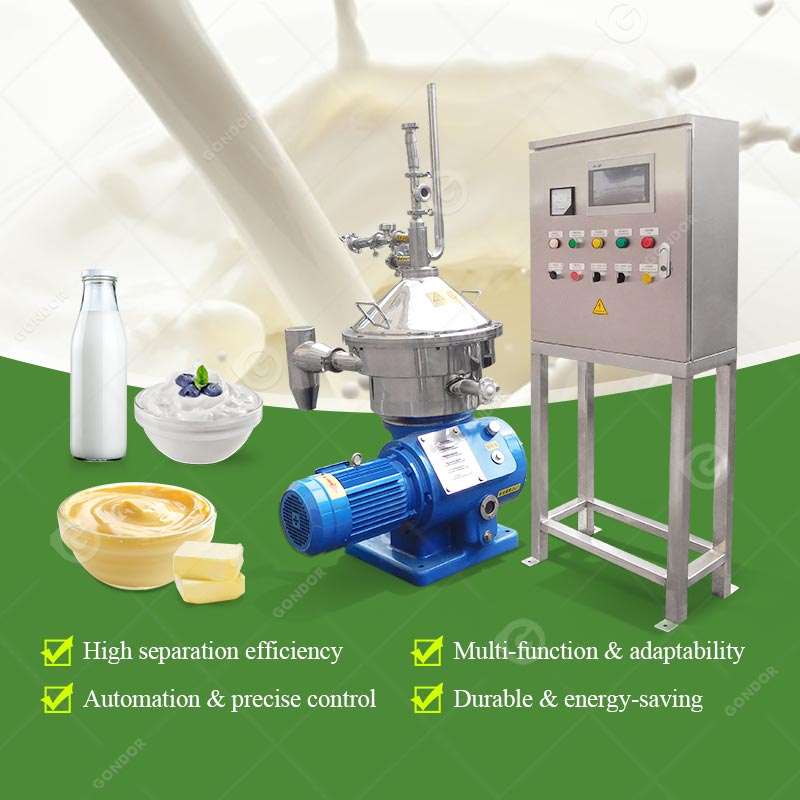
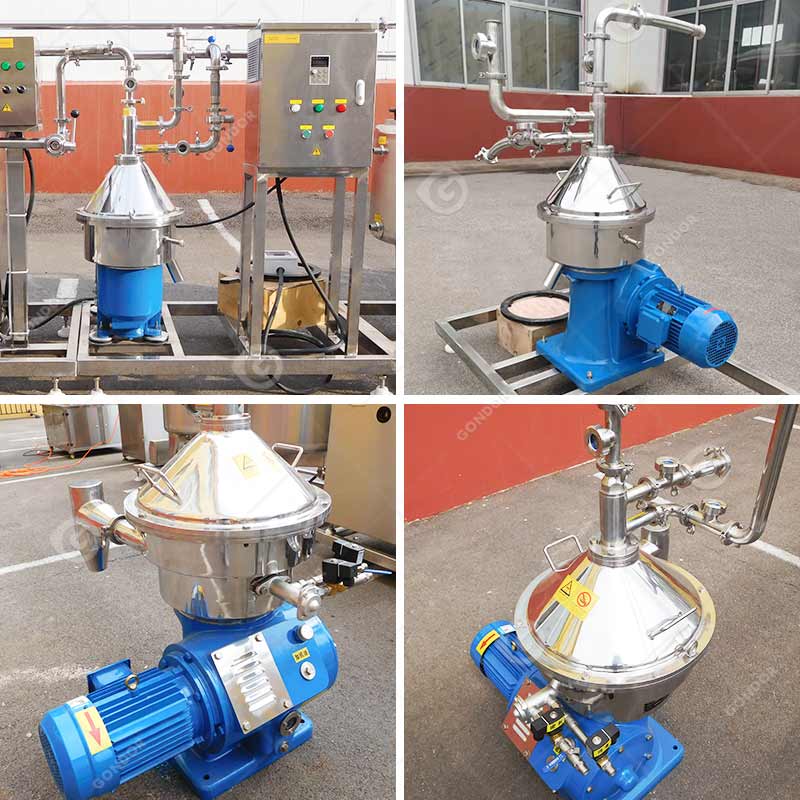
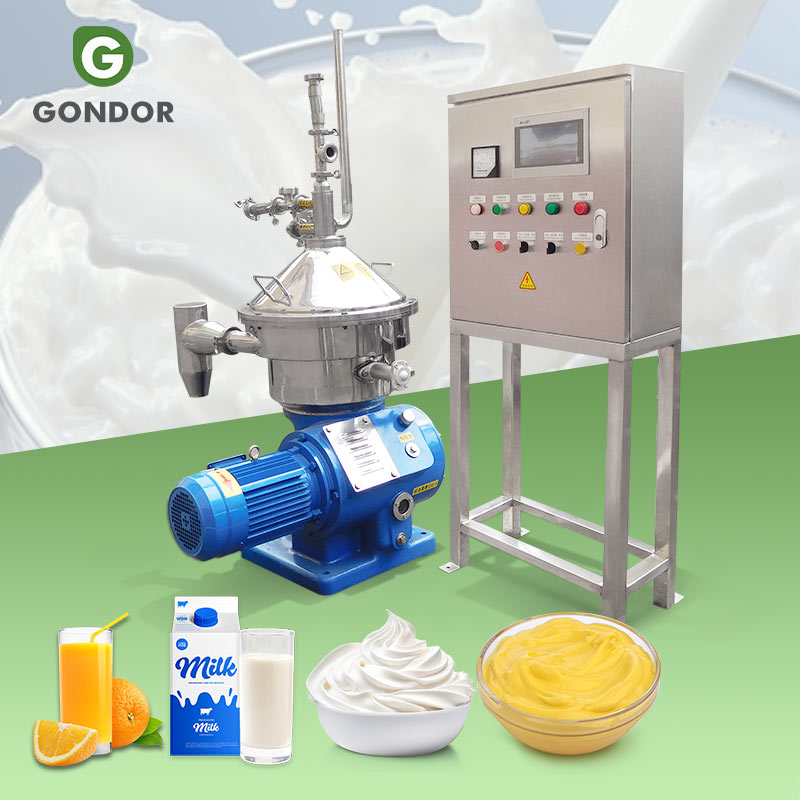
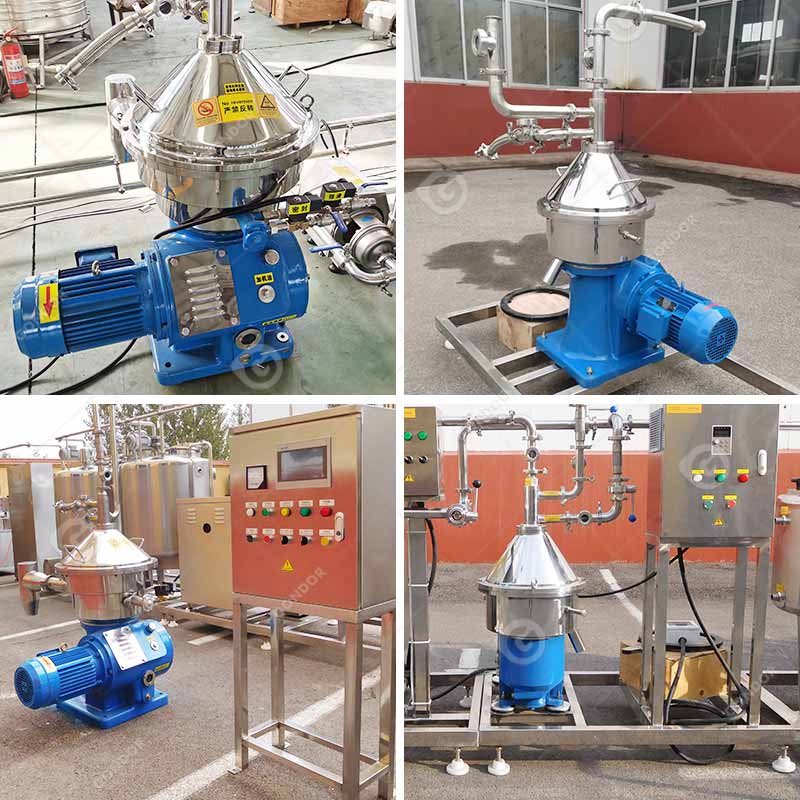
Disc stack centrifuge at 400-3000 L/h, discharging cream and skim milk from two outlets continuously instead of waiting on gravity.
Fat Standardisation Starts With the Right Dairy Cream Separator
The first job in most dairy plants is splitting the fat out of the incoming milk. Cream goes to the butter maker, skim milk goes to yogurt or is standardized back into whole milk, and the margin lives in that split. Waiting for cream to rise in a vat delivers a few buckets a day at a poor fat recovery rate. Running a disc stack centrifuge, milk goes in and two streams come out, cream and skim milk, continuously, without stopping.
The dairy cream separator is that disc stack machine. Whole milk enters the spinning bowl through a central inlet, and centrifugal force separates it by density: light cream at about 0.93 g/ml gathers near the bowl centre and leaves through the light phase outlet, while skim milk at about 1.036 g/ml is thrown to the periphery and leaves through the heavy phase outlet, the whole path sealed away from air. Four models cover 400 L/h to 3000 L/h, matching farms, collection centres, dairy plants and laboratories. Self-cleaning models discharge sludge automatically, so continuous production does not pause.
Dairy Cream Separator Capacities, Bowl Speed and Motor Ratings
Four-model comparison (per the official parameter table)
| Item | GD-CS203 | GD-CS204 | GD-CS207 | GD-CS309 |
|---|---|---|---|---|
| Material | SUS304 | SUS304 | SUS304 | SUS304 |
| Power supply | 380 V 50 Hz | 380 V 50 Hz | 380 V 50 Hz | 380 V 50 Hz |
| Rated water capacity | 1500 L/h | 2000 L/h | 4000-5000 L/h | 8000 L/h |
| Milk output | 400-500 L/h | 700-800 L/h | 1500-2000 L/h | 3000 L/h |
| Bowl speed | 8300 rpm | 7350 rpm | 7970 rpm | 5980 rpm |
| Bowl diameter | φ230 mm | φ265 mm | φ360 mm | φ400 mm |
| Sludge cleaning | Manual | Automatic | Automatic | Automatic |
| Motor power | 2.2 kW | 4 kW | 7.5 kW | 11 kW |
| Weight | 240 kg | 280 kg | 730 kg | 980 kg |
| Dimensions | 850×720×1000 mm | 830×800×1150 mm | 1100×990×1400 mm | 1200×990×1550 mm |
General parameters
| Item | Specification |
|---|---|
| Machine type | Disc stack separator centrifuge |
| Separation duty | Continuous centrifuge, solid-liquid-liquid |
| Feed material | Milk, goat milk, etc. |
| Voltage | 380 V 50 Hz, customizable |
| Motor power range | 2.2-11 kW |
| Product-contact material | SUS304 stainless steel |
| Discharge | Manual / automatic (by model) |
| Warranty | 12 months |
| Certification | ISO 9001, ISO 14001, ISO 45001, CE, BSCI, ETL |
| OEM / ODM | Accepted |
Note: customized voltage range and wiring are confirmed per order. Model numbers follow the official naming (203/204/207/309); the GD-CS prefix is the series code.
How a Dairy Cream Separator Splits Cream From Skim Milk
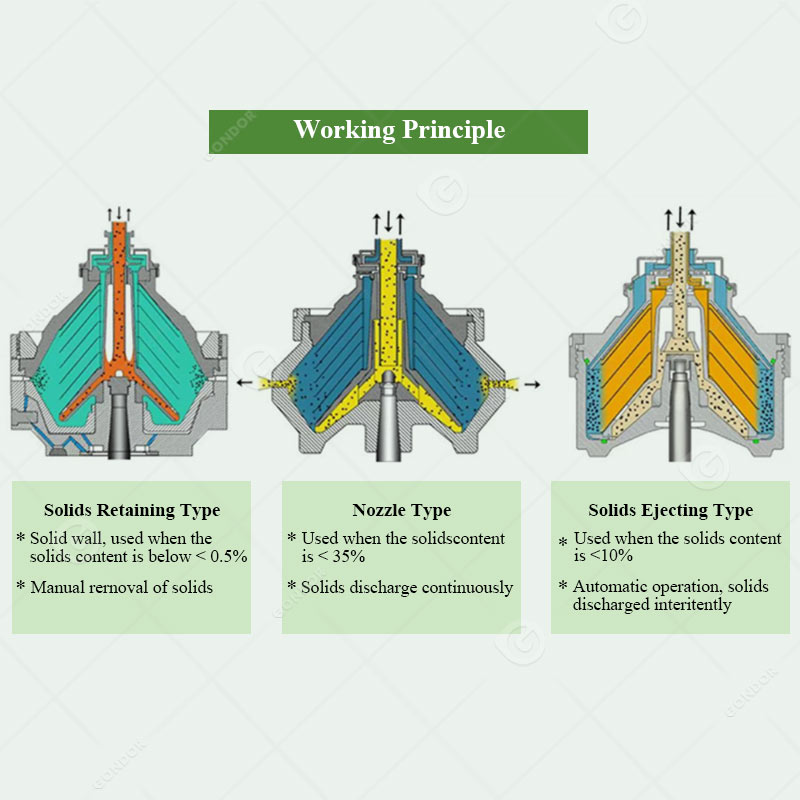
In short. The separation cycle divides into four steps: raw milk enters the spinning bowl through the central inlet, the disc stack splits the flow into thin layers, centrifugal force separates solids, heavy liquid and light liquid by density, and the three streams leave through the heavy phase outlet, light phase outlet and sludge port. The cream-to-skim ratio is set by adjusting the interface position, and solids discharge continuously, intermittently or manually depending on the model.
Product Performance Advantages
- From hundreds to three thousand litres an hour, every scale covered. Model 203 at 400-500 L/h suits farms and small stations; model 309 at 3000 L/h anchors a dairy plant main line. Sizing a separator works like sizing a pump: pick by flow, do not oversize.
- Separate outlets, and fat recovery you can tune. Cream and skim milk leave through independent outlets, and the interface position adjusts freely. Whether you skim to 40% fat for butter making or 20% for standardization, one adjustment does it, which makes milk standardization an executable routine.
- Sealed running that stands up to hygiene audits. The full path is enclosed in stainless steel. Milk never touches air or operators, meeting dairy workshop hygiene reviews and cutting flavour loss from fat oxidation.
- Automatic desludging without downtime. Models 204, 207 and 309 discharge sludge on a set cycle, so continuous runs never stop for a manual clean. For plants receiving milk by the shift, that converts directly into productive hours.
- Brushless variable-frequency drive, quiet and steady. Motors from 2.2 to 11 kW match each model. Ramp-up is smooth, vibration is low, and the high-speed bowl asks little of the floor, so it can even sit on an upper storey of a normal workshop building.
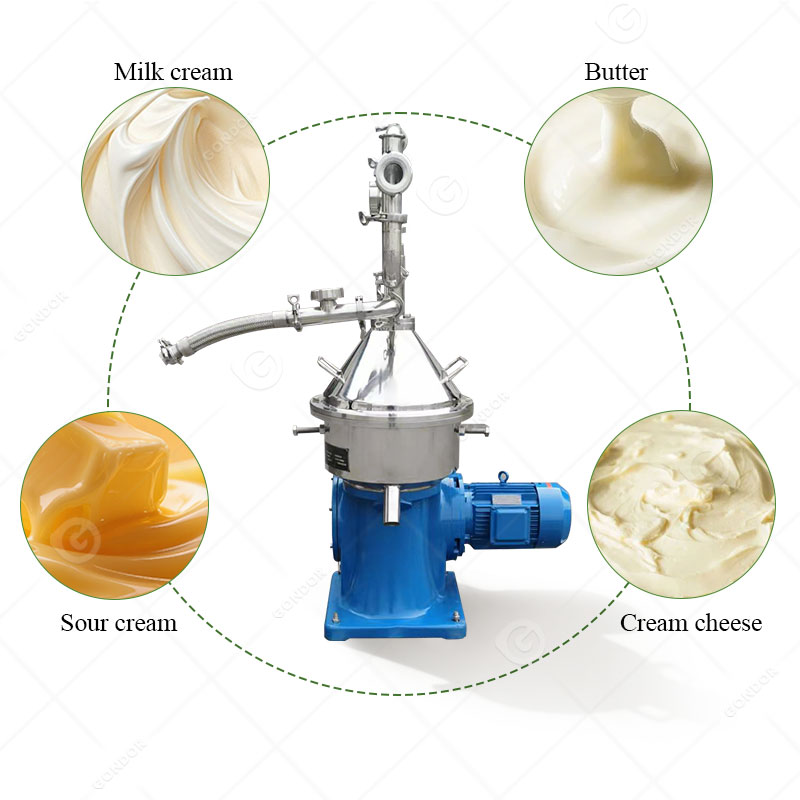
- One machine, several jobs. Cream, butter feed, sour cream and cream cheese all pass through this separation step, and a laboratory preparing fat content samples runs far faster than with chemical methods.
Engineering Design and Structure
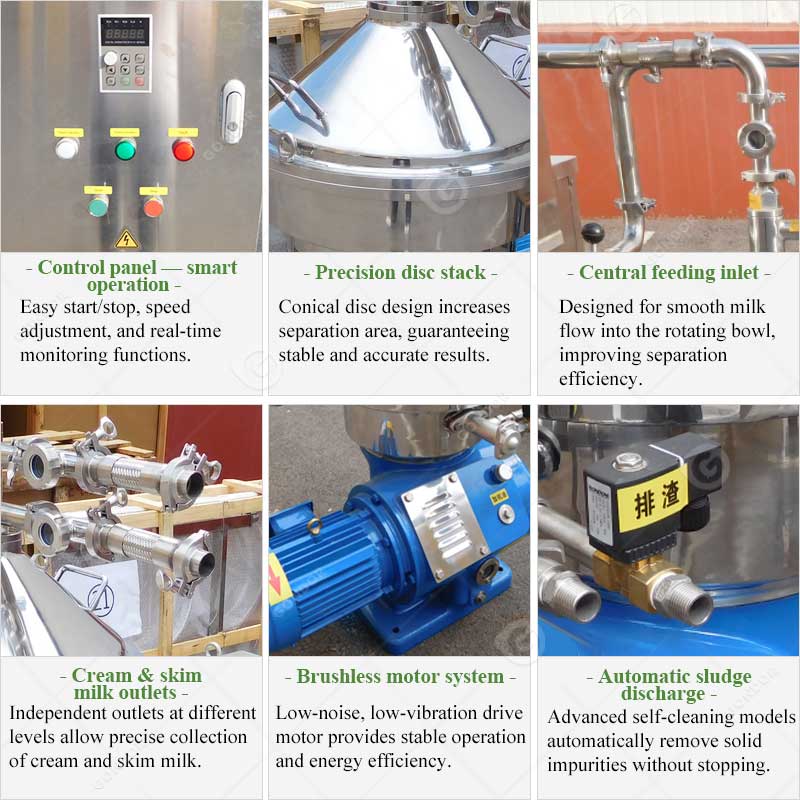
Bowl and disc stack. The bowl is the heart of the machine, running 5980 to 8300 rpm by model with diameters from 230 to 400 mm. The discs are precision conical plates stacked at even spacing. Their machining accuracy decides layering quality, and after cleaning they must be reseated in alignment, which is why disc handling takes the most time in operator training.
Inlet and outlet system. The central inlet sits on the bowl axis so milk enters the rotating field without disturbing the layered liquid. The heavy phase line connects at the bowl periphery and the light phase line at the centre, and the elevation difference between the two mirrors the interface position.
Desludging system. The manual model (203) is the simplest build and the least expensive, right for very low-solids fresh milk. Automatic models add a discharge port and sealing mechanism, and sealing reliability during the discharge instant is the critical design point of this type.
Drive and electricals. A brushless motor brings the bowl to speed through a gearbox, with variable frequency control keeping starting current gentle. The cabinet centralizes start, stop and speed control with live monitoring on the panel. After a long shutdown, a few minutes of low-speed running before feeding is the standard practice that protects the bearings.
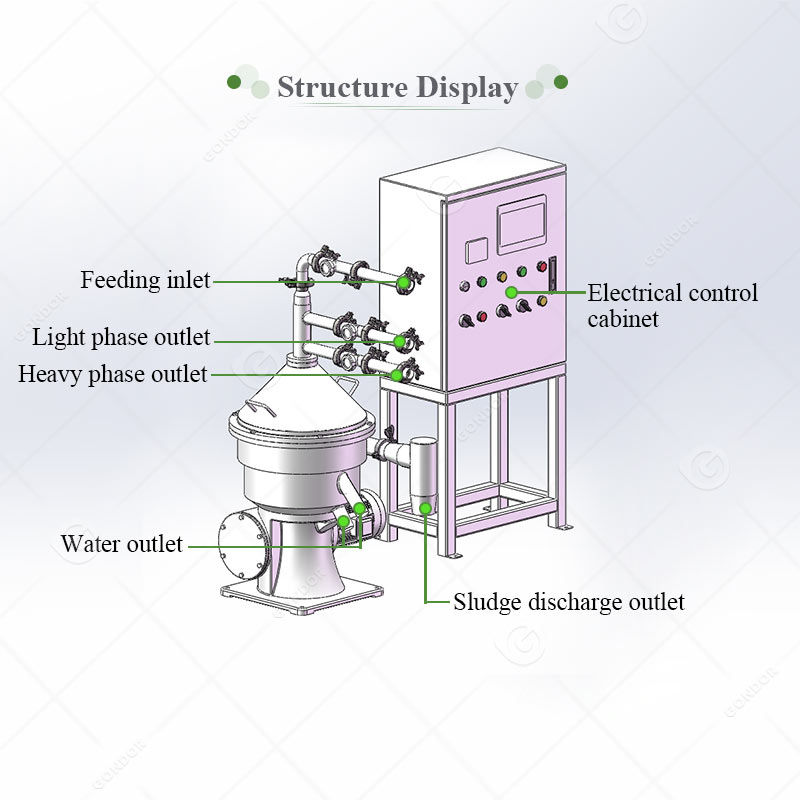
Structure breakdown
| No. | Part | Function |
|---|---|---|
| 1 | Central feeding inlet | Even entry of milk into the spinning bowl |
| 2 | Disc stack | Multiplies settling area for fine layering |
| 3 | Bowl | Spins to generate the centrifugal field |
| 4 | Light phase outlet | Cream discharge |
| 5 | Heavy phase outlet | Skim milk discharge |
| 6 | Sludge discharge outlet | Solids removal (automatic or manual by model) |
| 7 | Drive motor & gearbox | Brings the bowl to working speed |
| 8 | Control cabinet | Start, stop, speed control and monitoring |
Operating Procedure
- Warm-up. Confirm water and power, start the motor and let it run at low speed for a few minutes so the gearbox and bearings reach a lubricated state.
- Priming. Let process water fill the bowl while it ramps up, avoiding dry-running vibration.
- Feeding and separation. Switch the inlet valve to raw milk, watch both outlet streams, and adjust the interface to the target cream fat content.
- Running checks. Record inlet and outlet flow, cream concentration and desludging state at intervals. If the light phase flow turns abnormal, check feed stability first.
- Shutdown and cleaning. Push milk out with water after stopping the feed, then desludge and CIP clean by model, with the disc stack cleaned per shift either in place or removed.
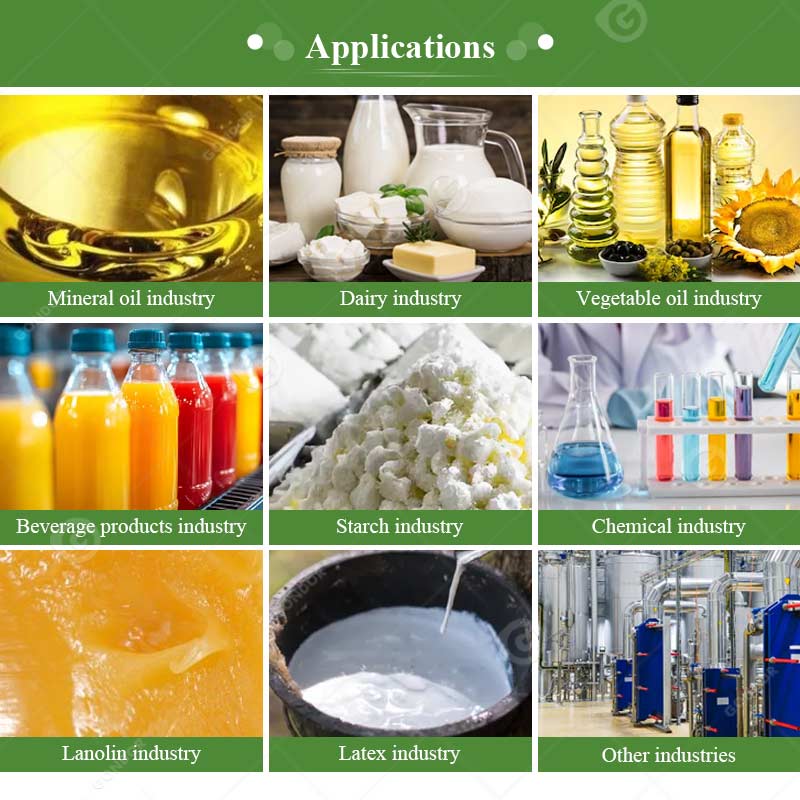
Where a Dairy Cream Separator Is Used in Milk and Cheese Plants
Dairy farms and farmsteads. Separate the daily milk on site: cream goes to butter or sour cream, skim milk feeds calves or becomes yogurt. Model 203 at 400-500 L/h matches a small farm’s daily volume.
Milk collection centres and milk bars. Grading raw milk by fat content for pricing, with on-site separation supporting standardization and settlement. Model 204 covers daily receiving at station scale.
Dairy processing plants. The standardization station for whole milk, feeding butter, yogurt and cheese lines. Model 309 at 3000 L/h runs inline as the standard configuration.
Food processing plants. Feed preparation for cream, sour cream and cream cheese, where separation accuracy decides the fat stability of everything downstream.
Laboratories and testing bodies. Fast sample preparation for fat content analysis, quicker than chemical methods with good repeatability.
Matching a Dairy Cream Separator to Your Fat Target
Pick by flow, by sludge, by site.
- Do the flow math. Work out the peak hourly milk volume and add 20% margin. A collection station receiving 5 t a day over two shifts peaks around 800-1000 L/h, which points to model 204 or 207.
- Look at the solids. Routine fresh milk at low solids runs fine on a manual model at lower cost. For dirty raw milk from pasture collection, or downstream separation duty, go automatic: the downtime saved pays back the difference.
- Check site and power. Model 309 weighs 980 kg and the high-speed models are sensitive to floor flatness, so harden and level the pad. Match the 380 V supply to the motor power in the table.
- Fix the outlet plan. Where the cream goes decides the collection layout: buffer tank, direct to a butter churn, or holding pails. Set pipe sizes and heights before ordering to avoid site rework.
Limits worth stating plainly. Separation performance depends on milk temperature and homogenization state; ambient-temperature raw milk is the normal duty. Milk carrying large particles must pass a filter first, or the disc gaps foul faster and separation quality drops. Manual models need a bowl teardown for desludging, and that time belongs in the shift plan.
Customization
OEM and ODM are both accepted. Voltage and frequency follow the target market, and inlet and outlet orientation, panel language and interface adjustment can be built to the order. Retooling lead time: quoted with the offer. MOQ: quoted with the offer. Export orders ship with certification documents and an English manual.
Commercial Information
- Minimum order quantity (MOQ): quoted with the offer
- Standard lead time: quoted with the offer (confirm separately for stocked standard models)
- Packaging: inner waterproof film, outer standard wooden case for international transport
- Trade terms and loading port: quoted with the offer
Quality Inspection and After-sales
A pre-shipment video inspection is provided and a mechanical test report ships with each unit. Factory inspection covers bowl dynamic balance, ramp running and sealing performance. The warranty runs 12 months, with after-sales mainly on online support and faults diagnosed remotely first. Spare parts list and supply cycle: quoted with the offer. Suggested service intervals for maintenance items such as the disc stack and seals are listed in the manual.
Dairy Cream Separator FAQ for First-Time Buyers
1. What can this machine separate?
Milk and goat milk. Whole milk splits into cream and skim milk on two outlet streams, and cream fat content is set by the interface. Feed preparation for butter, sour cream and cream cheese, plus pre-treatment for cheese and yogurt lines, all sit within its scope.
2. How should I read capacity, and why are there two figures?
The water capacity is the maximum throughput the bowl was rated at with water. Real milk, being more viscous and dense, runs lower: model 204 is rated at 2000 L/h on water but 700-800 L/h on milk. Size the machine by the milk output column, not the water figure.
3. Can cream fat content be adjusted?
Yes. The interface between light and heavy phases moves: toward the periphery raises cream fat and lowers cream volume, and inward does the opposite. A common adjustment band is 20% to 40% fat, set to your product.
4. Does desludging stop the machine?
Depends on the model. Model 203 cleans manually and needs a shutdown with the bowl opened. Models 204, 207 and 309 discharge automatically on cycle during running, so continuous production is not interrupted.
5. What does the raw milk need to be like?
Ambient-temperature raw milk is fine; temperature far from ambient slows layering. Run the milk through a strainer or filter first to remove coarse particles, or the disc gaps foul and separation quality falls.
6. How loud and shaky is it?
The brushless variable-frequency motor with gearbox ramps gently, and normal running vibration is low. Keep the installation floor level and hardened, anchor the feet per the manual, and upper-storey installation is generally fine.
7. Can it tie into an existing line?
Yes. The inlet and both phase outlets use standard pipe connections and can be tied directly to a receiving tank, pasteurizer or buffer tank. Connection sizes come with the technical file.
8. How are warranty and spare parts arranged?
The warranty runs 12 months. Pre-shipment video inspection is provided and a mechanical test report ships with the unit. The list and supply cycle of common maintenance items, such as the disc stack, seals and bearings, can be confirmed with sales at order time; items marked quoted with the offer follow the contract.
Next Step: From Separator Enquiry to Installation
Send three items: the peak hourly milk volume, the target cream fat content and its use, and the workshop power condition. We will recommend the matching model with a separation efficiency estimate and a quotation. To verify results first, send a milk sample and we will run separation tests at the factory, then return cream and skim milk samples with measured data.
Contact
Henan Gondor Machine Co., Ltd. Website inquiry form, WhatsApp or email. Replies within 24 hours on working days.
Related Equipment
- Milk Pasteurizer Machine — standardises and treats the skim and cream streams after separation.
- Fermentation Tank — takes the standardised milk where a set yogurt or cultured drink is the end product.
Request a Dairy Cream Separator Quote
Send us the daily volume, the product and the container or pack format you are working with, and we will come back with a model recommendation, a utility list and a price.