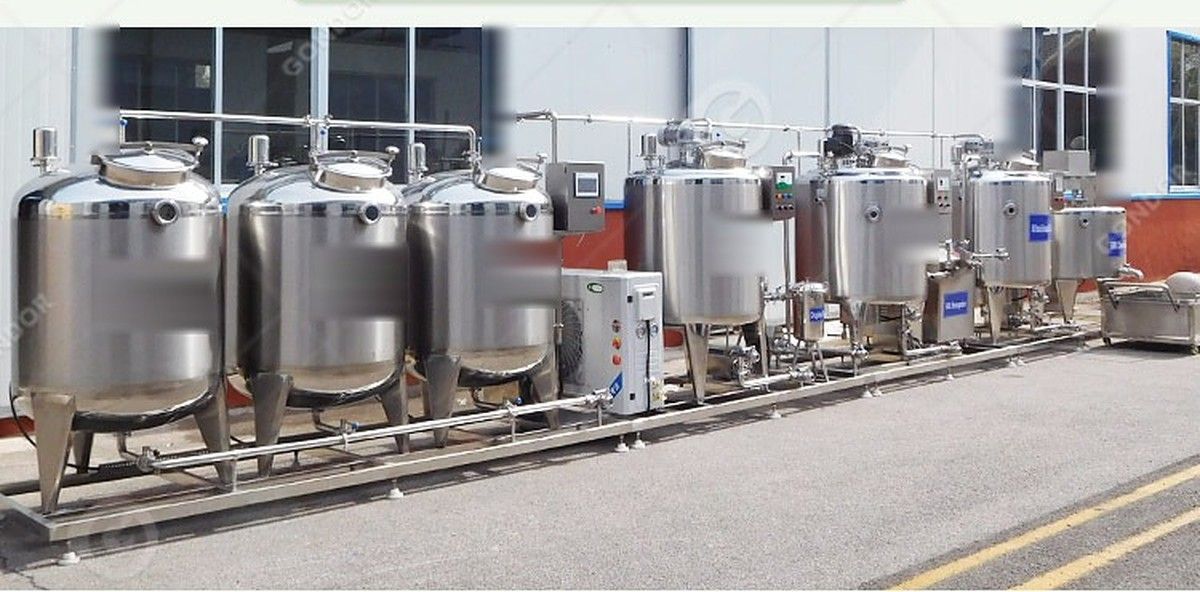

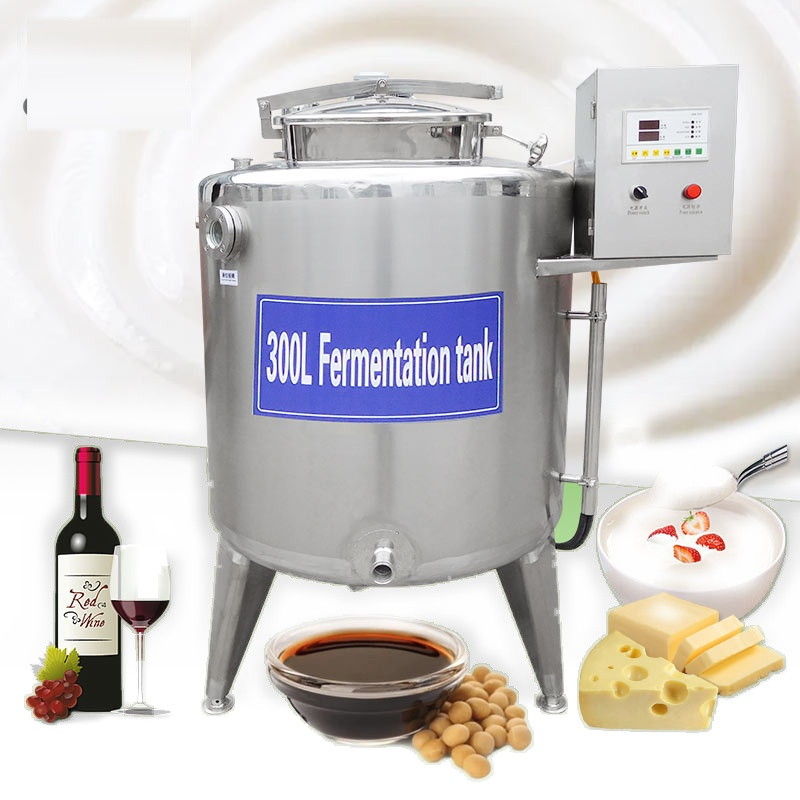
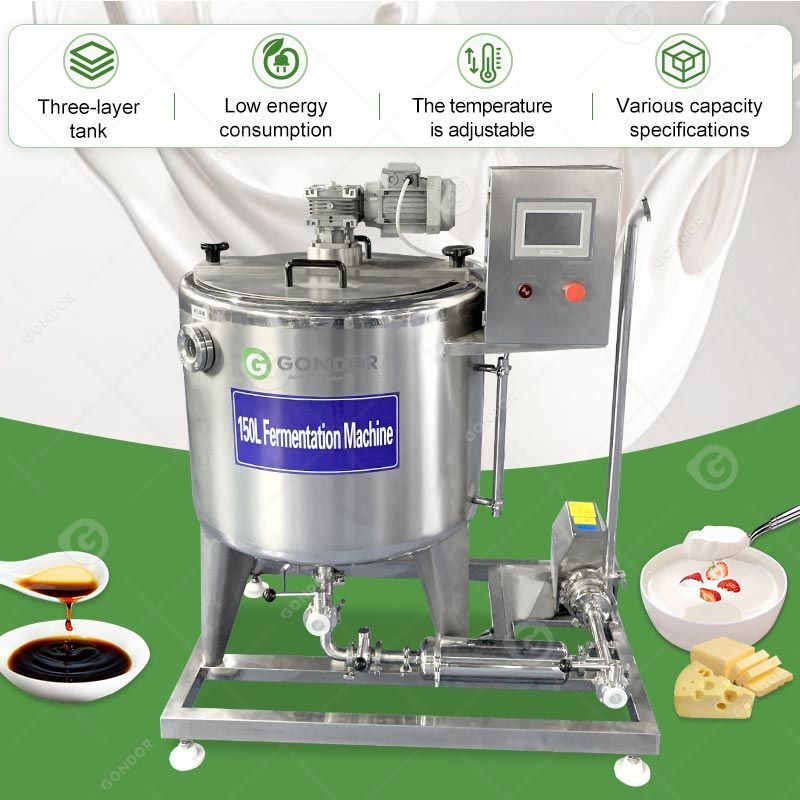
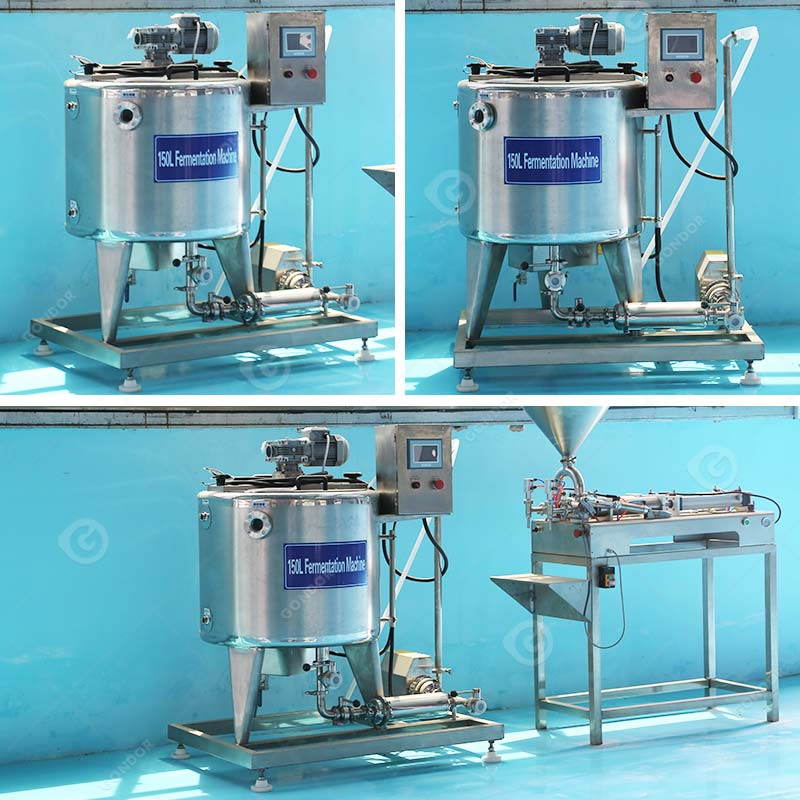
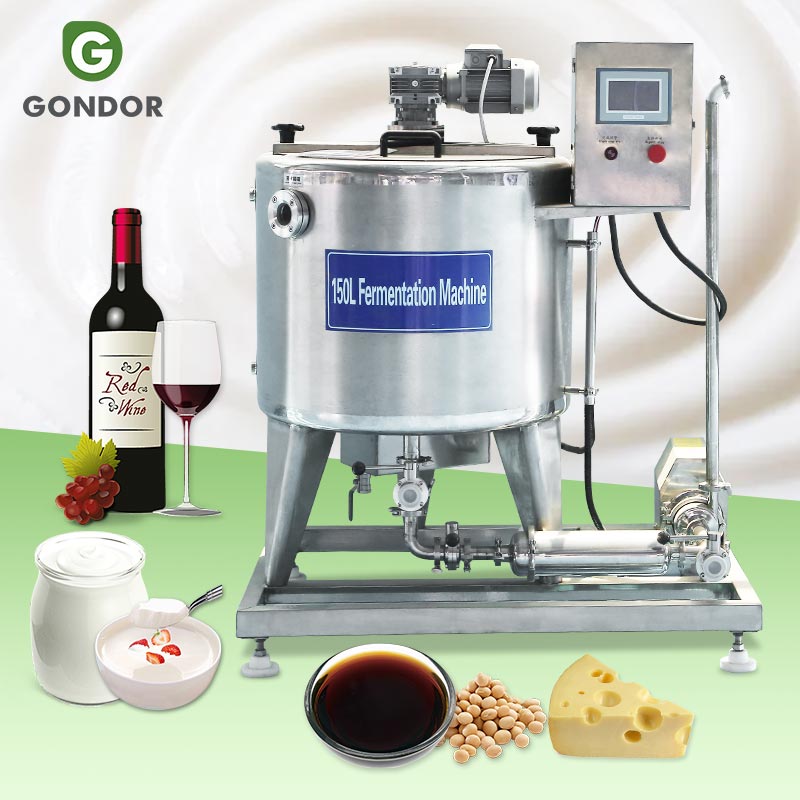
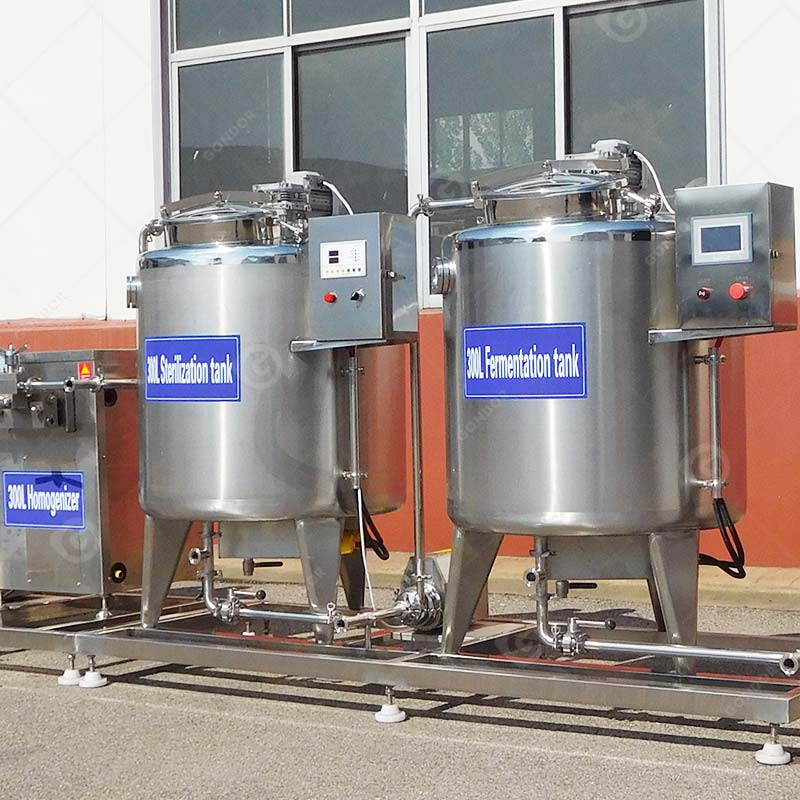
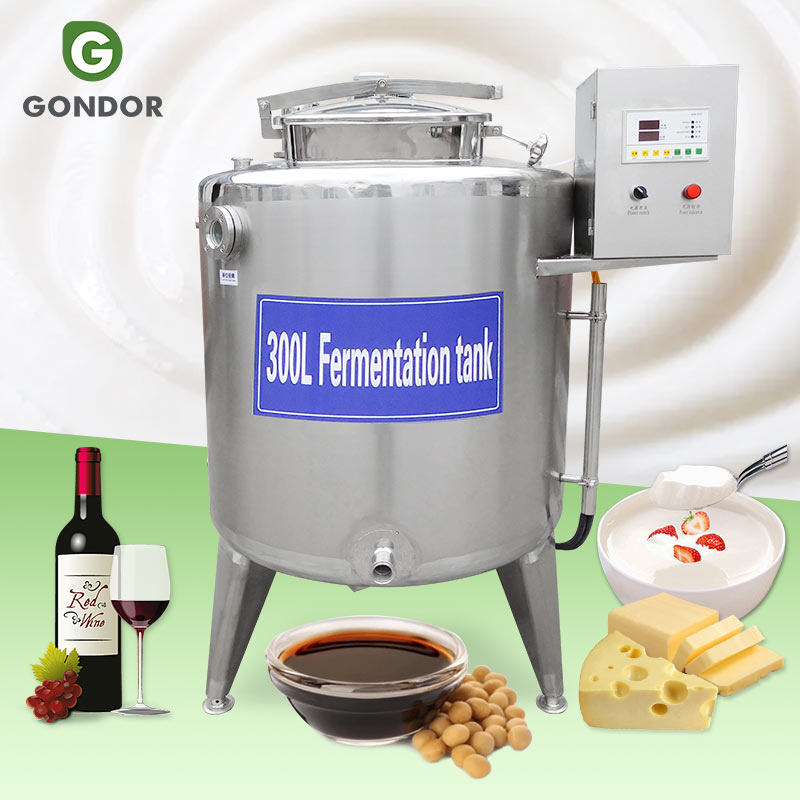
A 100-1000 L three-layer jacketed fermentation tank on PLC temperature control, so every batch sets the same curd without an experienced hand.
What a Yogurt Plant Fears Most Is a Two-Degree Drift in the Fermentation Tank
Anyone who has made yogurt knows that fermentation is not picky about raw material; it is picky about temperature. Once a batch of milk is inoculated, it has to sit at around 43 °C for several hours. If the tank temperature drifts a degree or two, acid development changes with it: the yogurt comes out either harshly sour or too thin to set, and the whole batch is lost. Open vats are worse still, because airborne contaminants land in the product and cut its shelf life before it ever leaves the plant.
The fermentation tank addresses both problems at once: temperature holding and contamination control. The product ferments in a fully closed vessel. A PLC drives heating or cooling media through a circulation jacket to hold the set point, and a sterile breathing valve with a filter element on top lets the tank vent without letting contaminants in. Once the temperature curve is stable, every batch becomes comparable in acidity, texture and viable count.
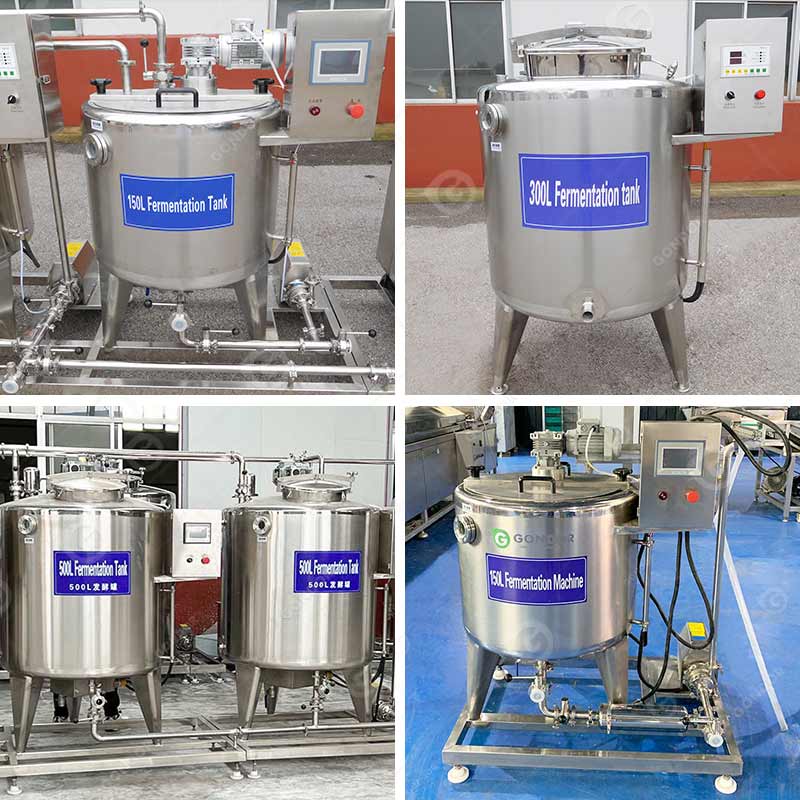
Standard models run from GD-100 to GD-1000, with working volumes from 100 L to 1000 L, covering small dairy rooms up to mid-size fermented beverage lines. The tank is built in three layers: inner vessel, water circulation jacket and insulation. Electric or steam heating is selected by model and site conditions, and larger volumes are available as custom builds.
Fermentation Tank Volume, Jacket Pressure and Agitator Options
Six-model comparison (per the official parameter table)
| Item | GD-100 | GD-150 | GD-200 | GD-300 | GD-500 | GD-1000 |
|---|---|---|---|---|---|---|
| Working volume | 100 L | 150 L | 200 L | 300 L | 500 L | 1000 L |
| Dimensions | 800×750×1230 mm | 800×750×1430 mm | 800×750×1530 mm | 1000×1100×1650 mm | 1300×1100×1850 mm | 1600×1400×2200 mm |
| Weight | 100 kg | 150 kg | 180 kg | 220 kg | 270 kg | 400 kg |
| Heating power | 9 kW | 9 kW | 9 kW | 12 kW | 24 kW | 48 kW |
General parameters
| Item | Specification |
|---|---|
| Voltage | 220 V / 380 V |
| Fermentation temperature range | 45 to 90 °C, adjustable |
| Tank construction | Three layers: inner vessel, circulation jacket, insulation |
| Material | SUS304 stainless steel in product contact |
| Control | PLC temperature control with live display |
| Heating | Electric below 300 L; electric or steam optional from 300 L up |
| Agitation | Motor-driven shaft, low-speed mixing for even temperature |
| Certification | ISO 9001, ISO 14001, ISO 45001, CE, BSCI, ETL |
| Core component warranty | 1 year |
Note: six standard models listed; custom volumes beyond the nominal range are available on request.
How a Fermentation Tank Holds Temperature Through the Whole Cycle
In short. The working cycle of a fermentation tank moves through four stages: charging, temperature holding, fermentation, and discharge with cleaning. Material enters through the feed port, inoculation follows, and the PLC circulates heating or cooling media in the jacket to hold the tank at the optimum range for the culture. When fermentation is complete, the product drains from the bottom outlet and the tank is cleaned for the next batch. Only one variable really decides the result: whether the temperature holds steady for hours on end.
Product Performance Advantages
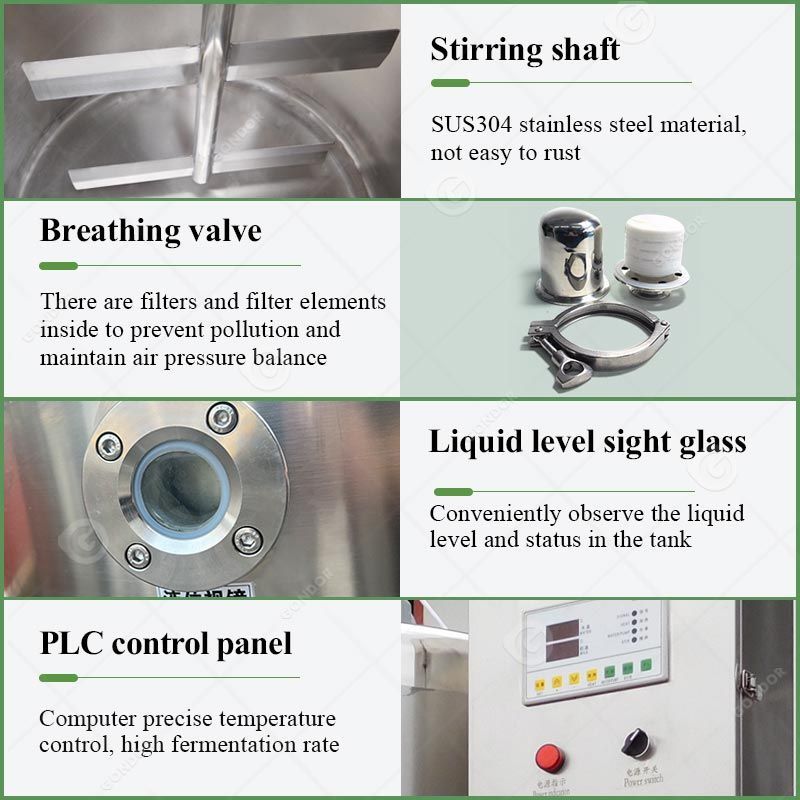
- Three-layer tank construction keeps temperature drift small. Inner vessel, circulation jacket for heating or cooling media, and an outer insulation layer. For a yogurt process held at 43 °C for hours, this structure loses heat far more slowly than a single-wall tank, which makes the fermentation endpoint easier to judge.
- PLC temperature control makes batches repeatable. Set point, live display and automatic correction sit on one panel. Different shifts running the same recipe get the same result, which matters directly when you supply private-label or chain-store customers.
- A sterile breather valve vents without letting contaminants in. The valve carries a filter mesh and element, so pressure changes from temperature swings pass through the filter while external contaminants stay out. An open vat simply cannot do this.
- Six standard models from 100 to 1000 L. Batch sizes from GD-100 up to GD-1000 let you match daily output and cycle time. Beyond the standard range, custom volumes are supported; factory documentation records demand covered up to 15000 L, subject to engineering confirmation.
- Heating options matched to site conditions. Models below 300 L use electric heating as standard. Models of 300 L and above accept electric or steam heating. Where plant steam is available it usually wins on running cost; where it is not, electric heating keeps installation simple.
- SUS304 stainless steel in product contact. The stirring shaft, inner vessel and pipework are all 304, resisting acid and alkaline attack, meeting food-contact requirements and cleaning down without carrying odours between batches.
Engineering Design and Operation
Three-layer vessel. Inner vessel, circulation jacket and insulation run from the inside out. The heat transfer area of the jacket is matched to the heating power of each model: GD-1000 carries 48 kW so that a vessel of that volume still heats up in reasonable time. The outer layer cuts heat loss and protects operators from contact burns.
Contamination control. The breather valve with its filter element balances tank pressure, the feed port seals shut, and the outlet sits low in the vessel to minimise residue. The design intent is plain: during the hours of fermentation, the only organisms active inside should be the ones you inoculated.
Control and electrical. The PLC panel centralises temperature control with live display. Agitator motor and heating circuits interlock, and heating can also be controlled independently where the process calls for it.
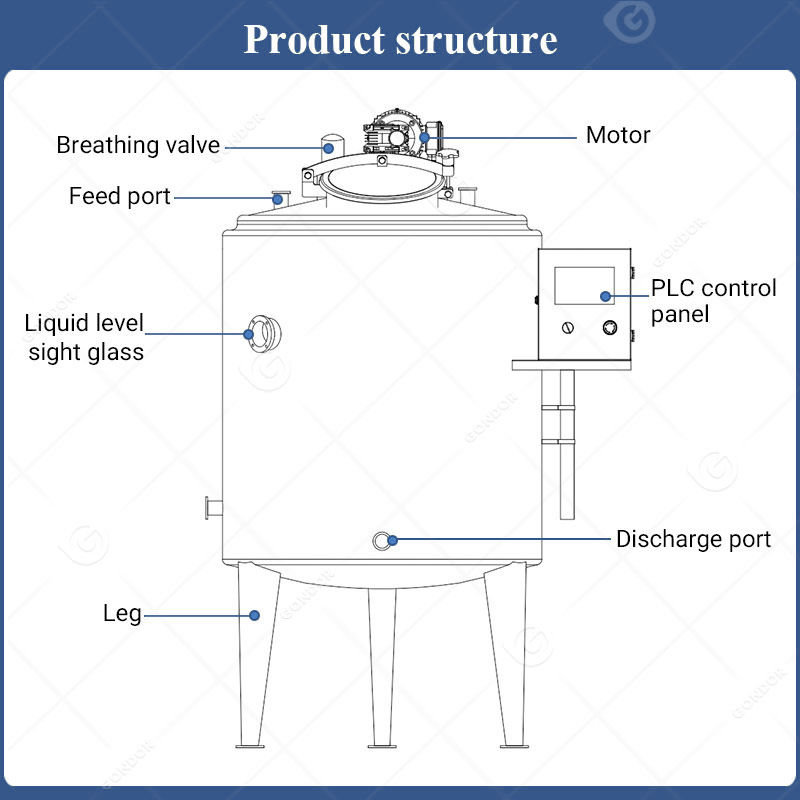
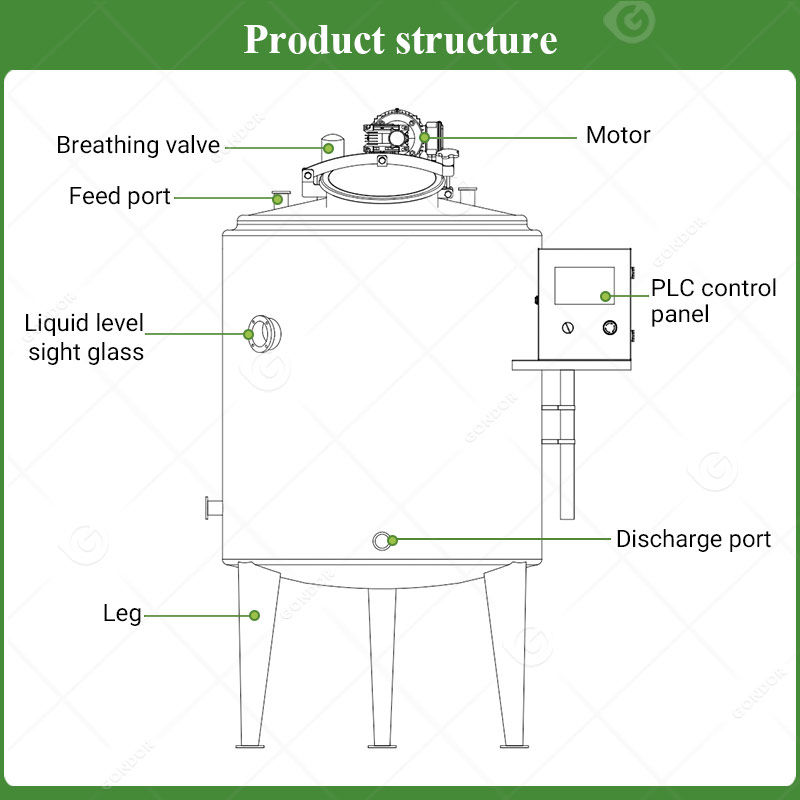
Structure breakdown (seven parts)
| No. | Part | Function |
|---|---|---|
| 1 | Breathing port (sterile breather valve) | Balances tank pressure; filter blocks external contaminants |
| 2 | Feed port | Entry for material and culture |
| 3 | Liquid level sight glass | View level and product condition inside the tank |
| 4 | Legs | Support the vessel and raise the outlet to working height |
| 5 | Discharge port | Bottom drain of finished product |
| 6 | PLC control panel | Temperature set point, display and heating/cooling control |
| 7 | Motor and stirring shaft | Low-speed agitation for even temperature and no separation |
Operating procedure.
- Pre-start check. Confirm jacket medium is at level, the breather filter is clean, the discharge valve is closed, and panel set points are correct.
- Charging and inoculation. Fill to the set volume and dose the culture in proportion.
- Heat-up and fermentation. Start heating and agitation. Once the tank reaches process temperature, hold through fermentation with periodic checks of the display.
- Discharge and cleaning. Drain at the endpoint, rinse the vessel and pipework, check the breather valve, and prepare for the next batch.
What a Fermentation Tank Handles: Yogurt, Kefir and Starter Cultures
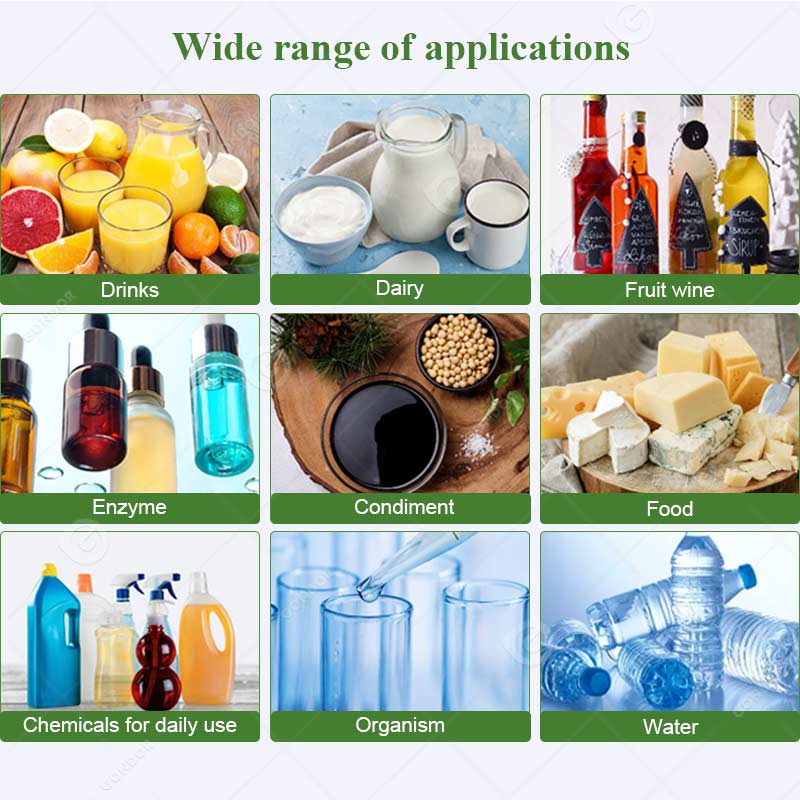
Yogurt and fermented milk. The primary application. Medium-temperature fermentation at around 43 °C demands holding stability, and the PLC control with three-layer insulation is built directly for this process.
Fermented beverages and fruit wine. Kombucha, fermented fruit and vegetable juices, and the primary fermentation stage of fruit wine run at different temperatures, all within the adjustable 45 to 90 °C range.
Culture propagation and fermented feed. For culture scale-up and fermented feed production, runs are small and frequent, which is where the 100 to 300 L models earn their keep.
Bioengineering and daily chemicals. Enzymatic and fermentation-based processes for personal care raw materials. The closed, hygienic construction is the entry ticket to these industries.
Sizing a Fermentation Tank Against Your Daily Fill Volume
Work out the batch first, then pick the volume.
- Daily output and cycle time. A yogurt batch takes 4 to 8 hours; plan on two to three batches a day. At 300 kg per day, GD-100 fits. Above 1 t per day, look at GD-500 or GD-1000.
- Heating method. Steam heating wins on running cost where plant steam exists. Otherwise go electric, but confirm transformer capacity first: GD-1000 draws 48 kW of heating power, which no lighting circuit will supply.
- Material characteristics. Liquid or medium-viscosity materials suit this unit. For high-viscosity pastes, confirm the agitator configuration with engineering before ordering.
- Voltage and floor space. 220 V or 380 V is confirmed by model and site. Leave room around the tank for charging, sampling and cleaning.
Limits worth stating plainly. This is batch fermentation equipment, not a continuous fermentation system. Daily output is worked back from cycle time. Yogurt ferments at around 43 °C, which sits at the lower edge of the 45 to 90 °C adjustable range, so state your process temperature when ordering and let engineering confirm the control arrangement.
Customization Capability
- OEM / ODM: Accepted, customer branding and labelling supported.
- Volume customization: Beyond the six standard models, custom volumes are built to process requirements; factory documentation records coverage up to 15000 L, subject to engineering confirmation.
- Structure and configuration: Heating method (electric/steam), voltage (220 V/380 V) and control configuration can be adjusted to requirement.
- Tooling lead time: quoted with the offer
Business Information
| Item | Details |
|---|---|
| Minimum order quantity | 1 unit |
| Lead time | In-stock models ship within 48 hours after order confirmation; custom lead time to be agreed before ordering |
| Packaging | Waterproof membrane inner layer, standard wooden crate outer layer, suited to international transport |
| Trade terms | Quoted per order |
| Loading port | Quoted per order |
Quality Inspection and After-Sales
- Pre-shipment inspection: Factory video inspection and a mechanical test report are provided, along with the instruction manual, test report and related data sheets.
- Warranty: One year on core components.
- After-sales support: Within three months of sale, non-human mechanical failures are covered with free parts or machine replacement. Fault handling: cut the power first, describe the fault to after-sales, and we diagnose remotely; where the site cannot resolve it, we send a technician. Engineers are also available to assist with installation and operator training.
Fermentation Tank Questions Buyers Ask Before Ordering
1. What products can this fermentation tank make?
Yogurt, fermented milk, fermented beverages, primary fermentation of fruit wine, culture propagation, fermented feed and enzymatic processes. Feedstocks should be liquid or of medium viscosity; for high-viscosity pastes, confirm the agitator configuration first.
2. What temperature and duration does yogurt need?
The best fermentation temperature is around 43 °C over 4 to 8 hours, adjusted to the culture and recipe. The unit adjusts from 45 to 90 °C; state your target process temperature when ordering so engineering can confirm the control arrangement.
3. Electric heating or steam heating?
Models below 300 L use electric heating as standard. From 300 L up, electric or steam is optional. Where boiler steam is available, steam is usually the cheaper option to run. Without a steam source, electric heating is the straightforward choice.
4. How does the tank stay free of contamination?
A fully closed vessel with a sterile breather valve; the filter mesh and element inside the valve block external contaminants whenever the tank vents. The SUS304 inner vessel cleans down without trapping residue. Checking the breather filter each shift is the single most important routine task.
5. How many batches per day?
At 4 to 8 hours per yogurt batch plus charging and cleaning, two to three batches a day is a common rhythm. Estimate daily output as tank volume multiplied by batch count, and leave headroom in planning.
6. Can it be customised?
Yes. Volume, voltage, heating method and control configuration are all customisable, and OEM/ODM projects are accepted with customer branding.
7. How are warranty and after-sales handled?
Core components carry a one-year warranty, and the manual plus test report ship with each unit. Non-human mechanical failures within three months are covered with free parts or replacement; after that, we diagnose remotely first and dispatch a technician when needed.
8. What site conditions does installation need?
Power at 220 V or 380 V per model; high-power models need confirmed supply capacity. The circulation jacket needs a water make-up point. Leave operating and cleaning space around the tank.
Getting Started With a Fermentation Tank Project
If product type (yogurt, beverage, fruit wine), daily output and site power conditions are settled on your side, send those three items and we will recommend a model, propose the heating arrangement and prepare a quotation. To validate the process first, send a material sample and we will run a trial at the factory and report back on the fermentation result.
Contact
Henan Gondor Machine Co., Ltd. Website inquiry form, WhatsApp or email. Replies within 24 hours on working days.
Related Equipment
- Mixing Tank — blends fruit, sugar and stabiliser into the milk base before it goes into the fermenter.
- Milk Pasteurizer Machine — runs ahead of the tank on the same line, so the base arrives already treated.
Ask for Fermentation Tank Pricing and Drawings
Send us the daily volume, the product and the container or pack format you are working with, and we will come back with a model recommendation, a utility list and a price.