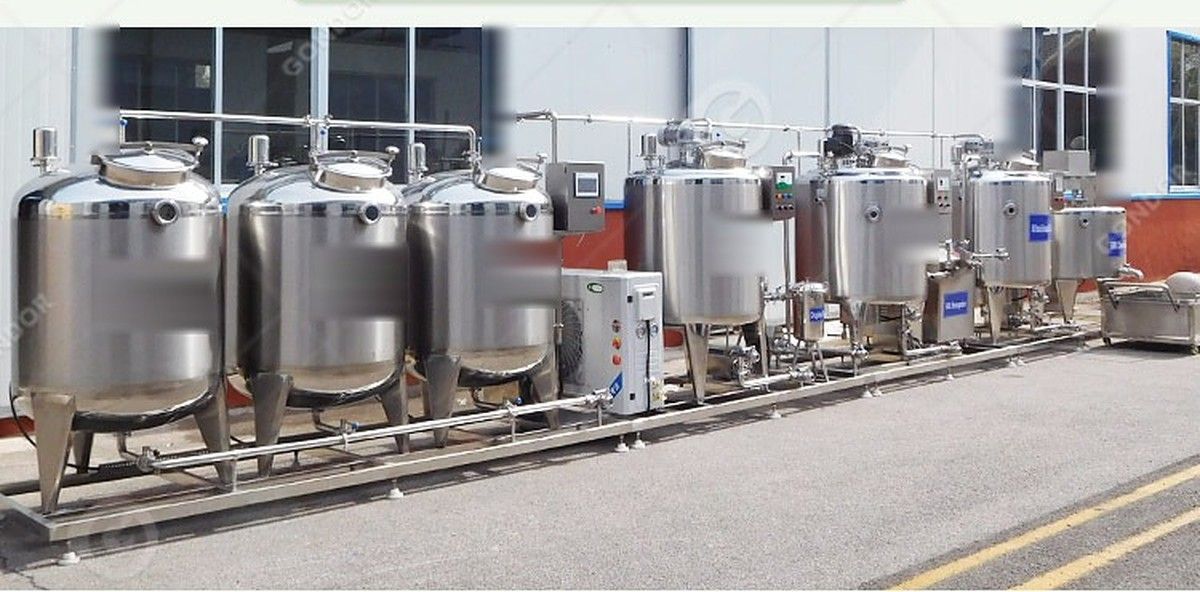


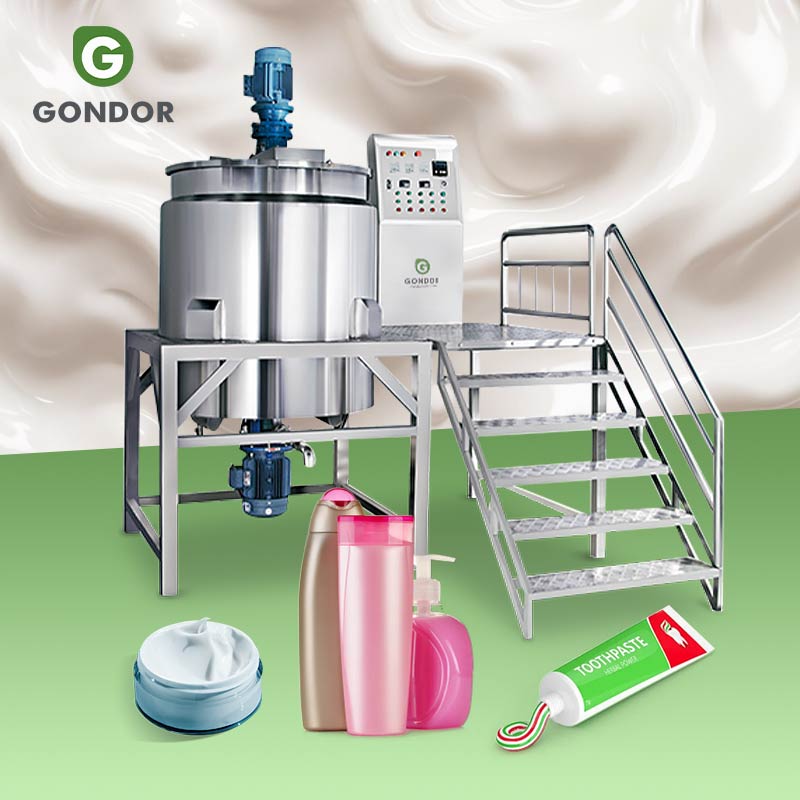
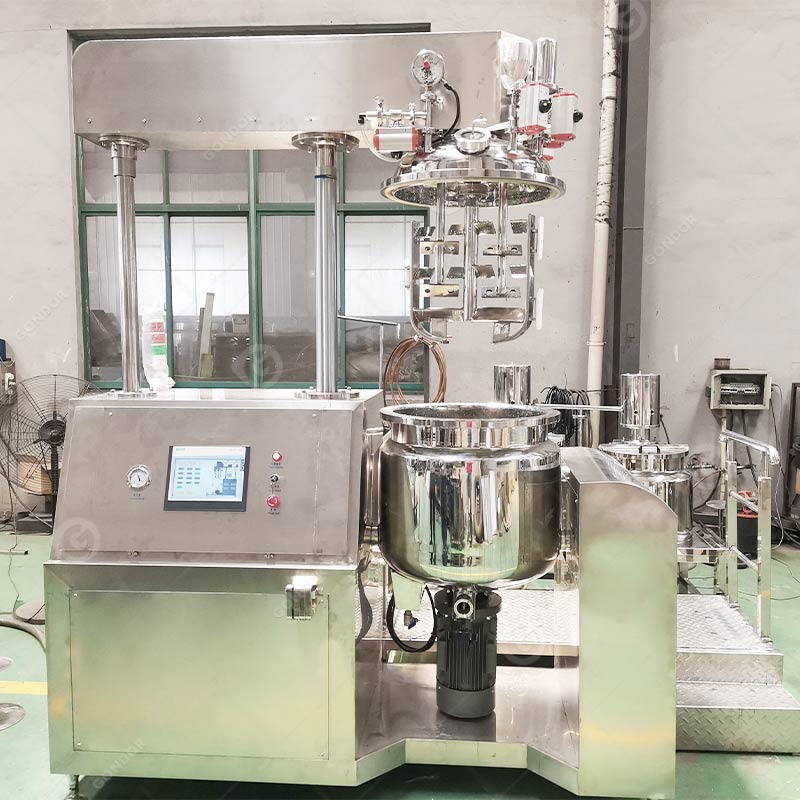
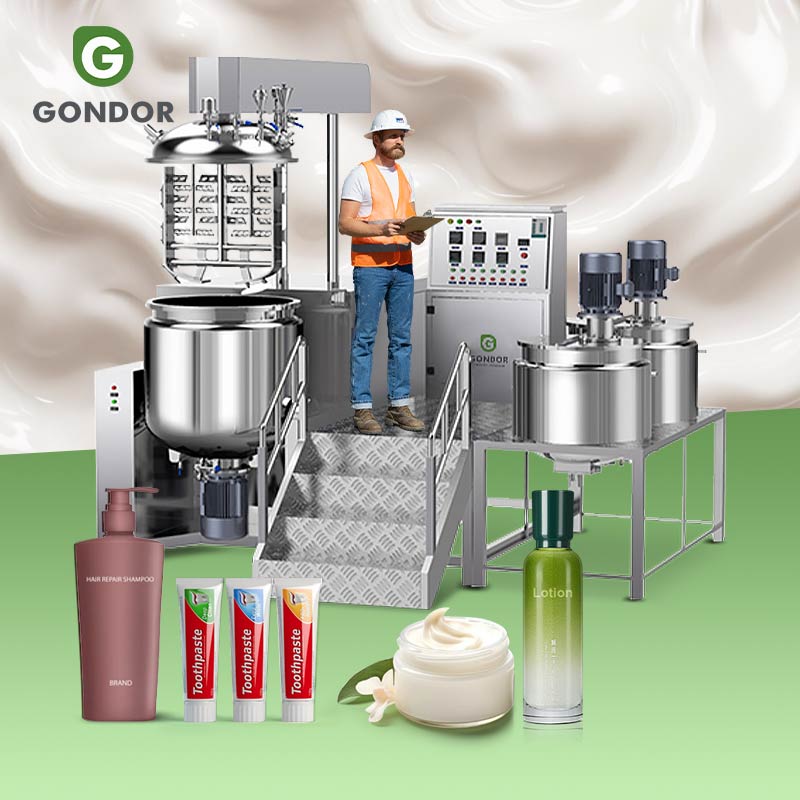
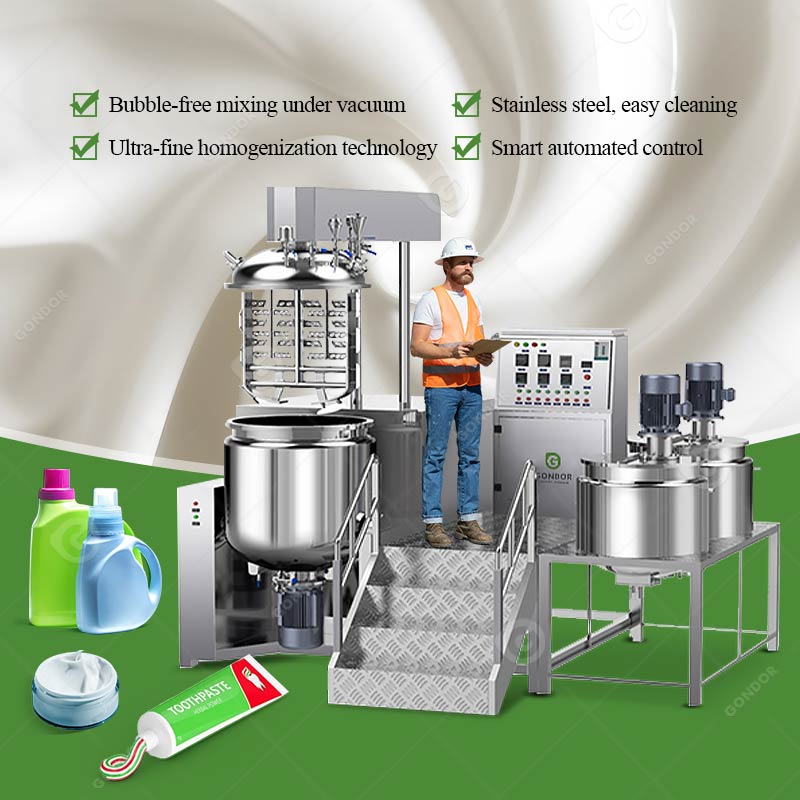
A 300-5000 L vacuum emulsifying tank with adjustable homogenizing speed and vacuum deaeration, keeping high-viscosity batches from separating or foaming.
What a Vacuum Emulsifying Mixer Changes Inside the Batch
Plants making mayonnaise and face cream fight the same battle: the top of the batch reads different from the bottom, bubbles cling to the bottle wall at filling, and separation starts within two weeks on the shelf. The problem is rarely the recipe. It is emulsification. Oil and water have only been stirred together, never broken into a stable fine emulsion, and standing time does the rest.
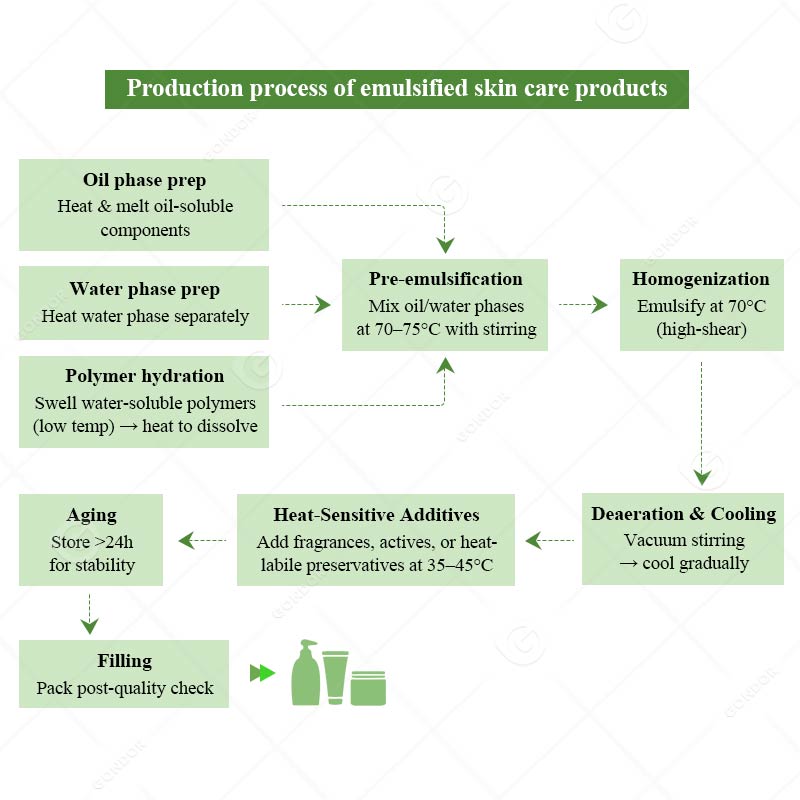
A vacuum emulsifying mixer concentrates stirring, homogenizing, emulsifying and dispersing inside one jacketed vessel. The tank holds vacuum while a high-speed homogenizing head shears the batch, and the air mixed in during emulsification is pulled out as it forms. The finished product comes out fine, low in bubbles and resistant to separation. The viscosity window runs from 0 to 100,000 cps, covering everything from thin lotion to peanut butter thickness; the jacket heats or cools, so the full chain from pre-emulsifying oil and water phases at 70 to 75 °C down to adding fragrance at 35 to 45 °C closes inside one tank.
The machine works in batches, with tank volumes from 300 L to 5000 L. Skin care lotion for cosmetics plants, mayonnaise and salad dressing for food plants, and resin emulsions for chemical plants all live in the same product family. Small batches belong to the high-shear unit; continuous dairy duty at pressure belongs to the high-pressure homogenizer. This machine owns large-volume, high-viscosity batch emulsification with vacuum and temperature control.
Vacuum Emulsifying Mixer Technical Specifications
Three-rating comparison (per the official parameter table)
| Item | 300 L | 500 L | 5000 L |
|---|---|---|---|
| Tank capacity | 300 L | 500 L | 5000 L |
| Installed power | 6.2 kW | 7.7 kW | 33 kW |
| Dimensions | 2050×2300×2280 mm | 2200×2500×2700 mm | 3650×4830×3960 mm |
| Machine weight | 500 kg | 600 kg | 1500 kg |
| Packing size | 2200×2450×2430 mm | 2350×2650×2850 mm | 3800×4960×4100 mm |
| Packing weight | 600 kg | 720 kg | 1700 kg |
Note: the series is recorded under the internal code GD-VEMM. On design detail, the 300 L rating uses a nominal 360 L tank with working charge configured at 300 L.
General parameters
| Item | Specification |
|---|---|
| Voltage | 380 V / 50 Hz |
| Viscosity range | 0 to 100,000 cps |
| Spindle speed | 0 to 3000 rpm, inverter controlled |
| Heating | Electric heating (other schemes per custom confirmation) |
| Tank material | SUS304 / SUS316L, mirror polished |
| Vacuum system | Water-ring vacuum pump |
| Control | Push-button cabinet; PLC touch screen optional |
| Machine variants | Vacuum / non-vacuum; fixed lid / hydraulic lifting lid |
| Certification | ISO 9001, ISO 14001, ISO 45001, CE, BSCI, ETL |
| OEM / ODM | Accepted |
| Core component warranty | 1 year |
How a Vacuum Emulsifying Mixer Works Under Vacuum
In short. Material is drawn into the main tank by vacuum and brought to process temperature in the jacket. An anchor paddle with wall scrapers stirs slowly to stop sticking, while a high-speed homogenizing head at the tank bottom sucks material in, shears it and ejects it back, cycling the batch. Vacuum holds through the cycle and removes the bubbles that emulsification creates. Once fineness and uniformity are reached, the batch cools and leaves through the bottom outlet.
Product Performance Advantages
- Vacuum emulsifying with simultaneous deaeration, and the appearance gains show directly. Bubbles are a prime cause of separation and wall clinging at filling. Tank vacuum removes the gas as it forms during shearing, so the product comes out fine and clear, and the filling line sees far less foam.
- A 100,000 cps viscosity span covers many categories on one machine. From thin lotion to peanut-butter-thick paste, the dual system of paddle plus homogenizing head holds up. Switching category means changing the process card and speed, not buying another machine.
- Independent homogenizing and stirring control with inverter speed. Pre-emulsification and fine emulsification want different speeds. The two motors run separately with stepless adjustment, widening the process window and improving batch repeatability.
- Three-layer stainless jacketed tank with mirror polish. The inner layer contacts product, the jacket carries heating or cooling media, and the outer layer insulates. The mirror surface does not hold material, saving water and time at cleaning and meeting sanitary requirements.
- Water-ring vacuum pump on a water loop, with capacity in reserve. Vacuum builds to what the emulsification process needs, a sight glass shows tank conditions in real time, and the vacuum system is sized with margin for the most viscous duty.
- No floor transfer from feeding to discharge, small batch loss. Vacuum feeding, bottom discharge and a tiltable tank leave noticeably less wall residue per tonne of finished product than open-lid agitated tanks.
Engineering Design
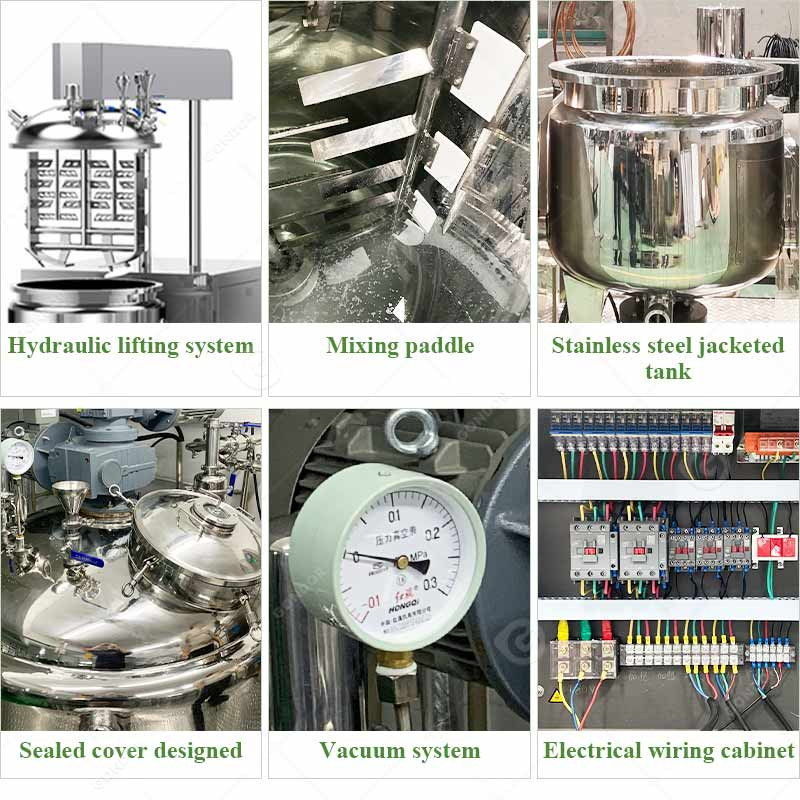
Tank and jacket. The vessel is a three-layer structure: product-contact inner shell, a jacket layer for heating and cooling media, and an insulating outer layer. Heating is electric; other schemes such as steam are confirmed with engineering per custom project. Tank volumes step up from 300 L to 5000 L. Two lid styles exist: half-open and hydraulic lifting. The lifting-lid style opens completely for dead-corner-free cleaning, and the tank tilts for direct discharge.
Mixing system. The anchor paddle carries wall scrapers, built for the wall-sticking problem of high-viscosity batches. Without scraping, mayonnaise and cream insulate themselves against the jacket, heat stops transferring, and the wall ring eventually scorches. The scraper settles that at the structure level.
Homogenizing system. A high-speed homogenizing head sits at the tank bottom, driven by the motor through a coupling and a self-positioning spindle system, with a precision rotor-stator gap. The source data lists no separate wear-parts schedule; rotor and stator are precision-mated parts and are inspected by duty intensity.
Vacuum and sealing. The sealed lid carries a sight glass, CIP cleaning ball, material inlet and ingredient inlet. A water-ring vacuum pump builds negative pressure for the whole tank, and the sealing structure holds vacuum through the emulsification cycle.
Electrical control. The push-button cabinet carries a temperature controller, power indicator, emergency stop and timer; a PLC touch screen is optional for automatic or semi-automatic operation. The cabinet follows international wiring practice with branded key components, so maintenance and troubleshooting stay straightforward.
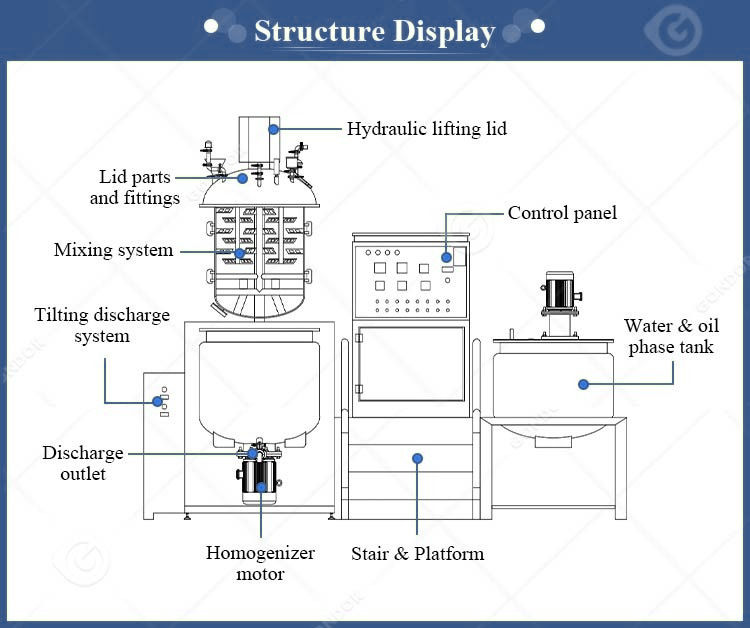
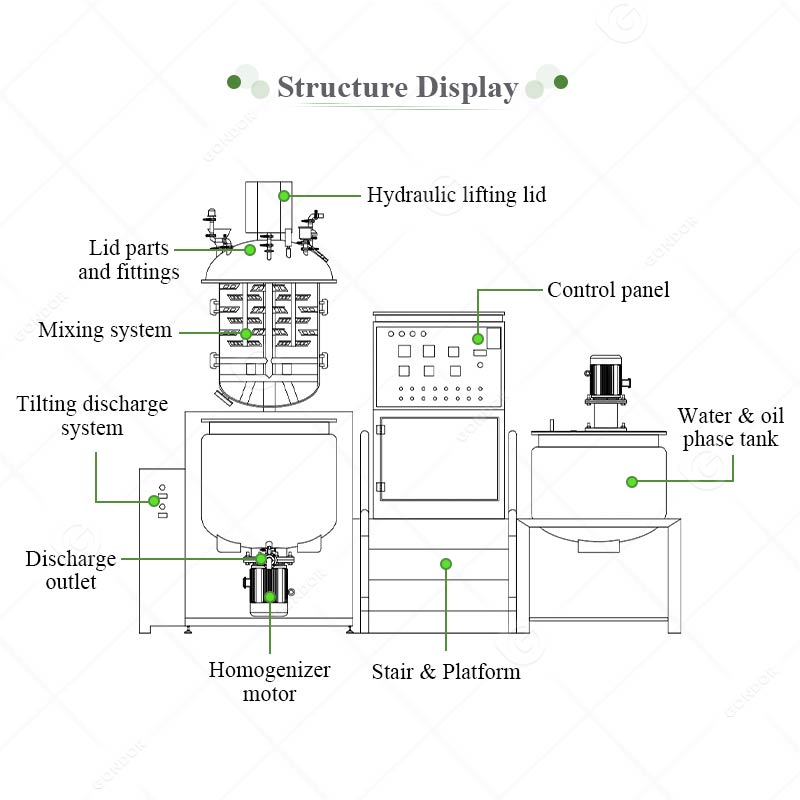
Structure breakdown
| No. | Part | Function |
|---|---|---|
| 1 | Three-layer jacketed tank | Product-contact inner shell, heating and cooling jacket, insulation layer |
| 2 | Anchor mixer with wall scraper | Slow stirring with scraping against high-viscosity wall sticking |
| 3 | Homogenizing head | High-speed bottom shear through precision rotor-stator gap |
| 4 | Hydraulic lifting lid | Optional; fully open lid, tiltable tank for direct discharge |
| 5 | Sealed cover | Sight glass, CIP ball, material inlet and ingredient inlet |
| 6 | Water-ring vacuum pump | Builds tank vacuum, removes emulsification bubbles |
| 7 | Control cabinet | Temperature, timer, emergency stop; PLC touch screen optional |
| 8 | Stair and platform | Feeding and maintenance access for large models, with safety railing |
Operating Procedure
- Pre-start check. Confirm the vacuum pump water circuit, valve positions, emergency stop reset and controller setpoints.
- Phase preheating. Heat the water phase and oil phase tanks separately; swell water-soluble polymers at low temperature before dissolving with heat.
- Vacuum feeding. Start the vacuum pump, build negative pressure in the main tank, and draw the water and oil phases in through the lines.
- Stirring pre-emulsification. Start the stirring motor and combine the two phases at 70 to 75 °C.
- Homogenizing. Start the homogenizing motor, hold vacuum, and run fine emulsification per the process card.
- Deaeration and cooling. Keep vacuum stirring after homogenizing, switch the jacket to cooling, and add fragrance and actives at 35 to 45 °C.
- Discharge. Drain from the bottom outlet to filling or aging tanks. Run the CIP cycle on tank and homogenizing head after production.
Applications for a Vacuum Emulsifying Mixer
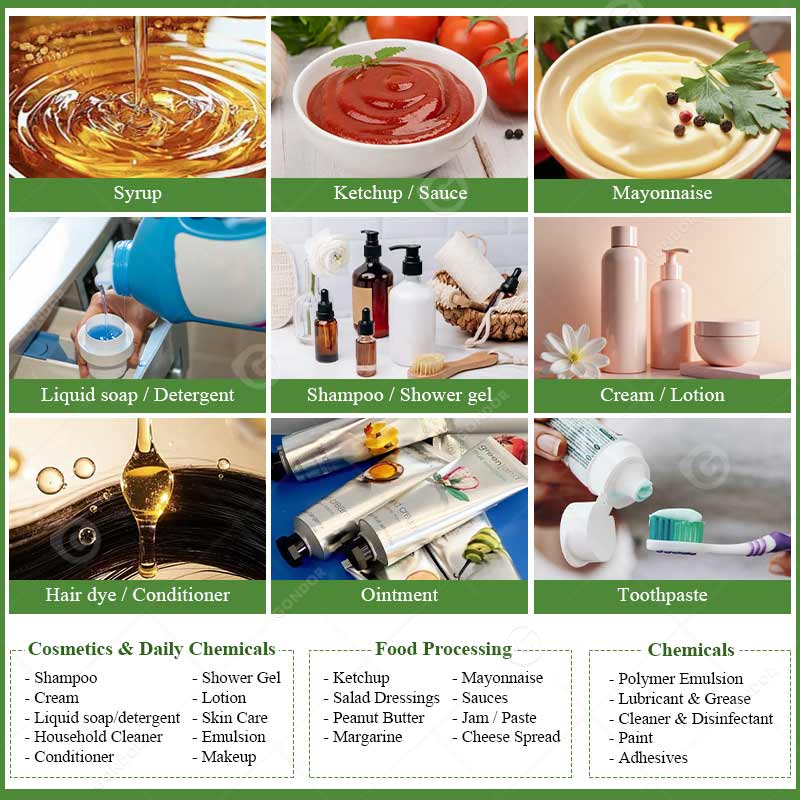
Cosmetics and daily chemicals. Face cream, lotion, shampoo, shower gel, conditioner, liquid soap, toothpaste, and makeup bases. The smaller the emulsion droplets, the finer the skin feel, which is an open secret in skin care formulation.
Food processing. Mayonnaise, salad dressing, ketchup, jam, peanut butter, tahini, margarine and hot pot base. Mayonnaise runs a high oil-to-water ratio, and without vacuum emulsification, separation is only a matter of time.
Chemicals and adhesives. Pigments, paints, dyes, resins, polymer emulsions, lubricants, adhesives and shoe polish. General chemicals span a wide viscosity range, and the 100,000 cps ceiling with vacuum deaeration matches that profile.
Customization
Tank volume, material (SUS304 or SUS316L), agitator direction (single or bidirectional), lid style (fixed or hydraulic lifting), control level (push-button panel or PLC touch screen) and an external recirculation loop are all configurable, with vacuum and non-vacuum variants in the range. OEM and ODM projects are accepted, with branding and panel language per order. Tooling lead time and minimum order quantity: quoted with the offer.
Quality Inspection and After-Sales
Pre-shipment video inspection and a mechanical test report are provided, with the manual shipped alongside. Core components (motor, pressure vessel) carry a one-year warranty with online technical support. Fault handling starts with remote diagnosis; on-site repair is arranged when the issue cannot be resolved remotely. Large models include the stair platform and safety railing; confirm foundation loading and working space at installation.
Selection Guide for a Vacuum Emulsifying Mixer
- Size the tank from batch charge. Effective charge is usually six to eight tenths of nominal volume; plan 300 L charge for the 300 L rating and 500 L for the 500 L rating. Divide daily output by batch hours (heating, emulsifying and cooling, typically several hours) to get the batch count, then back into tank volume.
- Size the structure by viscosity. Above roughly 50,000 cps, the wall-scraping anchor paddle is a must; thin lotion can go simpler. Choose the vacuum variant first, and skip the non-vacuum type for bubble-sensitive products such as clear gels and glossy sauces.
- Size the lid by cleaning demand. Lines that change color or fragrance often should take the hydraulic lifting lid for full access; single-product continuous runs do fine with a fixed lid.
- Size the electrics by control needs. The push-button panel covers basic processes; multi-product lines with many parameters belong on the PLC touch screen, where recipes are stored and recalled.
Vacuum Emulsifying Mixer Questions From Emulsion Formulators
1. What does vacuum emulsification add over plain stirring?
Plain stirring only mixes the two phases together: large droplets, plenty of trapped air, separation and foam after standing. Vacuum emulsification shears at high speed while pulling gas out, so droplets reach micron scale and the finished product carries few bubbles. Stability and appearance sit on a different level.
2. Can it make mayonnaise without separation?
Mayonnaise is a classic high-ratio oil-in-water emulsion and a core duty for this machine. Pre-emulsify the phases, then fine-emulsify under vacuum with proper deaeration, and separation is settled at the process level.
3. What is the viscosity ceiling?
The material window is 0 to 100,000 cps. Ultra-thick material beyond that (some paste fillers, for example) runs outside the design envelope; share the material data with engineering before selection.
4. Is heating electric only?
The published figure is electric heating. Projects that need steam can raise it as a customization item with engineering, subject to quotation confirmation.
5. How big is the 300 L tank really?
The design reads nominal 360 L with a 300 L working charge, leaving headspace for circulation and foam. The 500 L rating follows the same working-charge logic.
6. How is this different from the high-pressure homogenizer and the small high-shear unit?
This machine is a batch emulsifying tank with vacuum and jacket, taking 300 to 5000 L per batch for high-viscosity material. The high-pressure homogenizer is a continuous in-line pressurizing unit at the 20 MPa class for low-viscosity liquids such as milk and juice. The small high-shear unit covers 50 to 500 L batches. Each has its own boundary; they do not replace one another.
7. How long is the warranty, and how are wear parts covered?
Core components carry a one-year warranty. The source data lists no separate wear-parts schedule; inspect rotor, stator and seals by duty intensity, and cover common parts in the first order.
8. Can it be customized to our workshop layout?
Yes. Tank volume, material, lid style, control level and inlet and outlet positions are all configurable per project, and OEM and ODM are accepted.
Next Step: From Vacuum Emulsifying Mixer Enquiry to Start-Up
Send over your product type (lotion, sauce or paste), batch volume, viscosity range and whether vacuum is needed, and we will propose a tank rating, machine variant (fixed or lifting lid) and electrical configuration along the process chain. Where recipe confidentiality applies, a trial run can be arranged under NDA.
Contact
Henan Gondor Machine Co., Ltd. Website inquiry form, WhatsApp or email. Replies within 24 hours on working days.
Related Equipment
- High-Pressure Homogenizer — the continuous route for low-viscosity dairy and juice at 20 MPa.
- High Shear Homogenizer — trial and small-batch dispersing from 50 to 500 L.
- Mixing Tank — prepares the water and oil phases that feed this tank.
Request a Vacuum Emulsifying Mixer Quote
Send us the daily volume, the product and the container or pack format you are working with, and we will come back with a model recommendation, a utility list and a price.