

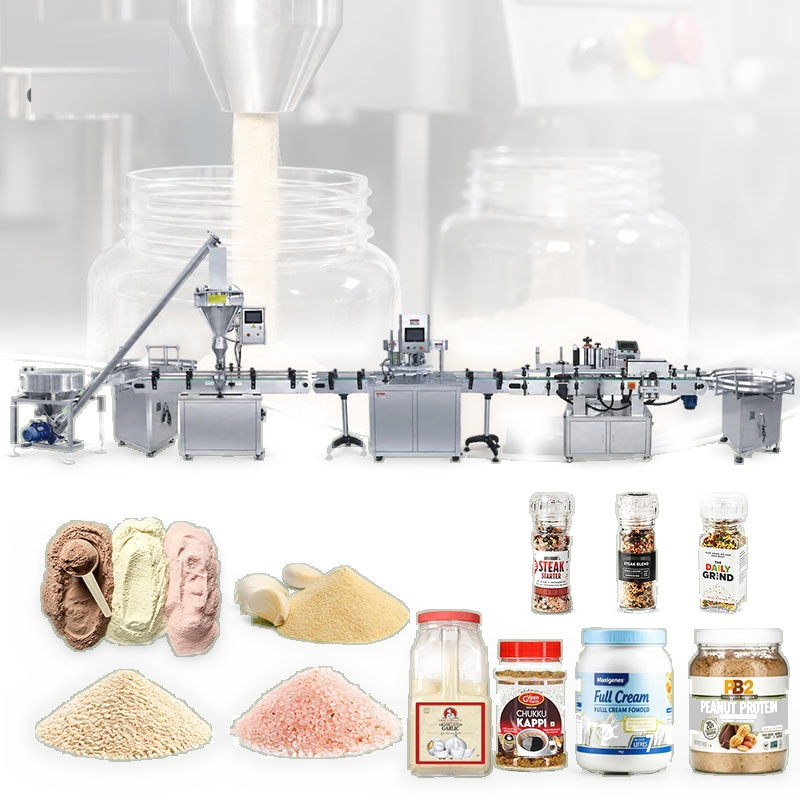
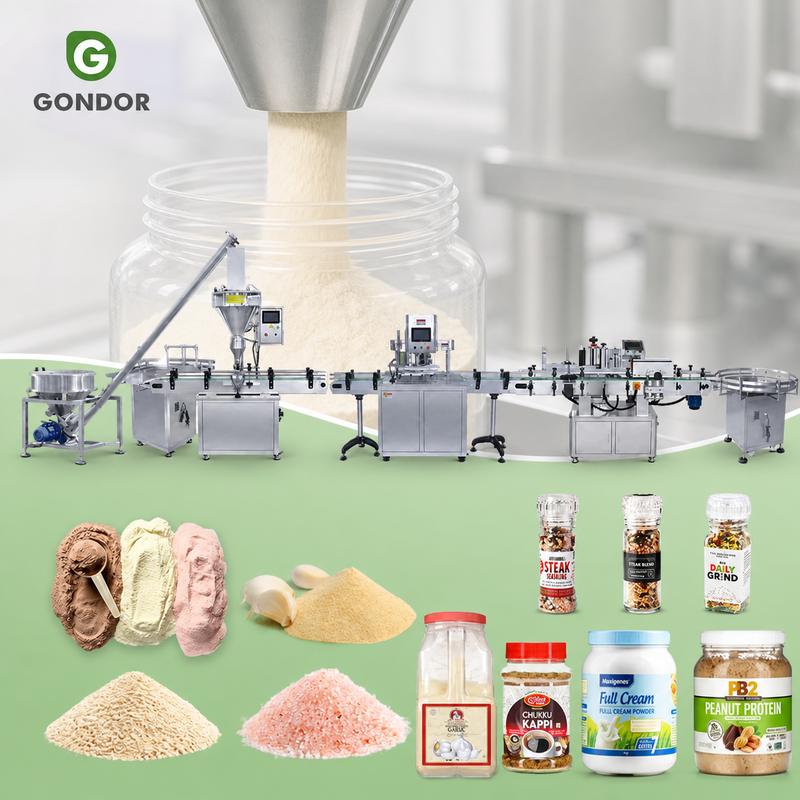
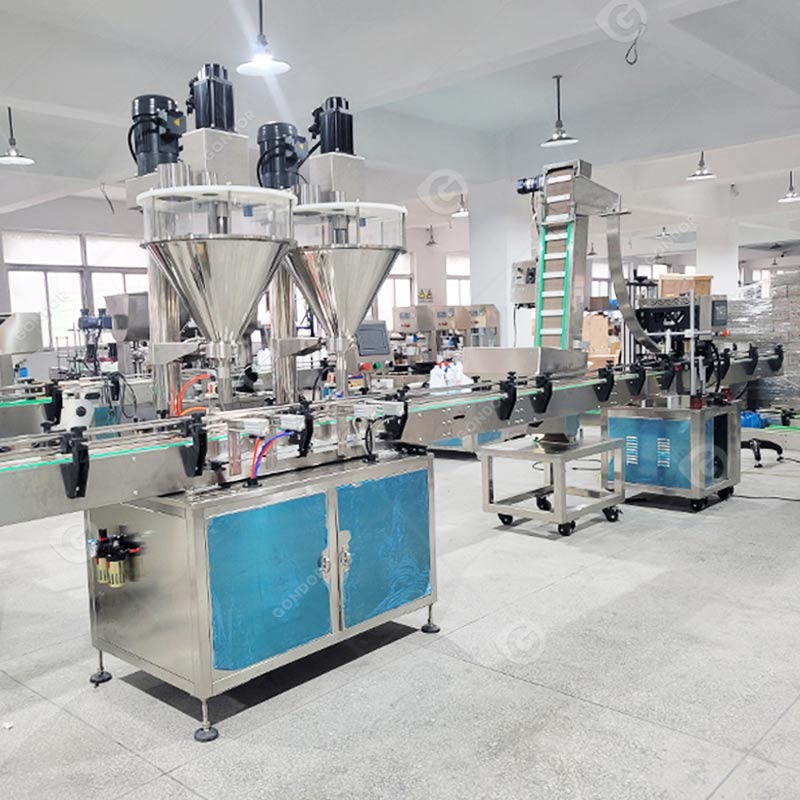
Unscrambling, servo dosing, capping and labeling on one line at ±1% and up to 40 bottles per minute, ending the weight spread within a batch.
Why Hand-Scooping Powder Into Bottles Loses to a Powder Filling Production Line
Quality managers at milk powder and seasoning plants hear the same complaint again and again: some bottles in the same batch look full, others sit visibly short. Hand filling runs at several percent error, and powder scattering over the bench, moisture pickup and airborne dust are simply part of the workshop atmosphere. Powder flows unevenly, a worker glances away for a second, and overfill and underfill end up in the same shipment.
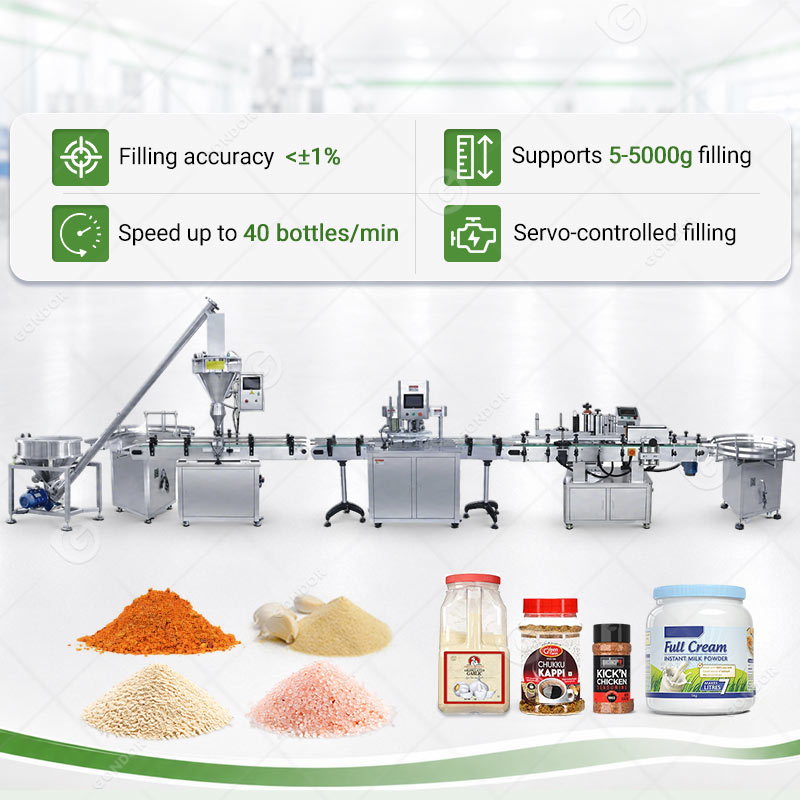
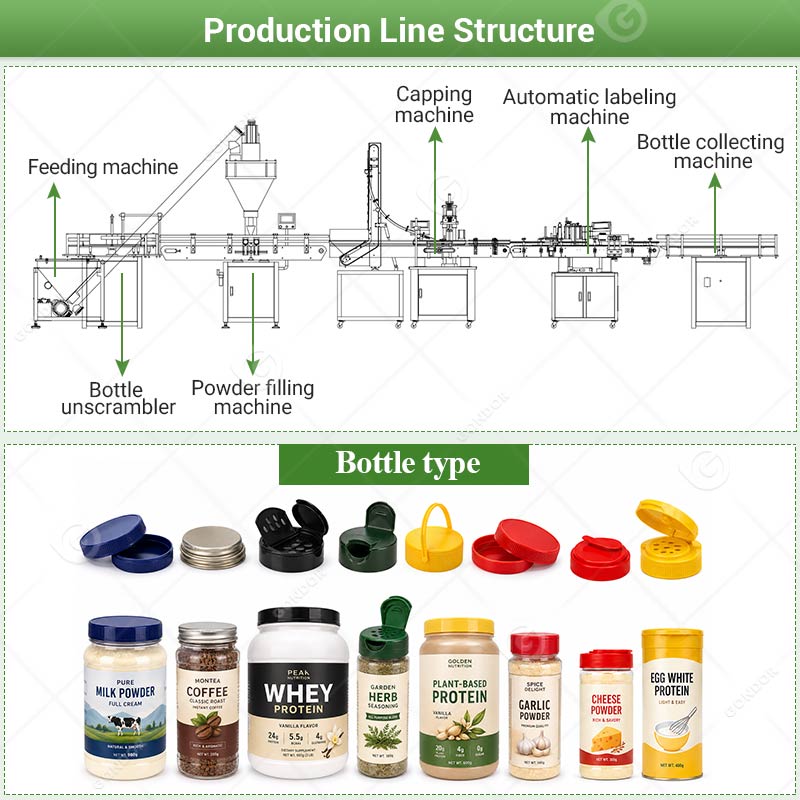
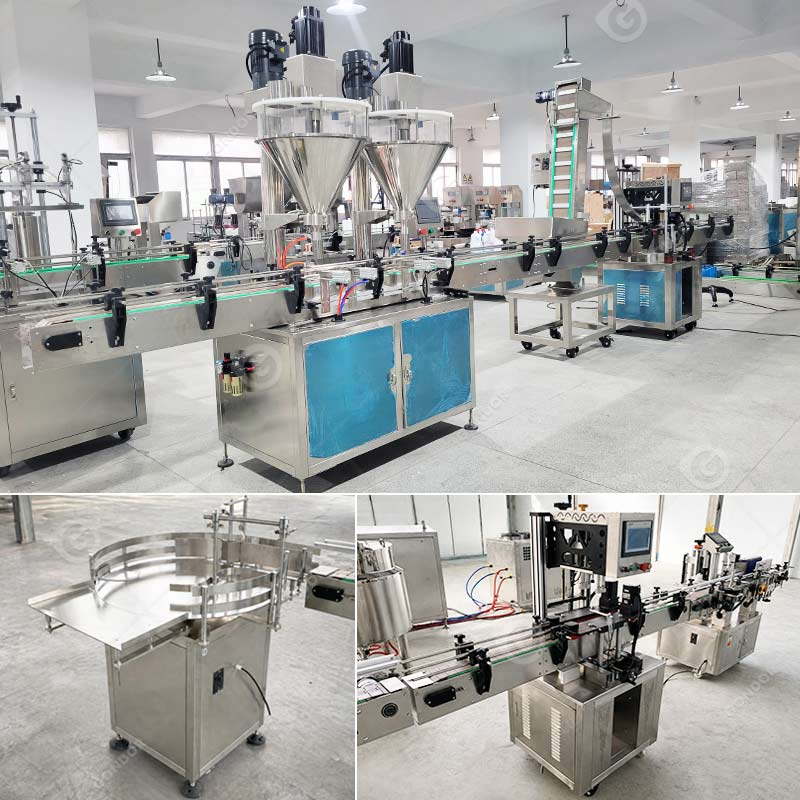
This powder filling production line connects six stations, from unscrambling to collecting, with no manual transfer in between. A single PLC coordinates the whole line. Filling accuracy stays within ±1%, and speed reaches 40 bottles/min. Metering is done by a servo-driven auger whose speed and revolutions are set as numbers, so switching a milk powder jar for a chili powder can means swapping the auger set and calling up the recipe. Product-contact parts are food grade 304 stainless steel with a polished finish, and there are few places for powder to hide during cleaning.
Powder Filling Production Line Models and Output Ratings
Line overview (line-level figures)
| Item | Specification |
|---|---|
| Line type | Fully automatic powder filling production line |
| Stations | Unscrambling, feeding, filling, capping, labeling, collecting |
| Filling speed | 0-40 bottles/min |
| Line capacity | 2000-3000 bottles/hour |
| Filling accuracy | ±1% |
| Filling range | 10-5000 g (by changing auger sets) |
| Containers | Bottles, jars, cans; plastic, metal, glass |
| Voltage | 220 V / 380 V, 50-60 Hz |
| Drive | Electric and pneumatic |
| Line power | 1.8 kW (main filler) |
| Line dimensions | 6500×1500×2200 mm |
| Line weight | 1500 kg |
| Material | SUS304 in product contact parts, SUS316/SUS316L optional |
| Control | PLC with touch screen |
| Dust control | Vacuum dust port, optional system |
| Certification | ISO 9001, ISO 14001, ISO 45001, CE, BSCI, ETL |
| OEM / ODM | Accepted |
Note: the line is recorded under the internal code MET-PFPL. Layout and conveyor length are customizable to the workshop.
Station specifications (per the official single-machine data sheets)
| Station | Key specifications |
|---|---|
| Bottle unscrambler / collecting conveyor | Conveyor length 8000 mm or 10000 mm; 110/220 V, 50/60 Hz; 120 W |
| Screw feeding elevator | 0.75 kW; auger diameter φ141 mm; capacity follows the filler; 3000×850×2400 mm |
| Powder filling machine | Fill weight 10-2000 g; weighing range 1-6000 g; accuracy <0.5%; 30-45 fills/min; 380/220 V, 50-60 Hz; 1.8 kW; 75 L hopper; 150 kg; 3000×1060×2000 mm |
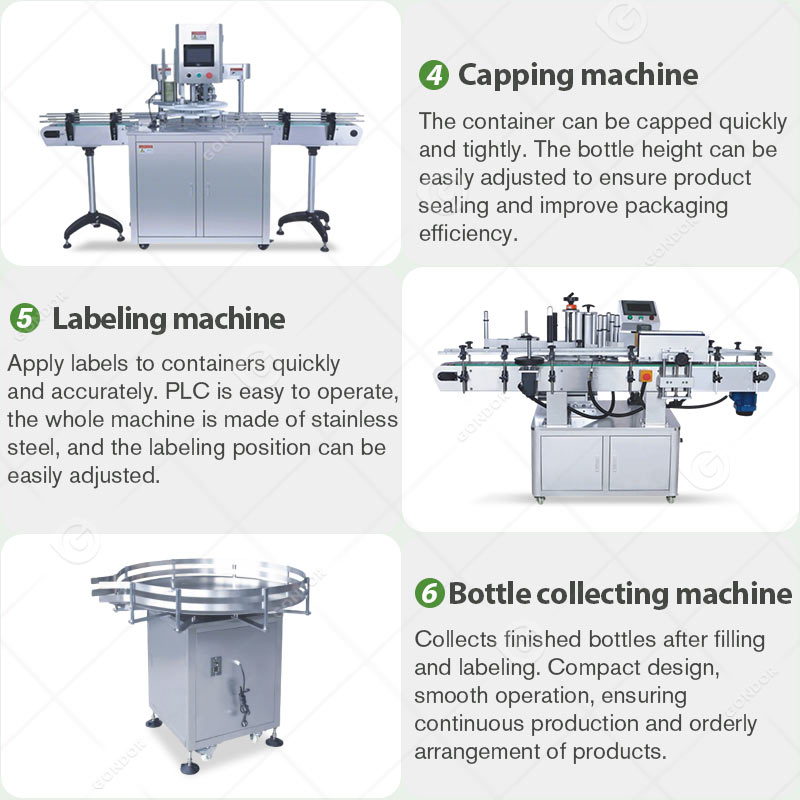
| Capping machine | AC220 V, 50/60 Hz; 800 W; 30-60 bottles/min; air 0.4-0.6 MPa; 250×75×158 cm; packed 2500×1000×1700 mm; 180 kg |
| Labeling machine | 220 V 50 Hz / 110 V 60 Hz; 1500 W; 50-80 bottles/min; ±1 mm; bottle diameter 20-120 mm; label roll inner 75 mm, outer max 300 mm; packed 2000×1000×1450 mm; 200 kg |
Working Principle of a Powder Filling Production Line
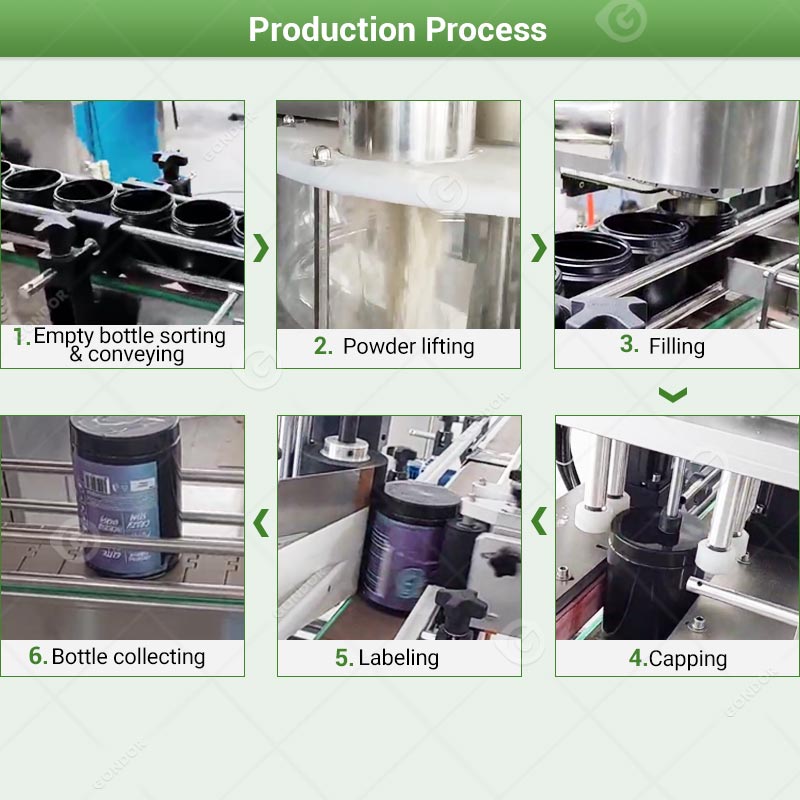
In short. Empty bottles are lined up by the unscrambler and fed onto the conveyor, while a screw elevator lifts powder in a closed tube from the floor hopper to the filler hopper. At the filling station the bottle is positioned and clamped, and a servo motor turns the metering auger a set number of revolutions to push a measured dose into the bottle. Capped and labeled next, the finished bottles are gathered at the collecting station. All stations are interlocked by the PLC, which alarms and stops on missing bottles, missing caps or a jam.
Product Performance Advantages
- Metering comes from a servo auger, not from a scoop hand. Servo control sets the auger revolutions, so every bottle is filled by parameter rather than by an operator’s judgment. Line accuracy is ±1%, and the filling station is documented at better than 0.5%. Giveaway and short-fill complaints drop accordingly.
- Format changeover is counted in minutes. Swap the auger set, call up the recipe on the touch screen, and the line runs a new fill weight. For producers juggling frequent small batches, this matters more than peak speed.
- Dust travels inside closed channels. Feeding and filling are enclosed, with a vacuum dust port on the filler. Milk powder and chili powder behave very differently in the air, and both stay where they belong.
- One person runs the line. One-button start and stop, no-bottle-no-fill, no-cap-no-run and jam alarms. After training, a single operator handles refilling and patrol inspection. A filling crew of four to six becomes one person plus a helper at shift end.
- Food grade build, quick to wash down. Product-contact parts are SUS304 with a polished finish, SUS316 series optional. Tri-clamp style joints come apart without special tools for daily cleaning.
- Buy the line, or fill the gaps you have. If a capper or labeler is already on your floor, order only the missing stations and we will re-lay the line to your space.
Station Engineering
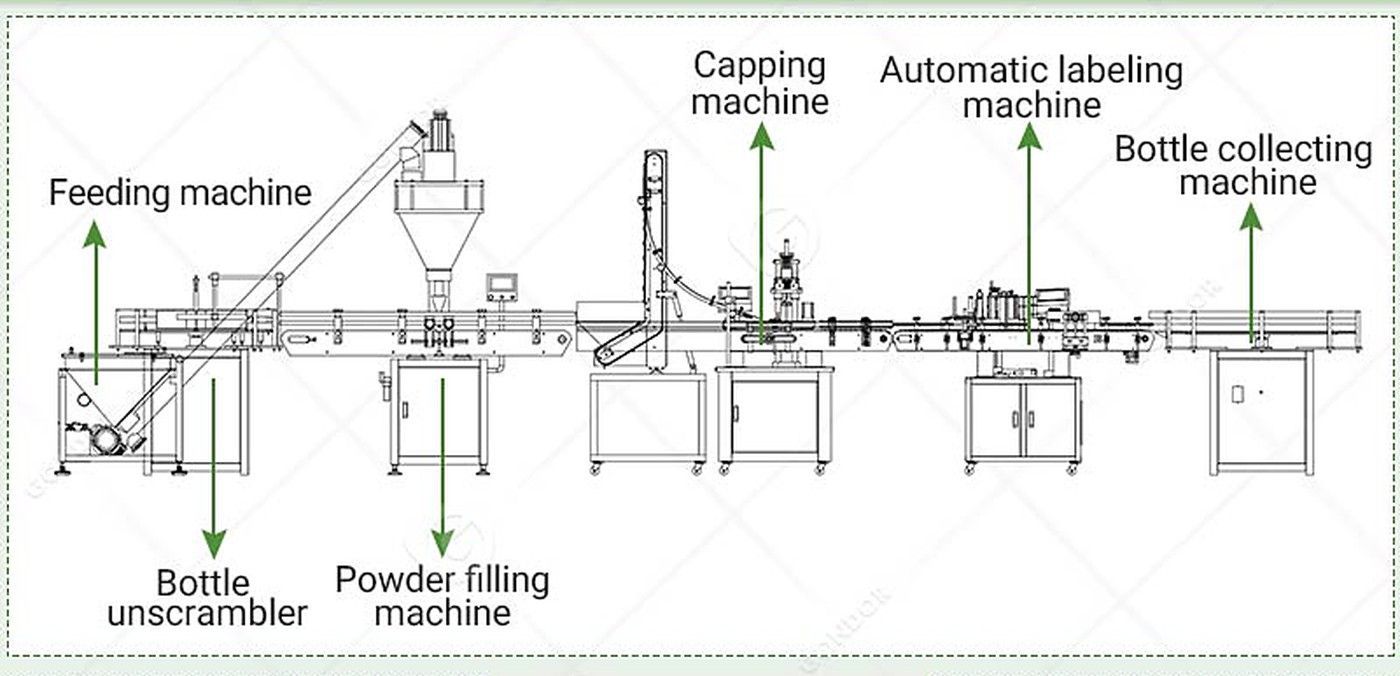
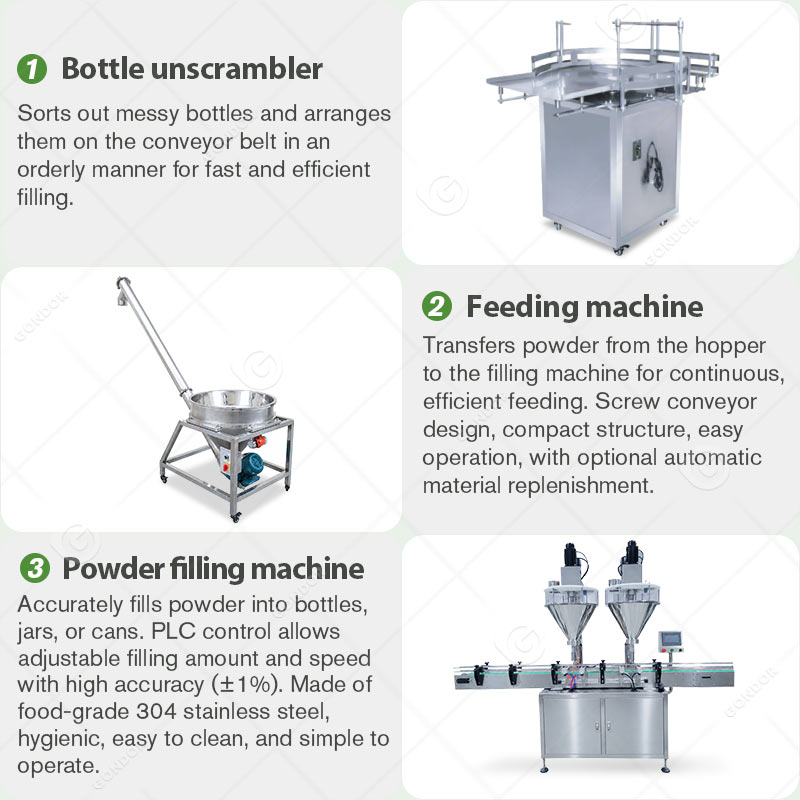
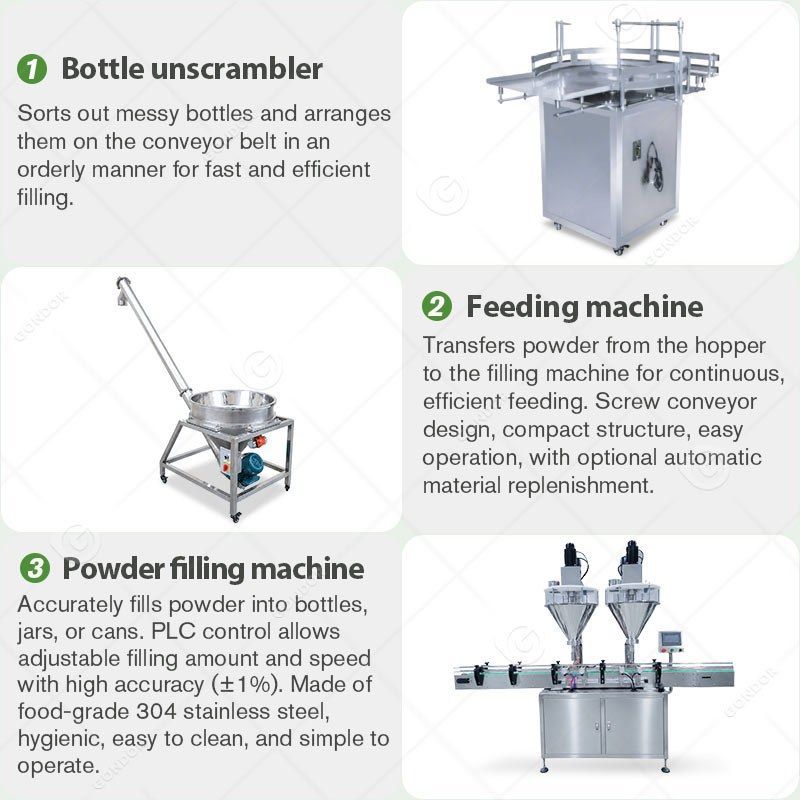
Unscrambling and collecting. An 8 to 10 m conveyor unscrambler feeds the line, and a matching collecting section gathers finished bottles. Both ends run slightly faster than the middle conveyor, which buffers surges so the filler never waits or chokes.
Screw feeding elevator. A φ141 mm auger driven by a 0.75 kW motor lifts powder about 2.4 m into the filler hopper. Closed conveying is the first defense against dust and against moisture pickup on hygroscopic powders.
Powder filling machine. The 75 L hopper covers a weighing range of 1 to 6000 g, with fill weights of 10 to 2000 g at better than 0.5% accuracy and 30 to 45 fills per minute. The filling head is where line accuracy is made or lost. Fit the auger to your main volume and keep other augers as change sets.
Capping machine. Air supply 0.4 to 0.6 MPa, 30 to 60 bottles per minute, faster than the filler so it never limits the line. Bottle height is set by a handwheel, no change parts.
Labeling machine. 50 to 80 bottles per minute at ±1 mm accuracy, handling bottle diameters of 20 to 120 mm. The labeling station keeps enough reserve speed for the filler at its limit.
Rate logic. The rated 0 to 40 bottles/min of the line is set by the slowest station, which is almost always the filler. Set the bottle, fill weight and target rate first, size the filler to match, then pick every other station faster than that.
Where a Powder Filling Production Line Is Used
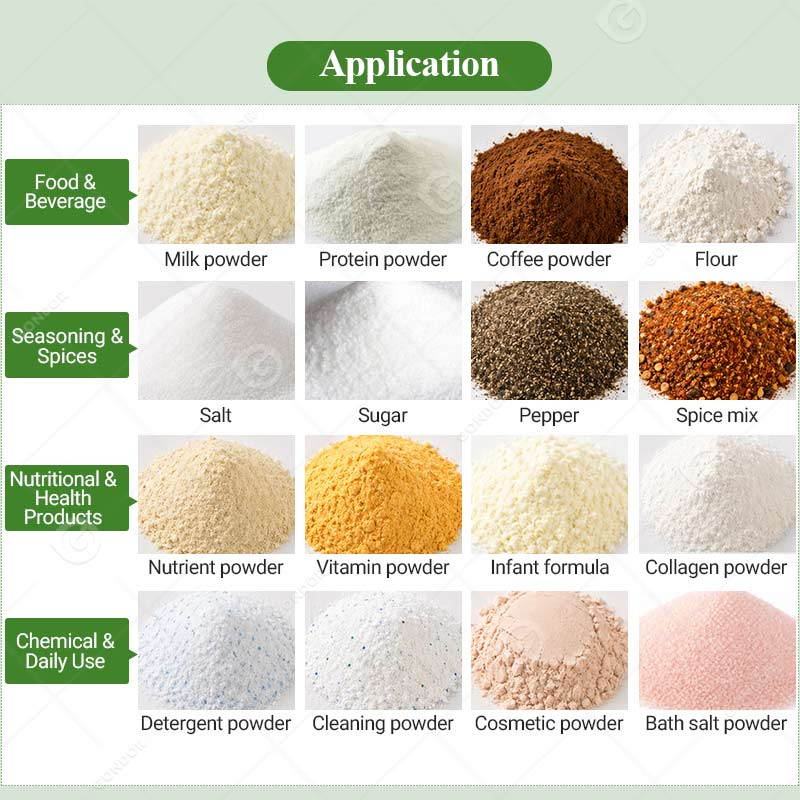
Dairy and instant drinks. Milk powder, protein powder, cocoa powder and solid drink mixes bottled on one line. Hygiene and dosing accuracy are both demanding here, and this is the line’s main battlefield.
Spices and seasoning. Pepper, chili powder, curry powder, mixed seasoning, salt and sugar. Irritating spice dust makes enclosed conveying and dust extraction worth their cost many times over.
Bakery and food ingredients. Flour, bakery premix, starch and gelatin powder. Wide fill-weight spreads suit producers who cover multiple formats by changing augers.
Household and personal care. Laundry detergent, cleaning powder, bath salt and loose cosmetic powders. SUS316 series contact parts are available where formulas corrode.
Industrial fine powders. Pigments and additive powders outside the food category can be handled with customization toward dust-tight or explosion-proof requirements; state the material properties when inquiring.
Choosing the Right Powder Filling Production Line
Do four calculations before fixing the configuration.
- Bottle and fill weight. Write down the diameter, height and target grams of your main format. Fill weight decides the auger set, and the bottle decides the compatibility range of the unscrambler, capper and labeler.
- Daily output. Convert to bottles per minute over your shift pattern. At 40 bottles/min, one 8-hour shift fills about 19,000 bottles. A two-shift plan can still start as a single-shift configuration, since the filler leaves room to speed up.
- Material behavior. Hygroscopic powders such as milk powder, dusty ones such as chili powder and caking-prone ones such as some protein powders must be declared, because enclosed feeding, hopper agitation and dust extraction are configured per material.
- Existing equipment. If a capper or labeler is already running, send its parameters and we will quote only the missing stations.
Limits worth stating plainly. The rated 0 to 40 bottles/min is a ceiling, not a guarantee. Actual output depends on fill weight, powder flowability and neck diameter, and heavy fills run slower. Auger metering suits free-flowing fine powders; materials with poor flow or fiber content need a filling trial first. The line is built for rigid bottles, jars and cans, and irregular soft pouches are outside the standard configuration.
Customization, Commercial Terms and After-Sales
Customization. OEM and ODM are both accepted. Filling nozzles, hopper capacity and conveyor length are customized to the bottle and the workshop layout. Product-contact material can be SUS304, SUS316, SUS316L or aluminum alloy. Vacuum dust extraction and nitrogen purging are available as options. MOQ is one line, and custom nozzles, hopper size or conveyor length are quoted with the offer.
Commercial terms. MOQ is one line. Standard lead time is 7 to 15 days (7 days for one set, 15 days for up to ten sets, subject to production scheduling). Export packing is a waterproof membrane inside a plywood case. Trade terms are FOB, CIF or DAP as agreed.
Inspection and after-sales. Pre-shipment video inspection and a mechanical test report are provided. Core components carry a one-year warranty with lifetime technical support. Faults are diagnosed remotely first, and an engineer is dispatched when the issue cannot be settled remotely. Augers, nozzles and belts are quoted with the line so a first spare set ships in the same case.
Powder Filling Production Line Questions Buyers Ask
1. Which powders can this line handle?
Milk powder, protein powder, coffee powder, cocoa powder, flour, starch, spice powder, seasoning powder, icing sugar, salt, plus laundry detergent and cleaning powder. Flowability affects the real speed, so a filling trial with your sample is recommended.
2. Is accuracy ±1% or 0.5%?
±1% is the published line-level figure. The filling station is documented at better than 0.5% under stable feeding with the right auger set. Trial data on your material settles the question for your line.
3. How long does a format changeover take?
Swap the auger set and call up the recipe on the touch screen. A practiced operator finishes in minutes; retuning the capper and labeler for a new bottle adds a little more.
4. Which containers are supported?
Bottles, jars and cans in plastic, metal and glass. The labeler handles bottle diameters of 20 to 120 mm as standard, beyond which customization is needed.
5. How dusty is the operation?
Feeding and filling are enclosed, and the filler carries a vacuum dust port. Workshop dust level depends on the material and the extraction setup, and we recommend the dust system for powders like chili.
6. How many operators does the line need?
One for normal production, covering refilling, patrol and collection. Cleaning at shift end goes faster with two.
7. What site conditions are required?
Power at 220 V or 380 V, plus an air compressor at 0.4 to 0.6 MPa for the capping station. The line needs about 6500×1500 mm of floor and 2200 mm of headroom.
8. Can I buy individual stations only?
Yes. All six stations are sold separately, and the missing ones can be added around your existing machines.
9. How are warranty and after-sales arranged?
Core components carry a one-year warranty with lifetime technical support. Faults are diagnosed remotely first, and an engineer is sent when remote diagnosis is not enough. Pre-shipment video inspection and a mechanical test report are included.
What Happens Next With a Powder Filling Line Enquiry
Send over the bottle type, fill weight and daily output, and we will return a line configuration with a quotation. For powder materials, a sample filling trial is the fastest way to settle accuracy questions: we mail back the filled samples and the trial data before you commit to a configuration.
Contact
Henan Gondor Machine Co., Ltd. Website inquiry form, WhatsApp or email. Replies within 24 hours on working days.
Related Equipment
- Powder Filling Machine — the filling station on its own, when the capper and labeler already exist
- Counting Bottling Line — for products counted by the piece instead of weighed
- Liquid Filling Production Line — the same layout for liquids, 10 to 1000 ml
- Complete Water Bottling Line — treatment, blowing and filling from 3,000 bottles an hour
Get Powder Filling Production Line Pricing
Send us the daily volume, the product and the container or pack format you are working with, and we will come back with a model recommendation, a utility list and a price.





