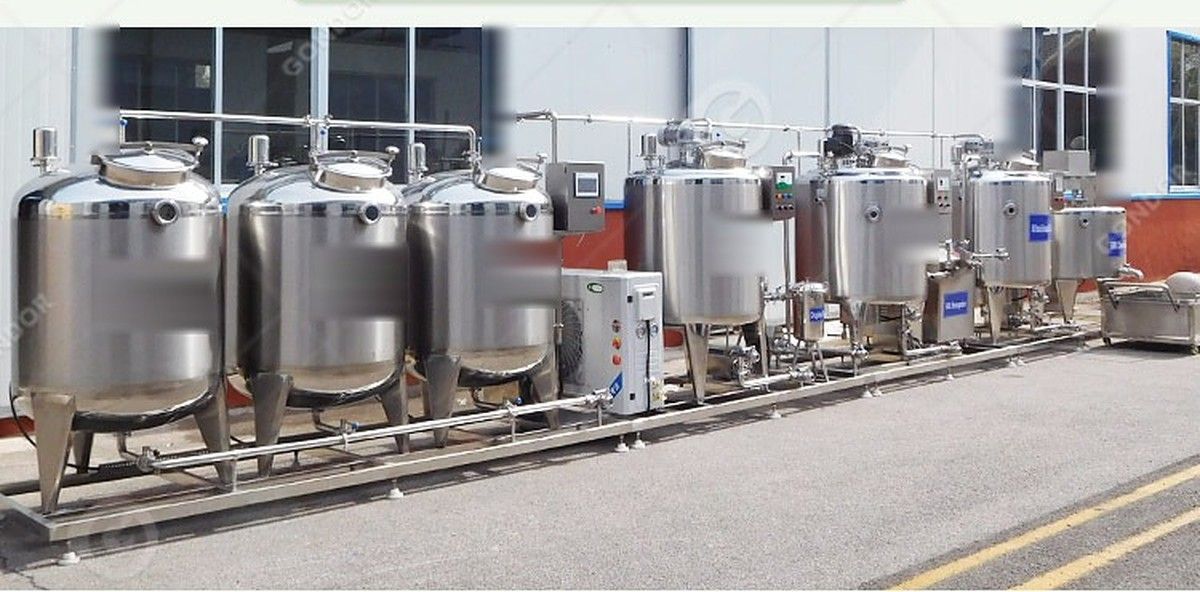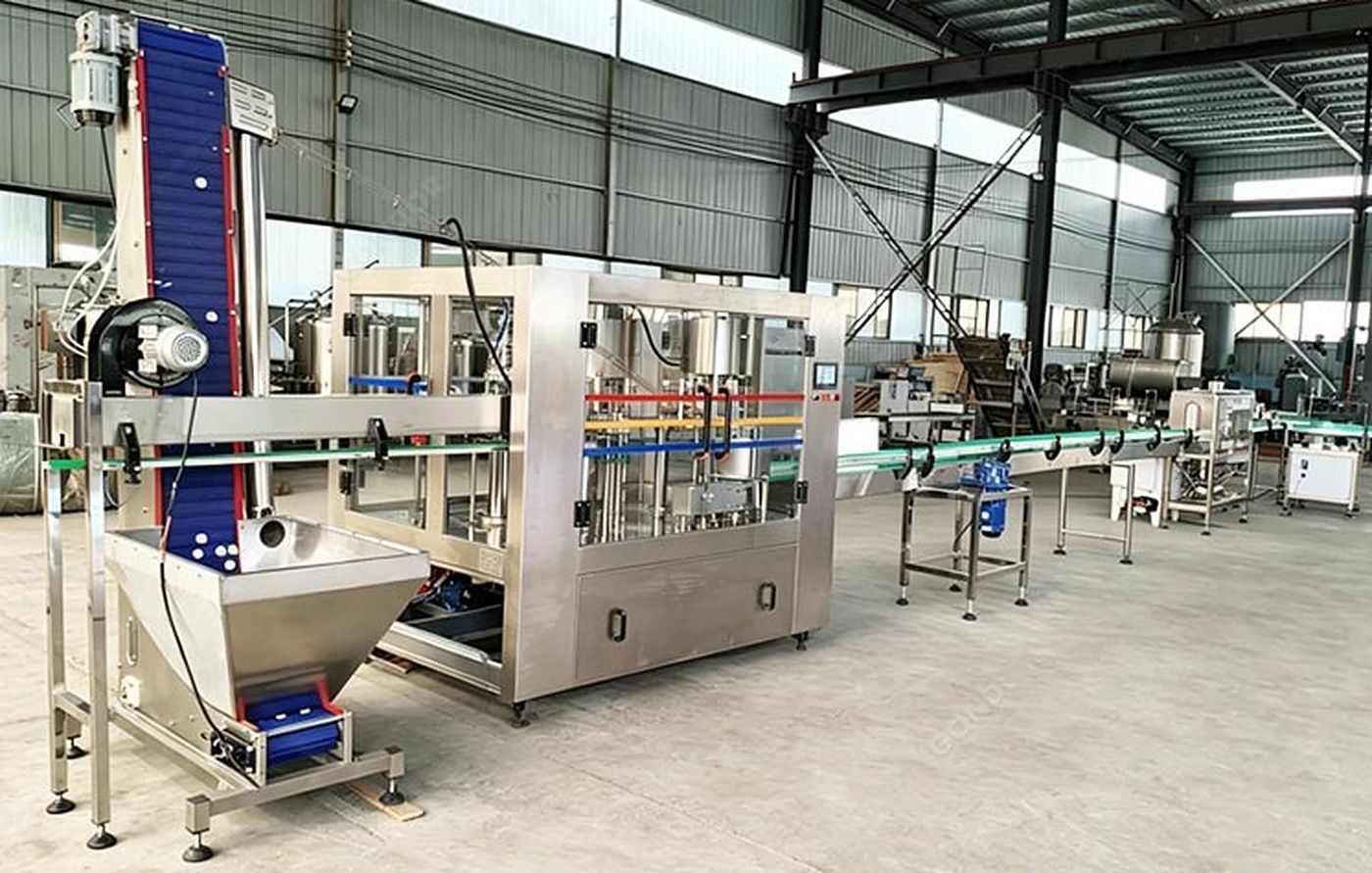


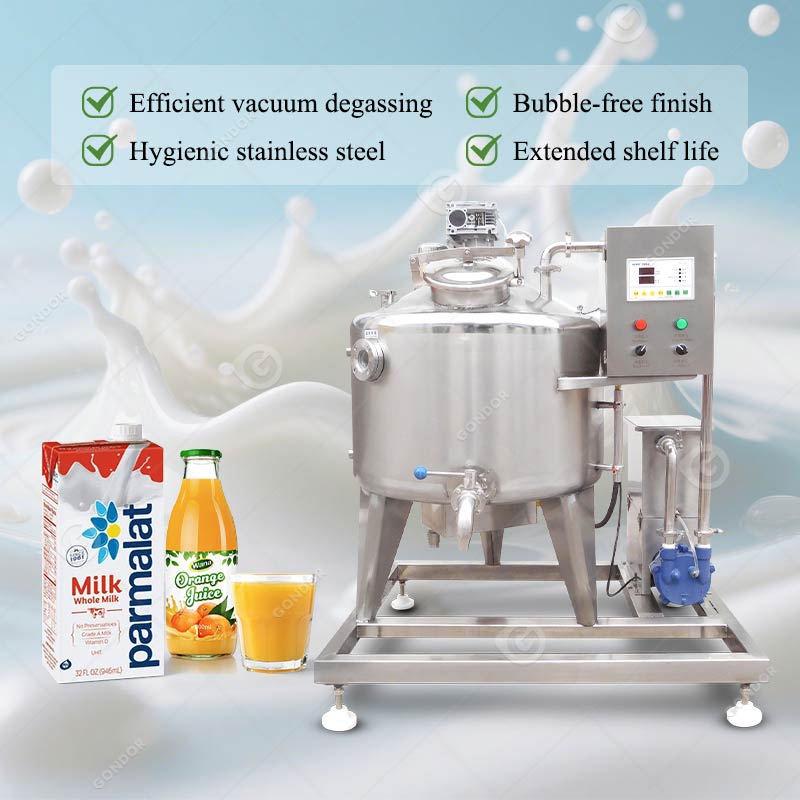
Continuous vacuum deaeration at 500-1500 L/h and -0.07 to -0.08 MPa, so filling runs without foam and the product keeps its colour on the shelf.
Dissolved Air Shortens Shelf Life, and a Vacuum Degasser Is the Fix
Filling halls fear two defects above all: a ring of foam on the fill level, and product that turns dull in color and flat in flavor after some weeks in storage. Both often trace back to the same root cause. Material leaving the homogenizer carries a heavy load of dissolved air and oxygen. Homogenization is a high-pressure process, and liquid under violent shear takes gas in. Left untreated, that gas foams at filling and oxidizes in storage.
A vacuum degasser is the deaeration step between homogenizing and filling. It builds a vacuum of -0.07 to -0.08 MPa inside the tank, disperses the material as a thin film or fine mist, and lets dissolved oxygen and trapped bubbles come out of solution fast, then pulls them away with the vacuum system. Oxygen content drops sharply, color, flavor and nutrients stay protected, and foam at filling shrinks.
The most practical trait of this machine is continuous duty. Instead of vacuuming one vessel at a time, material self-primes into the tank and discharges continuously while vacuum and inlet-outlet balance hold, so it drops straight onto a production line. Three capacity ratings cover 500, 1000 and 1500 L/h. Product-contact parts are 304 stainless steel, and the mid-to-late sections of juice, dairy and plant protein beverage plants all accept it.
Vacuum Degasser Models, Flow Rates and Vacuum Levels
Three-model comparison (per the official parameter table)
| Item | GD-500L/H | GD-1000L/H | GD-1500L/H |
|---|---|---|---|
| Capacity | 500 L/h | 1000 L/h | 1500 L/h |
| Circulation pump power | 2.2 kW | 0.75 kW | 3 kW |
| Vacuum pump power | 2.35 kW | 2.35 kW | 2.37 kW |
| Voltage | 380 V | 380 V | 380 V |
| Material | 304 stainless steel | 304 stainless steel | 304 stainless steel |
General parameters
| Item | Specification |
|---|---|
| Series model | GD-VDMM |
| Working vacuum | -0.07 to -0.08 MPa |
| Total power | 5.37 kW (single figure in the attribute sheet) |
| Voltage | 380 V (220 V or customized per order) |
| Sheet thickness | 2.5 mm |
| Machine weight | 150 kg (single figure in the attribute sheet, not split by model) |
| Dimensions | 1100×900×1450 mm (single figure in the attribute sheet, not split by model) |
| Pre-shipment inspection | Video inspection, mechanical test report |
| OEM | Supported |
Note: the official parameter table does not list weight and dimensions per model; the two rows above use the single figures from the attribute sheet, and per-model values are confirmed against your sample and pack format.
How a Vacuum Degasser Pulls Air Out of the Product
In short. The vacuum pump pulls the tank to working vacuum first. Material self-primes into the tank under negative pressure, disperses into a thin film or fine mist through the spray pipe, and dissolved gas and bubbles come out of solution and rise, drawn off continuously by the vacuum system. Deaerated material is pumped out continuously to the next stage. Holding vacuum and inlet-outlet balance keeps the unit in continuous operation.
Product Performance Advantages
- Continuous in and out, degassing without stops. Self-priming feed with automatic level control runs continuously under constant vacuum and drops straight onto a line. There is no vacuum-hold-discharge cycle as with batch tanks, and capacity utilization rises by a clear margin.
- One vacuum step for oxygen, bubbles and odor. Material spreads into a film under negative pressure, and dissolved oxygen, trapped bubbles and odor compounds come out together. Filling foam and storage oxidation risk fall at the same time.
- A clear working vacuum figure. The published band is -0.07 to -0.08 MPa, read directly off the gauge, reproducible batch after batch, with little quality variation between runs.
- 304 stainless product-contact parts, food-grade rubber optional. Corrosion resistant and easy to clean, meeting food-contact hygiene requirements; the 2.5 mm tank sheet carries pressure with margin.
- Compact structure that slides into a line. Tank, vacuum pump and circulation pump in one layout, with flange or clamp connections to the homogenizer upstream and the filler downstream. Retrofits fit too.
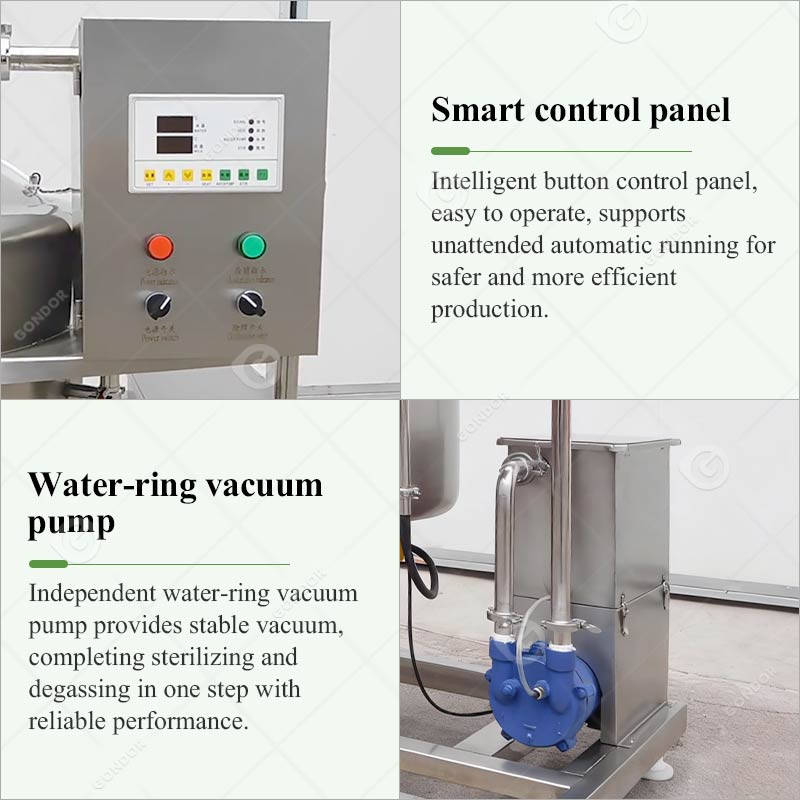
- Sight manhole plus smart push-button panel, status at a glance. The sight glass shows level and deaeration state at any time, and the panel supports automatic running for unattended shifts.
Engineering Design
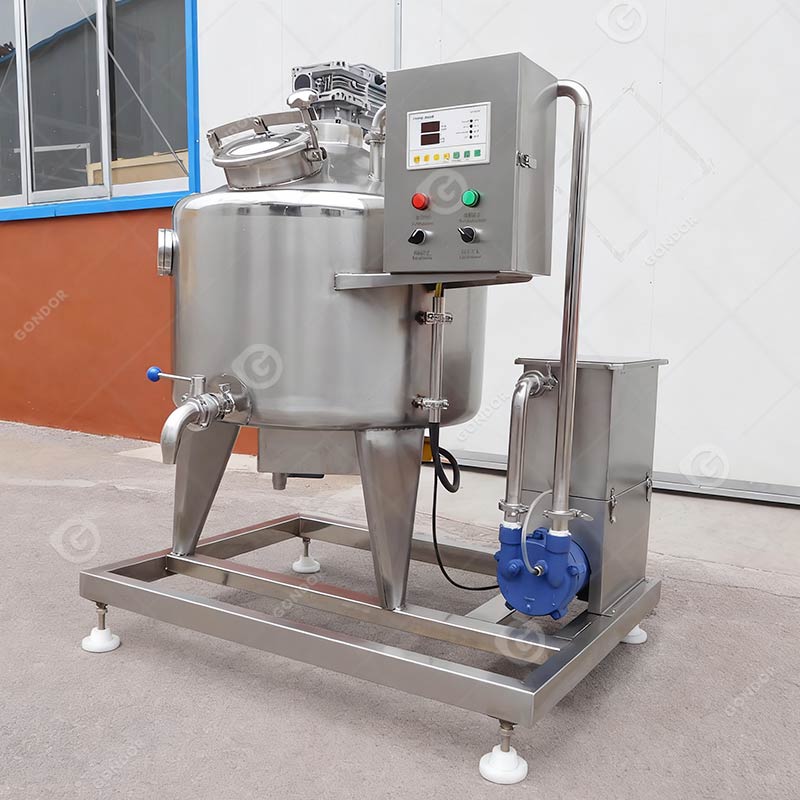
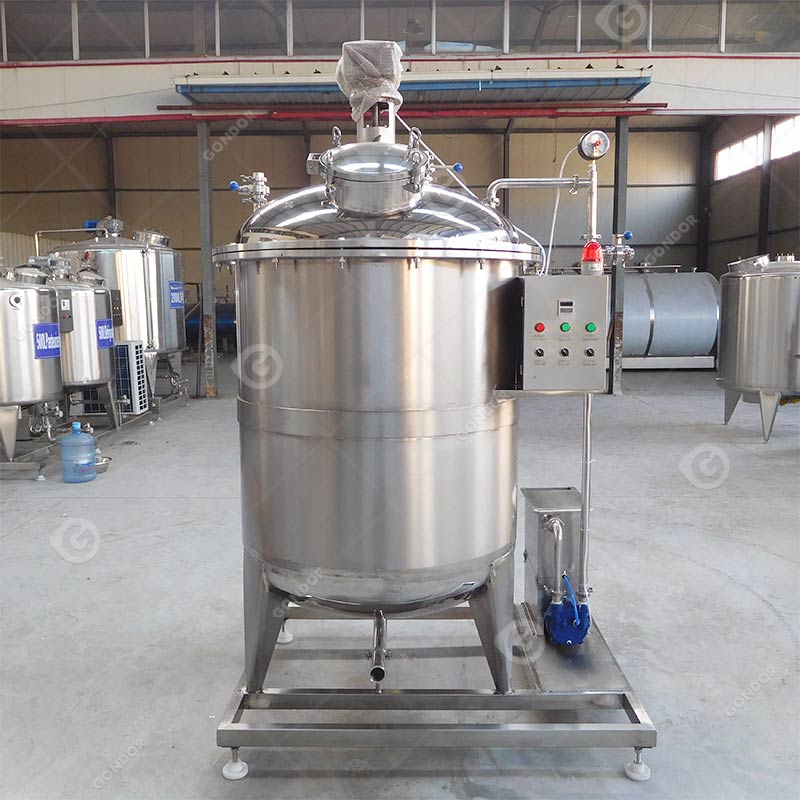
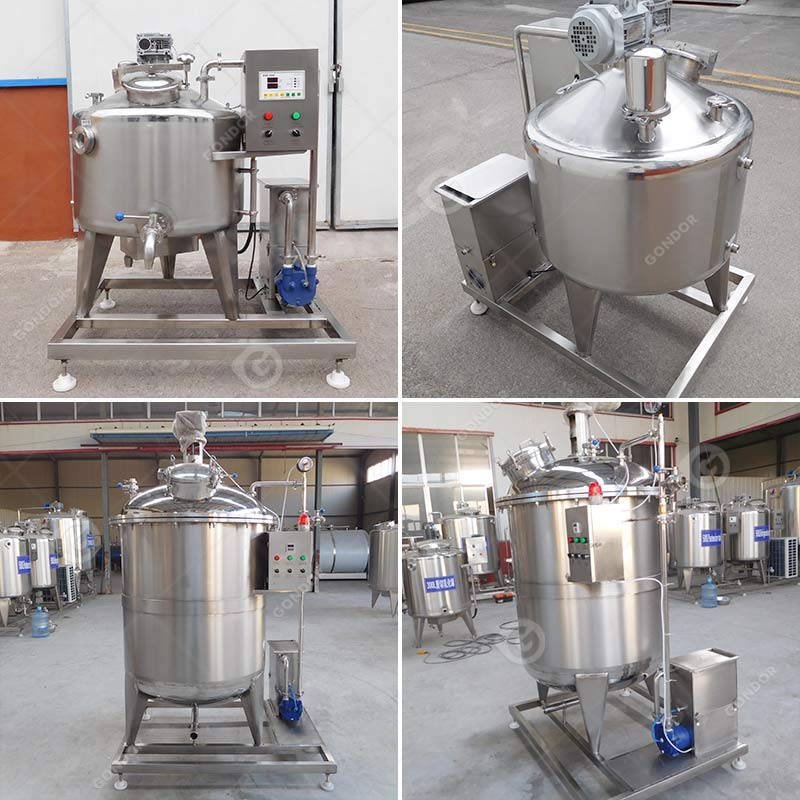
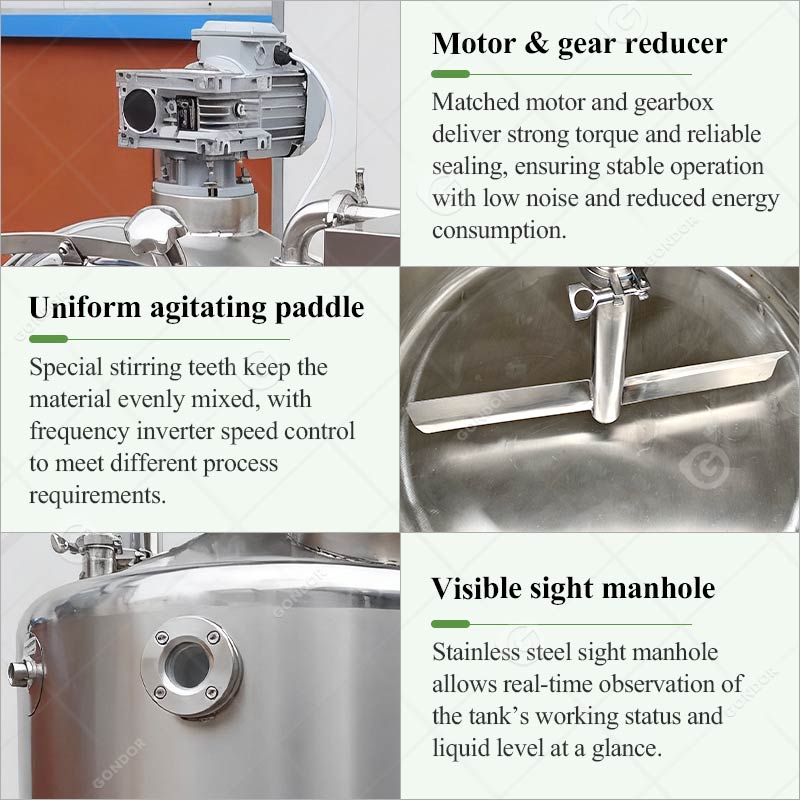
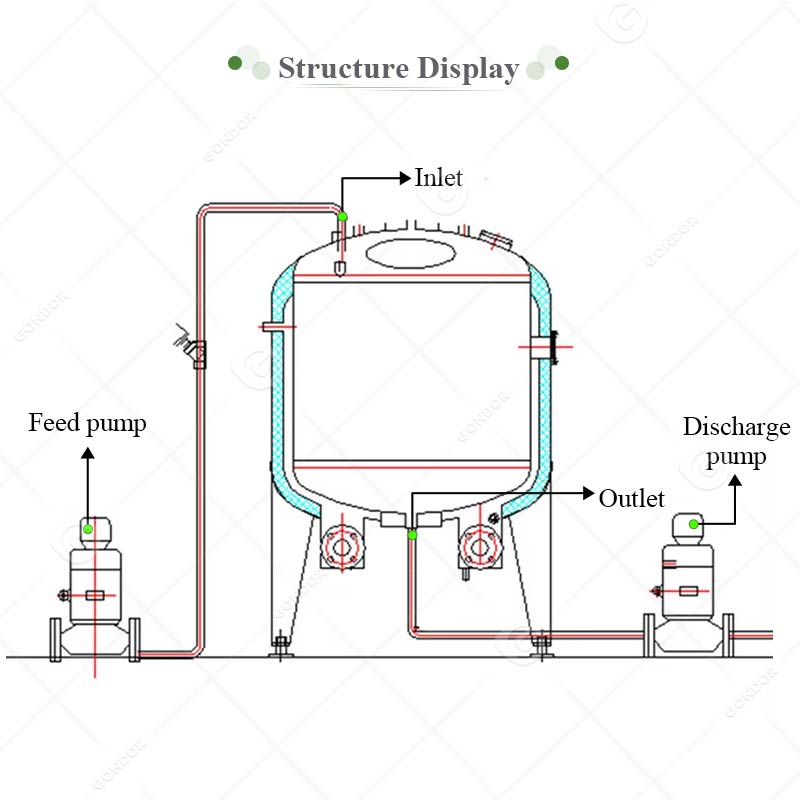
Tank. Barrel body with a top cover, 2.5 mm 304 stainless sheet, and a pressure manhole with sight glass for watching internal state and level. Product-contact parts are stainless steel, with food-grade rubber available as an option.
Vacuum system. An independent water-ring vacuum pump builds working vacuum, running smoothly and quietly on a water loop. The vacuum gauge sits on the operating panel for a one-glance check.
Feed, discharge and dispersion. The inlet carries a check valve and a spray pipe; material self-primes and spreads into a film at the pipe. The control valve throttles feed by level. At the outlet, the circulation pump discharges with inverter speed control, and the agitating teeth keep tank contents uniform against local level differences.
Electrical control. A smart push-button panel interlocks the vacuum pump, circulation pump and valves, and supports automatic running. The motor pairs with a gear reducer for torque, with reliable sealing and steady rotation.
Structure breakdown
| No. | Part | Function |
|---|---|---|
| 1 | Tank body | 304 stainless steel, 2.5 mm sheet, main deaeration chamber |
| 2 | Top cover | Pressure manhole and sight glass for internal monitoring |
| 3 | Check valve | Prevents backflow on the feed line |
| 4 | Spray pipe | Disperses material into film or mist for deaeration efficiency |
| 5 | Control valve | Automatic feed control by level |
| 6 | Water-ring vacuum pump | Builds and holds working vacuum |
| 7 | Circulation pump | Continuous discharge of deaerated liquid, inverter controlled |
| 8 | Control panel | Push-button operation, automatic running, vacuum gauge |
Operating Procedure
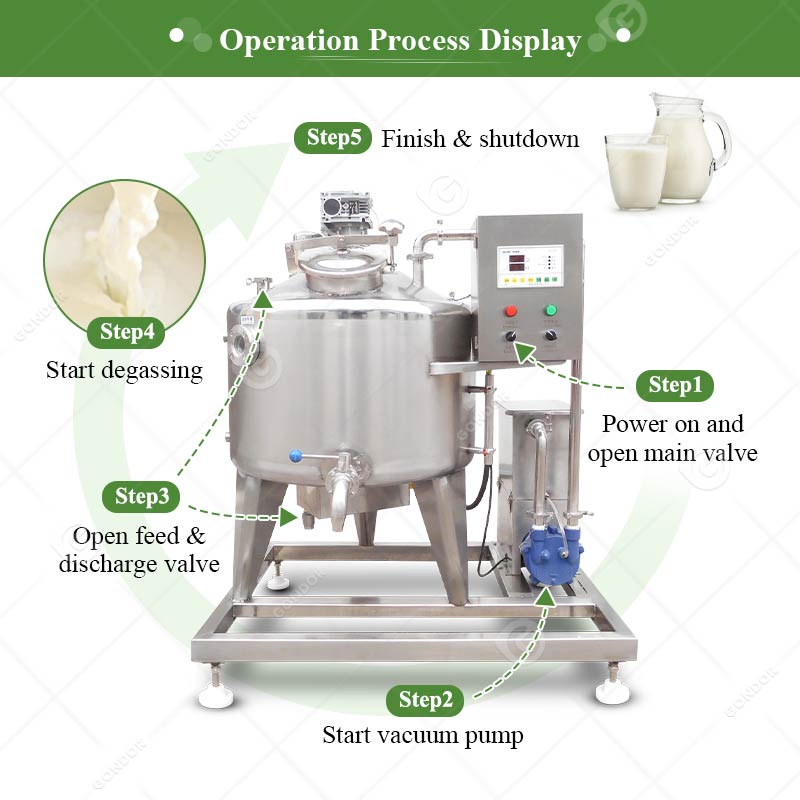
- Pre-start check. Confirm the control box wiring and that all line valves are in their normal positions.
- Cooling water on. Open the vacuum pump cooling water inlet valve and the discharge pump cooling water inlet valve.
- Vacuum build-up. Switch on the sight lamp, start the vacuum pump, and wait for -0.07 to -0.08 MPa.
- Feed and degas. Open the feed valve; material self-primes into the tank and the control valve throttles automatically as the level reaches the sight glass. Watch the deaeration state through the glass.
- Continuous discharge. Start the discharge pump and send deaerated liquid onward; holding vacuum and inlet-outlet balance keeps continuous production.
- Shutdown. Stop feeding, empty the tank, stop the vacuum pump and discharge pump, close the cooling water, and clean tank and lines per shift.
Where a Vacuum Degasser Is Used in Dairy and Beverage Lines
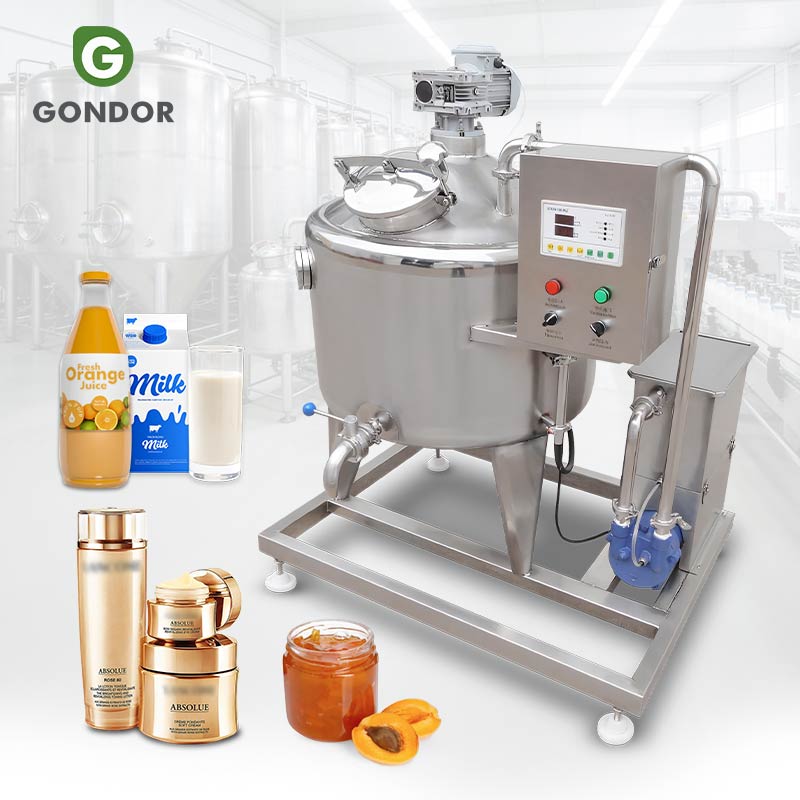
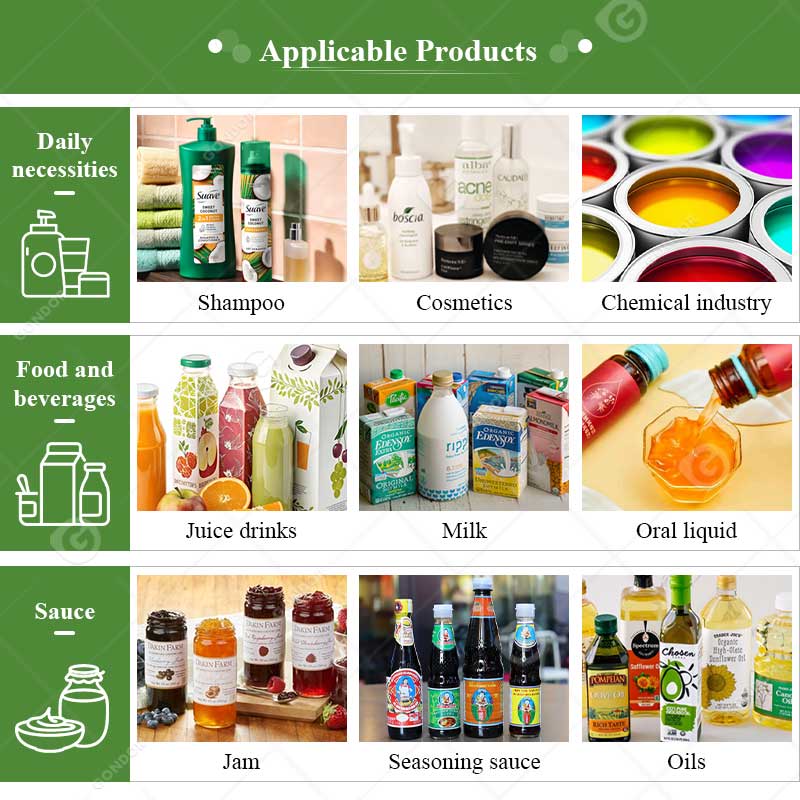
Juice and pulpy beverages. Homogenized fruit and vegetable juice carries high dissolved oxygen and is a hot spot for oxidative browning. Deaerated juice holds brighter color and cleaner flavor, with less foam at filling. It is standard equipment on juice lines.
Dairy and goat milk drinks. Deaeration for milk, formulated milk and yogurt base, easing storage oxidation. Part of the odor compounds in goat milk drinks leaves with the vacuum, and the flavor reads cleaner.
Soy milk and plant protein beverages. Soy milk, peanut milk and almond drink foam heavily, and foam running wild at the filler usually starts here. The degassing step handles foam at the source.
Jam, sauce and liquid foods. Liquid or semi-liquid foods that need de-bubbling and deoxygenation before filling also fit the same station after homogenizing.
Central kitchens, small and mid-size plants, and pilot lines. Three ratings cover everything from small plants to line duty, and on pilot lines running shelf-life verification, the difference between degassed and non-degassed control groups is hard to miss.
Customization
Capacity is selected from three ratings of 500 to 1500 L/h; capacities outside the range and voltage configuration (220 V / 380 V / others) are reviewed per order. Inlet and outlet positions and piping connection forms follow the line layout. Tooling lead time and minimum order quantity: quoted with the offer.
Quality Inspection and After-Sales
Pre-shipment video inspection and a mechanical test report are provided. The source data states no separate warranty term, so warranty coverage follows the quotation document (quoted with the offer). Core components (PLC, pumps, degassing tank) receive online technical support; faults are diagnosed remotely first, with on-site service arranged when needed. Vacuum pump and circulation pump seals are inspected by duty intensity, and common parts are worth covering in the first order.
Choosing the Right Vacuum Degasser for Your Flow Rate
- Size the rating from line flow. Three ratings of 500 / 1000 / 1500 L/h. Take a rated flow slightly above the actual homogenizer output, leaving 10% to 20% headroom so material does not back up in the buffer section.
- Judge necessity by foaming tendency. Heavy foamers such as juice and soy milk take degassing as standard equipment; low-gas materials can be evaluated and possibly skip the step.
- Check connections against the installation spot. Homogenizer or mixing tank upstream, sterilizer or filler downstream. Confirm inlet and outlet positions and line sizes before ordering to keep field rework small.
- Confirm automatic running against shift patterns. Unattended shifts rely on automatic level control and automatic running; state your operating pattern at selection.
Vacuum Degasser Questions Buyers Ask Before Ordering
1. What does the degasser actually remove?
Mainly entrapped air, dissolved oxygen, bubbles and part of the odor compounds. Deoxygenation slows storage browning, de-bubbling settles filling foam, and de-odorizing pays off most on flavor-sensitive drinks such as juice and goat milk beverages.
2. What is the working vacuum?
The published band is -0.07 to -0.08 MPa. Deaeration efficiency drops clearly once vacuum falls below the process requirement, so this is the reading to patrol daily.
3. Is it batch only?
No. Self-priming feed with automatic level control runs continuously as long as vacuum and inlet-outlet balance hold, so it works on a line; it can also run batch-wise when the process asks for it.
4. How do I choose among the three ratings?
By hourly line flow. Rated flow 10% to 20% above the upstream actual flow is the comfortable fit. Pilot lines take the 500 L/h rating; volume lines go with 1000 or 1500 L/h.
5. Can it connect into a production line?
Yes. A typical juice line runs juicing, filtration, blending, high-pressure homogenizing, vacuum degassing, pasteurizing and filling. This unit takes the homogenizer or blending tank upstream and the sterilizer or filler downstream, with connection positions configurable to the layout.
6. Do fruit pulp particles affect degassing?
Fine pulp travels with the liquid phase without trouble. Large solids interfere with spray dispersion and level control, so upstream particle size needs controlling first.
7. Does this machine sterilize?
No. Degassing is a deoxygenation and de-bubbling step. Sterilization belongs to the pasteurizer or tubular sterilizer. Degassing sits after homogenizing and before sterilizing; the two duties differ.
8. What information do you need for model selection?
Product type, hourly capacity, material viscosity, upstream and downstream equipment connections, and local voltage. With these five items, engineering can return a model and piping proposal.
What Happens Next After a Vacuum Degasser Enquiry
Send over your product type, hourly capacity and upstream and downstream configuration, and we will match a rating and propose the interface plan. To verify degassing results, send a sample for a trial run and compare dissolved oxygen and filling foam before and after.
Contact
Henan Gondor Machine Co., Ltd. Website inquiry form, WhatsApp or email. Replies within 24 hours on working days.
Related Equipment
- Liquid Filling Machine — fills degassed product without generating the foam that a filler alone cannot avoid.
- Mixing Tank — sits upstream and is where most of the air enters the product in the first place.
Get Vacuum Degasser Pricing and Delivery Details
Send us the daily volume, the product and the container or pack format you are working with, and we will come back with a model recommendation, a utility list and a price.