

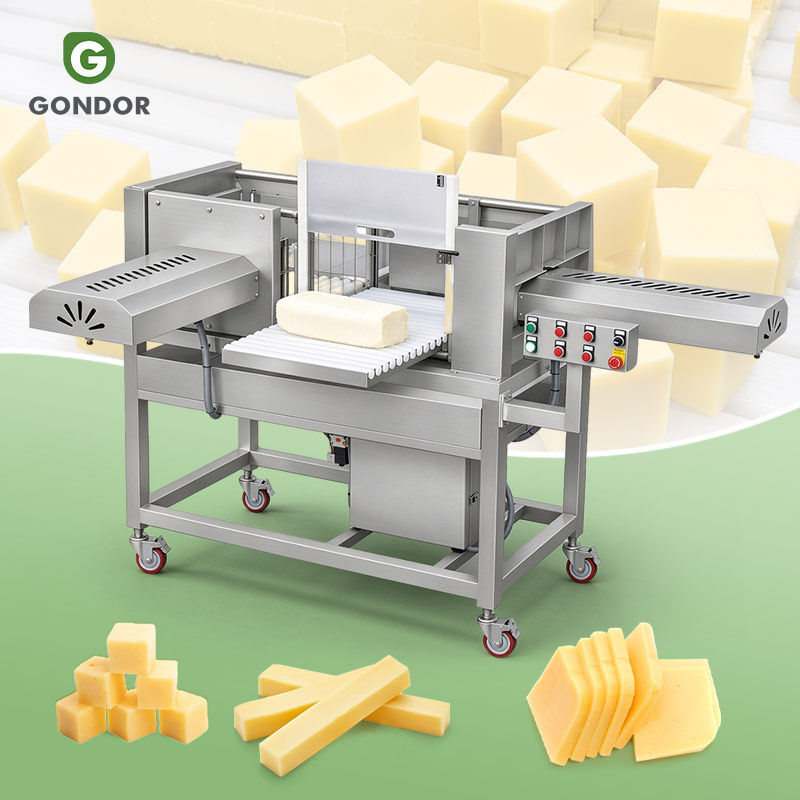
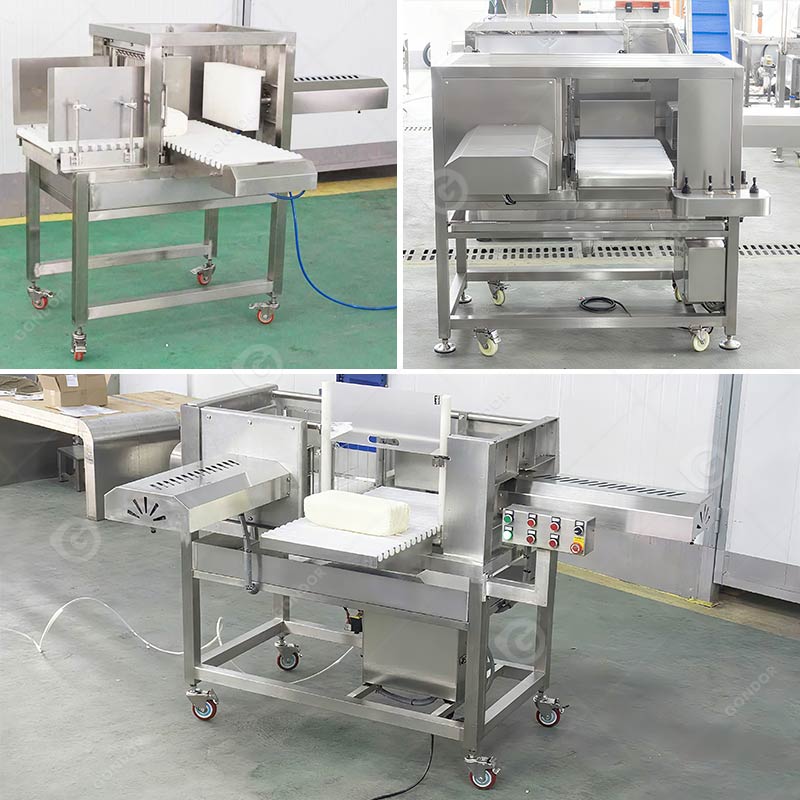
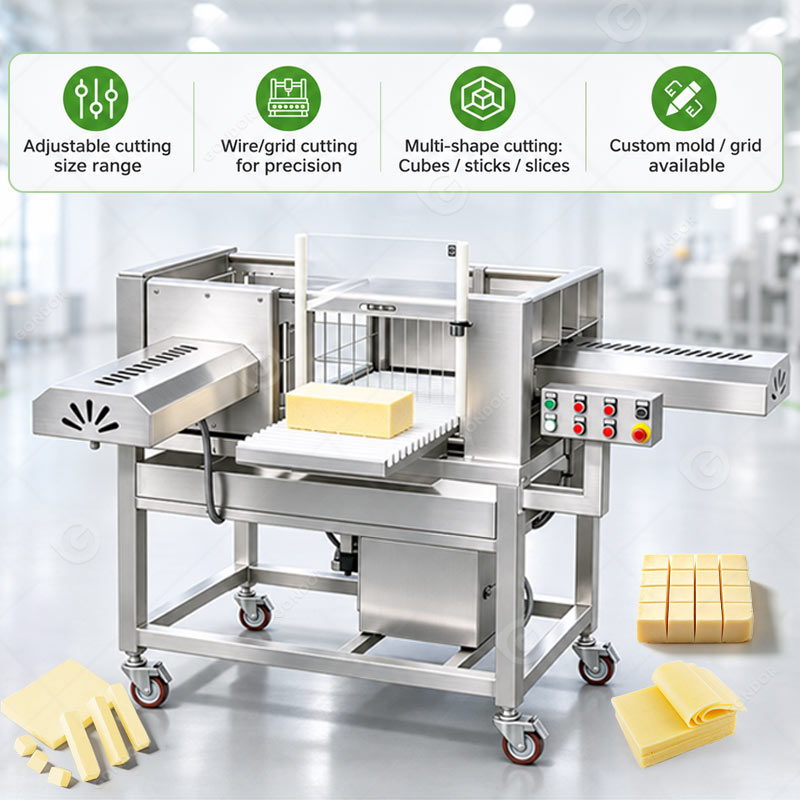
Wire-grid cutting that forms cubes or strips in a single pass on one or two lanes, removing the crumbs and hidden give-away of hand cutting.
What a Cheese Cutting Machine Covers: Blocks, Bars and Portions
In a cheese portioning workshop, hand dicing is the least visible and most expensive step on the floor. Give a skilled worker a block of hard cheese and the cubes still come out uneven; work with a brittle variety and the knife pressure alone chips the corners. Crumbs end up mixed into the finished goods, and the real loss only shows up at the weighing and packing table. A plant handling several hundred kilograms of cheese blocks a day typically ties up two or three people on this one job, with output that rises and falls with each worker’s condition.
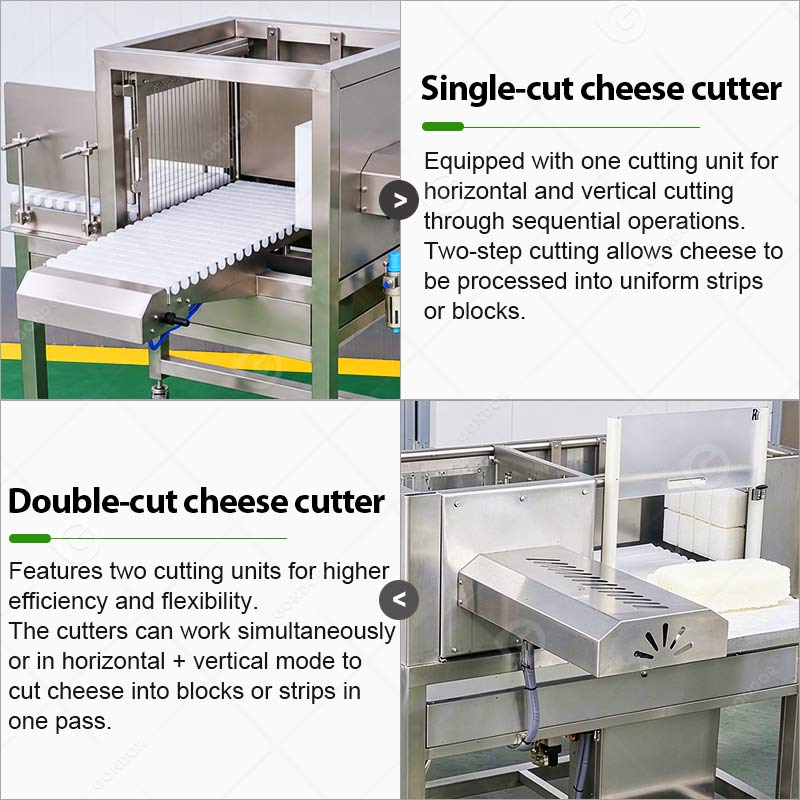
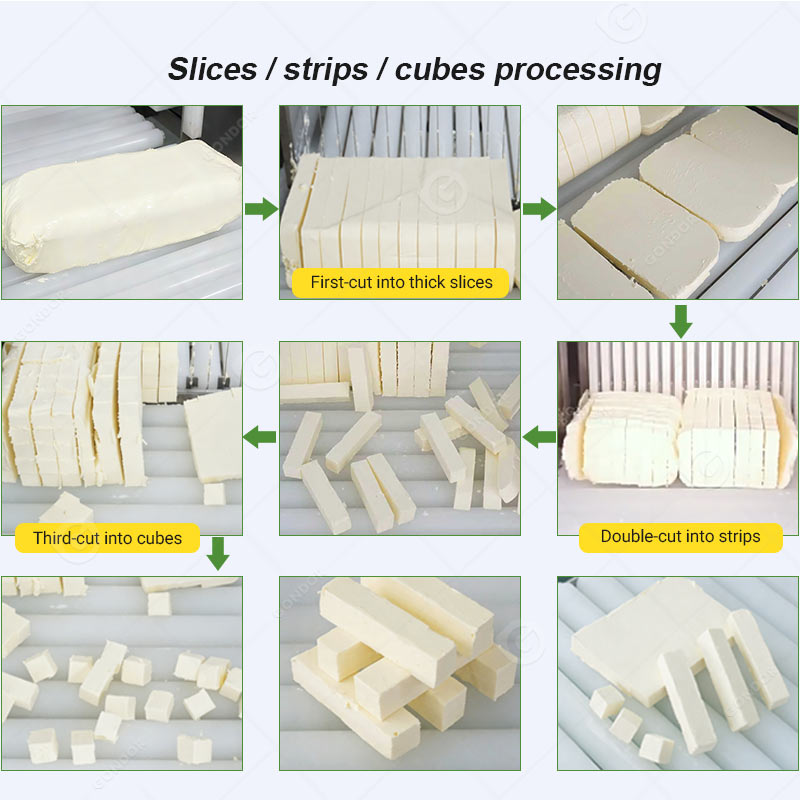
The cheese cutting machine replaces that manual step. A whole cheese block goes in at the feed end, wire or grid cutting tools portion it at a set spacing, and uniform cubes, sticks or slices drop out at the discharge. Two configurations exist, single channel and dual channel. Cutting size, grid spacing and belt width are all built to the product. Swap the mold set and you swap the SKU, from cheddar cubes to mozzarella sticks, without touching the main unit.
Cheese Cutting Machine Model Range and Cutting Ratings
Two-model comparison (per the official parameter table)
| Item | GD-SCCM-Ⅰ (single channel) | GD-SCCM-Ⅱ (dual channel) |
|---|---|---|
| Configuration | Single channel, single cutting unit | Dual channel, dual cutting units |
| Dimensions | 1620×1130×1290 mm | 2000×1630×1230 mm |
| Power | 7 kW | 7.5 kW |
| Voltage | 220 V | 220 V |
| Air supply | 0.3-0.8 MPa | 0.3-0.8 MPa |
| Cutting mode | Two-pass forming (horizontal + vertical) | One-pass forming (dual tools together) |
| Cut shapes | Cubes, sticks, slices | Cubes, sticks, slices |
| Cutting size | Built to mold | Built to mold |
General parameters
| Item | Specification |
|---|---|
| Series code | GD-SCCM |
| Weight | 180 kg |
| Voltage options | 110 V / 220 V / 380 V (per model and order) |
| Product-contact material | Food-grade stainless steel |
| Control | PLC touch screen |
| Applicable materials | Cheese, butter, tofu, nougat bricks, etc. |
| Certification | ISO 9001, ISO 14001, ISO 45001, CE, BSCI, ETL |
| OEM / ODM | Accepted |
Note: the dual-channel unit weight and the wiring details of customized voltages are not given in the official material. Confirm with engineering before ordering.
How a Cheese Cutting Machine Is Built to Work
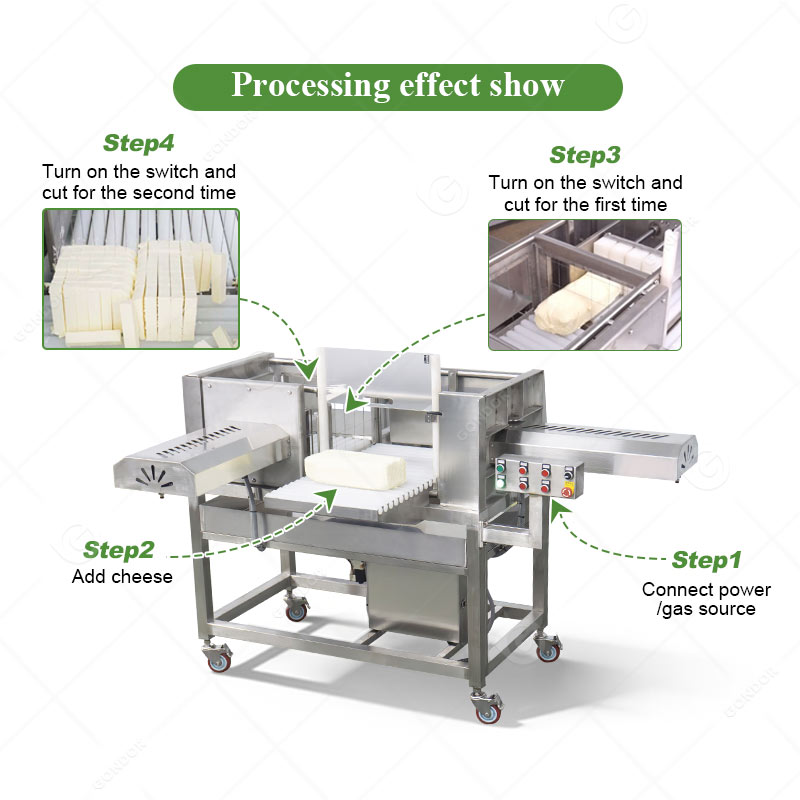
In short. The working cycle has four steps: an operator places the cheese block at the infeed, a non-stick conveyor carries it into the cutting zone, wire or grid cutting tools form the portions, and the finished pieces fall through the discharge chute into a collection frame. The single-channel model carries one cutting unit and needs two passes, one horizontal and one vertical. The dual-channel model carries two cutting units that can act together, forming the product in one pass. The mold set decides the size, not the operator’s hand.
Product Performance Advantages
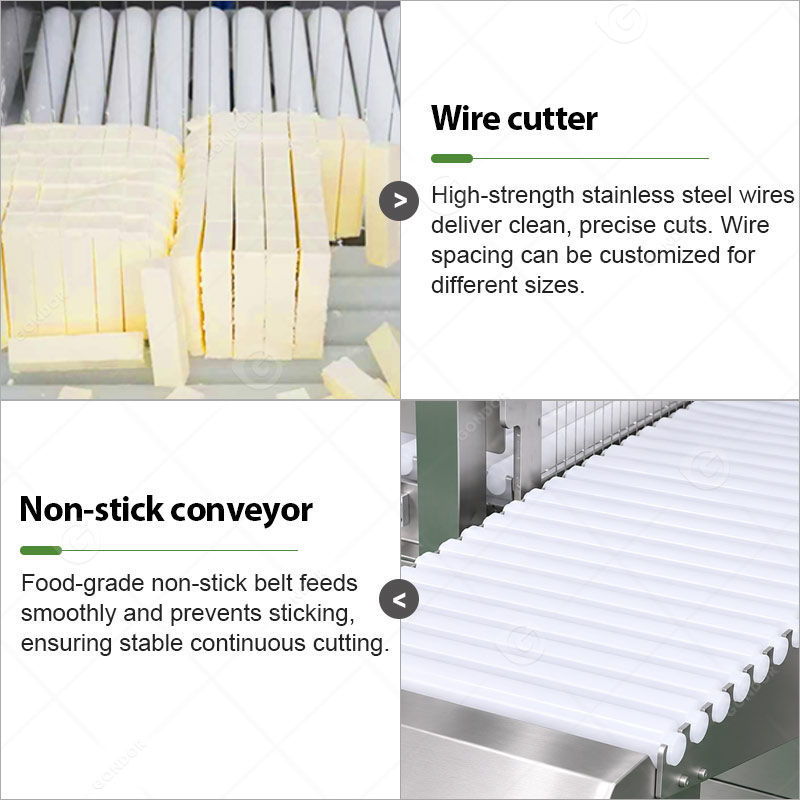
- Clean cut faces and fewer crumbs, so yield holds up. Wire cutting severs with a tensioned thin wire instead of pressing or chopping, and the cheese structure stays intact. On brittle hard varieties such as cheddar or gouda, the crumb ratio sits well below knife or manual work, and the saving is measured by the kilogram.
- The mold is the spec, and a mold swap is a product change. Both cutting molds come off and swap out, built to the required size and shape. Run 10 mm cubes in the morning and sticks after lunch. The main unit stays put, and the changeover between work orders takes minutes.
- Two configurations, so capacity follows the order book. The single-channel model asks for less floor space and less capital, and suits stable single-spec production. The dual-channel model pairs two tool sets and forms in one pass, roughly doubling output for portioning work bound for supermarkets and food service chains.
- PLC touch control with parameters that can be stored and recalled. Cutting parameters are set on the touch screen. Calling up a saved set for a given product removes the dependency on one skilled hand. Batch-to-batch consistency is exactly what chain buyers inspect during a plant audit.
- Quick-release structure that cleans without dead corners. Tool frames and molds follow a quick-release design for rinse-down between shifts. All product-contact parts are food-grade stainless steel, which passes the hygiene reviews common in dairy workshops.
- Not limited to cheese. Butter, tofu and nougat bricks share a similar texture logic. One machine with a mold change covers them, which matters for small plants running several product lines.
Engineering Design and Structure
Frame and cutting structure. The machine is a heavy-duty stainless steel build. Cutting puts real force on the tool set, and a frame without rigidity shows vibration marks on the cut face. The structure is designed for continuous duty, so the cutting position does not drift over long runs.
Mold system. Vertical and horizontal cutting molds handle forming and both come off independently. Molds are built to the customer’s target size, with wire spacing and grid pattern fixed at order time. Discharge chute baffles adjust to the mold size so the product lands in order.
Conveying system. A food-grade non-stick belt feeds smoothly, with no sticking and no residue. Belt width and length can be built to the product, so long slab-shaped blocks pass the cutting zone just as steadily.
Pneumatics and drive. The machine needs a 0.3 to 0.8 MPa air supply, with pneumatic components handling clamping and auxiliary motion. Confirm before installation that the plant air pressure holds steady in this band, since low pressure leaves cutting actions incomplete.
Electrical control. A PLC touch screen centralizes the cutting parameters, and the control box sits on the operating side. Parameters adjust and runs repeat, so daily operation needs no specialist maintenance background.
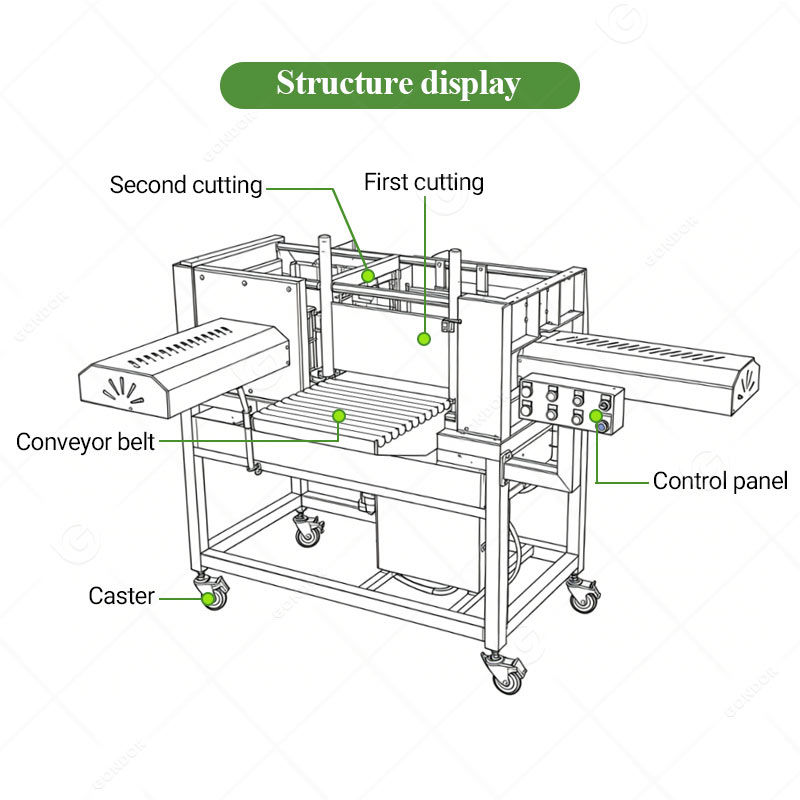
Structure breakdown
| No. | Part | Function |
|---|---|---|
| 1 | Infeed | Manual loading and product positioning |
| 2 | Non-stick conveyor | Steady feeding, anti-stick, synchronized |
| 3 | Vertical cutting mold | Longitudinal forming cut |
| 4 | Horizontal cutting mold | Transverse forming cut |
| 5 | Wire cutter set | High-strength stainless wires, spacing customizable |
| 6 | Discharge chute | Guided output, adjustable baffles |
| 7 | Control box | PLC touch screen and parameter setting |
Operating Procedure
- Pre-start check. Confirm air pressure in the 0.3 to 0.8 MPa band, no foreign matter on the conveyor, molds installed and locked, and the collection frame in place.
- Parameter recall. Select the cutting parameter set for the product on the touch screen, then run a first-piece trial cut.
- First-piece inspection. Measure the piece size and check the cut face. Move to continuous running only after it passes. Otherwise stop and check mold seating and air pressure.
- Continuous production. The operator keeps feeding, watches the discharge state, and clears chute crumbs at intervals.
- End of shift. After shutdown, remove the molds and contact parts for washing and sanitizing, and wipe the conveyor clean for the next shift.
Where a Cheese Cutting Machine Fits in the Line
Cheese processing plants and dairy factories. Portioning of hard and semi-hard cheese blocks is the core duty. Cheddar cubes and gouda sticks feed straight into weighing and packing lines.
Central kitchens and prepared food workshops. Diced cheese for pizza and baked rice toppings runs in large volume at a single spec. Machine portioning is far steadier than manual work and makes per-portion costing straightforward.
Supermarket and chain restaurant supply chains. Standardized cheese portions for store delivery leave no room for batch-to-batch size drift, and mold-based cutting meets that requirement by design.
Bakery and soy product plants. Dicing butter or tofu follows the same cutting logic as cheese. A mold change covers both, suiting plants that run several low-volume product lines in parallel.
Snack food factories. Portioned nougat bricks sit inside the machine’s working range as well.
How to Choose the Right Cheese Cutting Machine
Measure three things before picking a model.
- Material and target spec. Record the incoming block size, the target cube or stick size, and the output per shift. A single spec at moderate volume fits the single-channel model. If you must cover both retail and industrial channels at once, look at the dual channel.
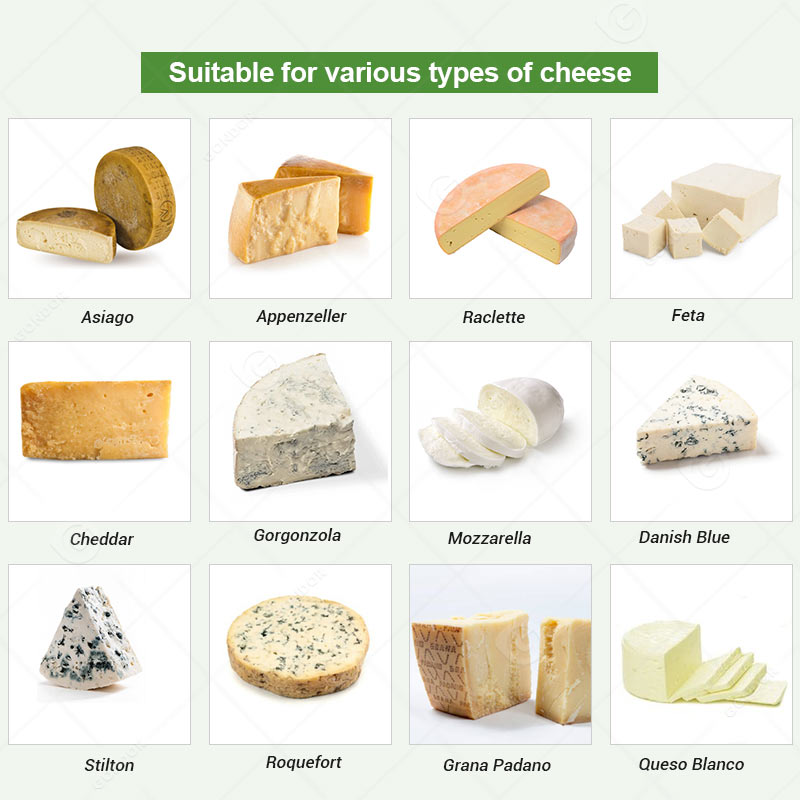
- Material texture. Hard and semi-hard cheeses are the standard duty. Soft varieties such as brie or camembert deform at the cut face, so state the material clearly at order time and let the cutting plan be evaluated separately.
- Workshop conditions. Confirm a 220 V supply and a steady air source in the 0.3 to 0.8 MPa band. A workshop without a compressor needs space reserved for one.
- Mold planning. List the specs you expect to run over the coming year and settle the mold plan in one discussion. Molds are built to order and retooling takes time, so planning ahead beats rush orders.
Limits worth stating plainly. The machine is built for block materials, not loose crumbs. Cutting size is decided entirely by the mold, and changing a spec mid-run means a mold swap. The first-piece check is not optional; it is the start of every conforming batch.
Customization
OEM and ODM are both accepted. Logos follow the customer’s brand. Cutting size, cutting thickness, wire and grid spacing, and belt width and length are all built to the product, and molds are tooled for the target spec. Retooling lead time: quoted with the offer. Mold MOQ: quoted with the offer. Export orders can be wired for the target market voltage, 110 V, 220 V or 380 V.
Commercial Information
- Minimum order quantity (MOQ): quoted with the offer
- Standard lead time: quoted with the offer (custom builds per contract)
- Packaging: inner waterproof film against dust and moisture, outer standard wooden case for international transport
- Trade terms and loading port: quoted with the offer
Quality Inspection and After-sales
A pre-shipment video inspection is provided, and a mechanical test report ships with each unit. Core components carry a one-year warranty. After-sales runs mainly on online support: faults are diagnosed remotely first, with on-site service arranged when needed. Spare parts list and supply cycle: quoted with the offer. Operator training runs together with installation and commissioning.
Cheese Cutting Machine FAQ for Buyers
1. Which cheeses can this machine cut?
Hard and semi-hard cheeses are the standard duty across moisture levels and textures. Soft varieties such as brie or camembert deform at the cut face, so the cutting plan needs a separate evaluation before configuration is fixed.
2. What shapes can it cut, and how is size set?
Cubes, sticks and slices. Size is decided by the mold: wire spacing and grid pattern are built to the target dimensions provided at order time. A mold swap on the same main unit changes the spec.
3. What separates the single-channel from the dual-channel model?
The single channel carries one cutting unit and forms in two passes, horizontal then vertical, and asks for less floor space. The dual channel carries two units that can act together, forming in one pass at roughly double the output, which suits large orders at a single spec.
4. Will the cutting crumble the cheese?
Wire cutting severs with a tensioned thin wire, not by pressing or chopping. Cut faces stay clean with few crumbs. On brittle hard varieties, loss runs clearly below manual work.
5. What material contacts the cheese?
All product-contact parts are food-grade stainless steel. Molds and the conveyor are selected to food-contact requirements and can be removed for washing and sanitizing between shifts.
6. How disruptive is a spec change? How long is the machine down?
Both cutting molds follow a quick-release design. A practiced operator completes a mold swap in about ten-plus minutes. Production resumes once the first-piece check passes.
7. What else can it cut besides cheese?
Butter, tofu and nougat bricks all work, provided the material forms a stable block and suits wire cutting.
8. Can you build it under our brand for export?
Yes. OEM and ODM are both accepted. Voltage follows the target market, and certification documents ship with the order.
How We Take a Cheese Cutting Machine Order From Here
Send three items: the incoming cheese block size, the target portion spec (cube, stick or slice, with dimensions), and the output per shift. We will recommend the single-channel or dual-channel model, list the mold plan and prepare a quotation. To verify cutting results first, ship a cheese block sample and we will run trial cuts at the factory, then send back photos and samples of the finished portions.
Contact
Henan Gondor Machine Co., Ltd. Website inquiry form, WhatsApp or email. Replies within 24 hours on working days.
Related Equipment
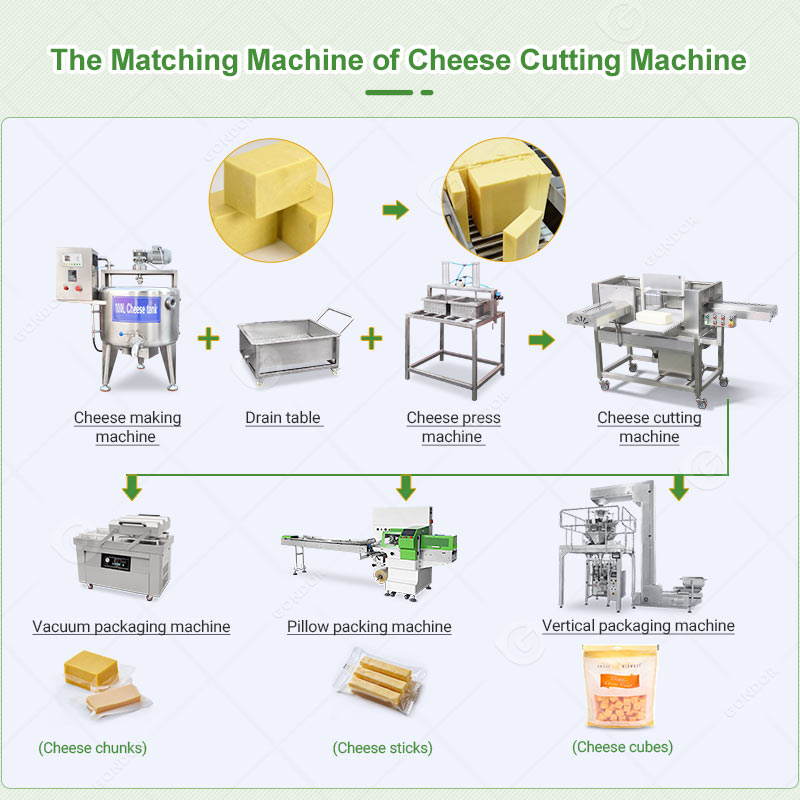
- Cheese Making Machine — produces the pressed block that this machine cuts to size.
- Cheese Processing Line — places this cutter at the end of a ten-station cheese line.
- Liquid Filling Machine — where the product is a spreadable soft cheese rather than a block.
Send Us Your Cheese Cutting Machine Requirements
Send us the daily volume, the product and the container or pack format you are working with, and we will come back with a model recommendation, a utility list and a price.