

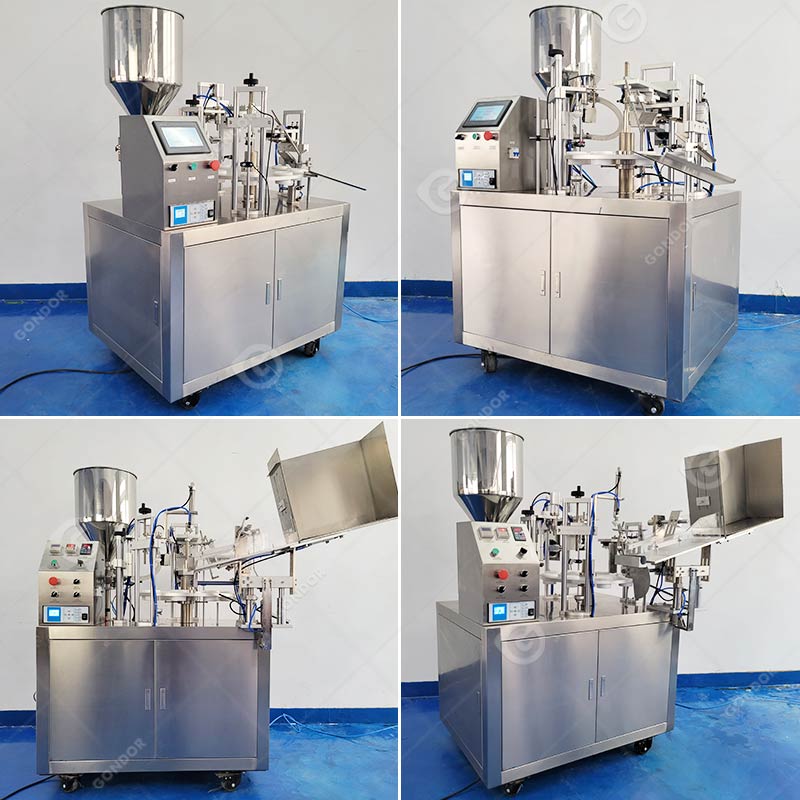
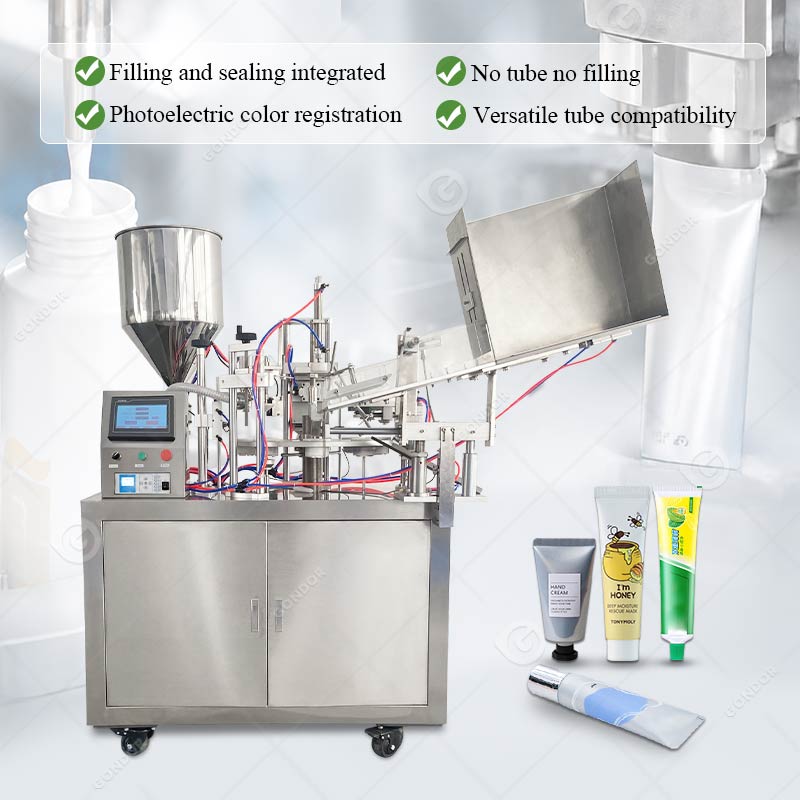
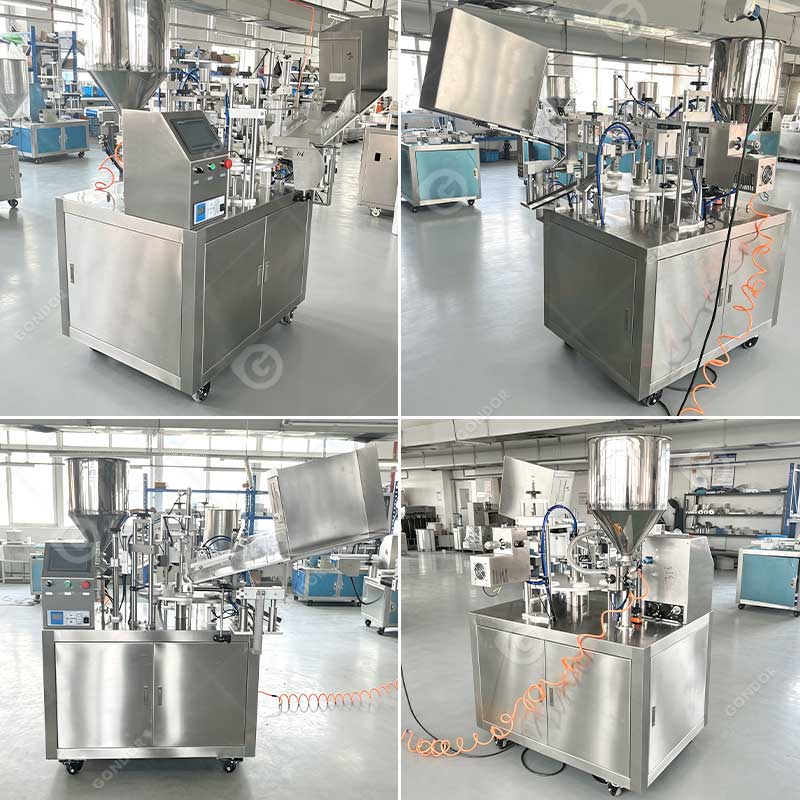
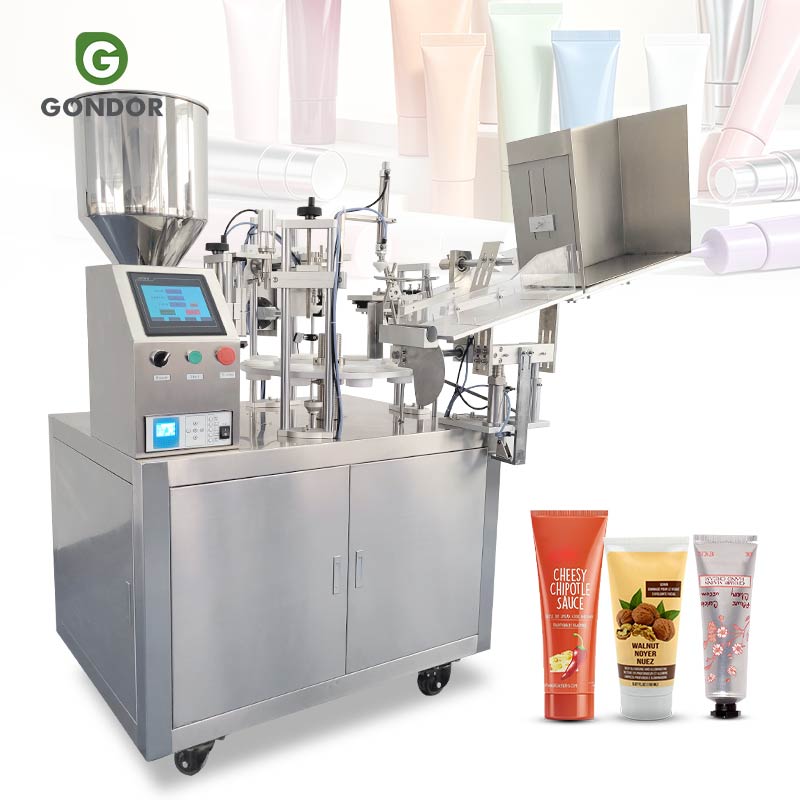
An eight-station ultrasonic tube sealer for 5-250 ml at up to 60 tubes per minute, giving a flat tail seal with no trapped product and a legible batch code.
The Tube Tail Decides Whether a Tube Filling and Sealing Machine Pays Off
For factories running toothpaste, hand cream or sauce pastes, the filling step rarely causes trouble. The tube tail does. A crooked seal, product trapped in the crimp, an unreadable batch code: supermarket inspection rejects the whole lot, and the loss outweighs a few mis-filled tubes many times over. Manual heat sealing is worse. Temperature is judged by hand, the tail comes out thick on one side and thin on the other, and the product fails on appearance before anything else.
This automatic tube filling and sealing machine finishes tube feeding, mark registration, filling, sealing, tail cutting and date coding on a single eight-station rotary table. The operator pours a case of empty tubes into the inclined feeding bin, sets the fill volume, and the machine does the rest: it seats each tube into its nest, the colour mark sensor finds the printed position, the filling head doses the paste, the ultrasonic horn welds the tail, the cutter trims it square, and finished tubes drop into the outfeed chute. Up to 60 tubes per minute, fill volumes from 5 to 250 ml, under ten seconds from bin to discharge.
Product-contact parts are 304 stainless steel, and the tube nests are custom made to the tube diameter. It covers soft tubes for cosmetics, food, daily chemical and adhesive products. For a workshop turning out thousands to tens of thousands of tubes a day, it replaces three or more manual filling stations.

Tube Filling and Sealing Machine Model Range and Ratings
Main machine (per the official parameter table)
| Item | Specification |
|---|---|
| Model | GD-60 |
| Voltage | 220 V, 50 Hz |
| Running speed | Up to 60 rpm (tubes/min) |
| Filling capacity | 5-250 ml |
| Filling accuracy | ≤ ±1% |
| Suitable tube length | 50-240 mm |
| Suitable tube diameter | 10-50 mm |
| Maximum processing height | 5-200 mm |
| Stations | 8-station rotary table |
| Feeding system | Inclined hanging automatic feeding bin |
| Sealing method | Ultrasonic sealing with synchronous cutting and coding |
| Dimensions | 170×82×169 cm |
| Weight | 280 kg |
| Installed power | 2 kW |
General parameters
| Item | Specification |
|---|---|
| Applicable tubes | Plastic laminated tube, aluminum-plastic laminated tube |
| Filling materials | Paste, cream, sauce, viscous materials |
| Product-contact material | 304 stainless steel (hopper, product path, nests) |
| Control | PLC touch screen, microcomputer chip control |
| Air supply | Compressed air drives sealing and actuators |
| Automation | Fully automatic |
| Applications | Food, beverage, daily chemical, cosmetics, adhesives |
| OEM / ODM | Accepted |
| Core component warranty | 1 year |
Note: a version with a safety guard is available for workshops that need operator isolation.
Customization
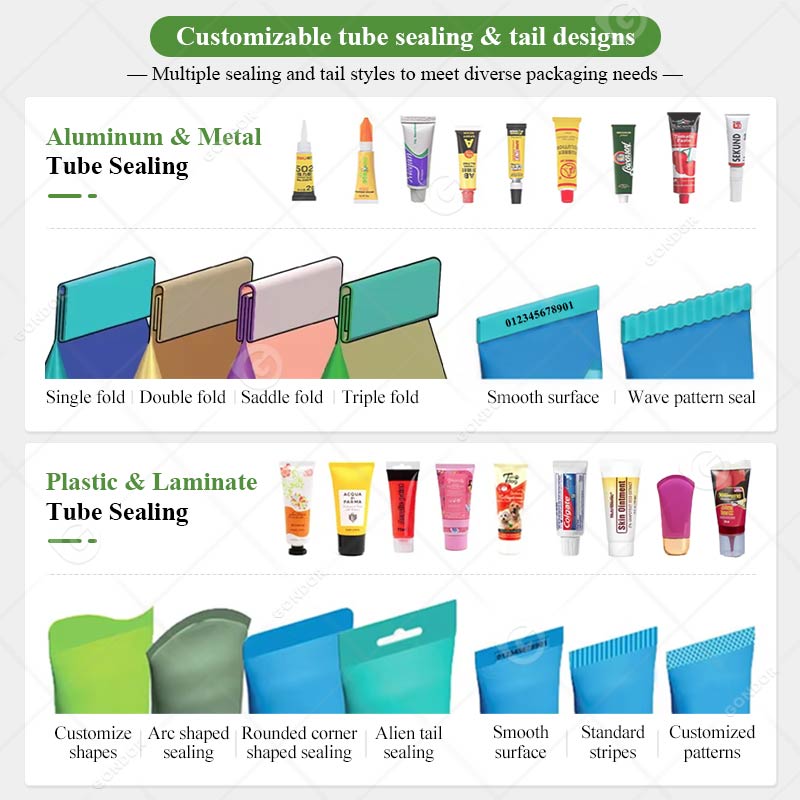
- OEM / ODM scope. Accepted. Fill volume range, table station layout, feeder form and exterior colour can be adjusted to requirement, and the interface language can be set for the target market.
- Mould customization. Tube nests are custom made to the tube diameter and swap without special tools. Lead time for new moulds: quoted with the offer.
- MOQ. One set, or one line for a complete system.
- Non-standard projects. Tubes outside the standard diameter range, volumes above 250 ml or shaped tubes can be evaluated from samples before quotation.
Quality Inspection and After-sales
- Pre-shipment inspection. A machinery test report and a trial-run video ship with each unit, and buyers can inspect by live video. Fill volume, seal appearance and code position are checked item by item before release.
- Warranty. One year on the whole machine and one year on core components (motor, gear drive, PLC).
- Installation. An operation manual and video demonstration ship with the machine, with remote guidance; on-site engineer support is available where needed.
- Spare parts. Common seals and nozzles are stocked long term. The source file lists no fixed wear-parts schedule, so a backup set ordered with the machine is advised; the specific list is confirmed against your sample and pack format.
- Response. Faults are diagnosed remotely first; a field visit is arranged when the issue cannot be resolved from distance.
How a Tube Filling and Sealing Machine Is Built to Work
The flow in one paragraph. Empty tubes slide from the inclined automatic feeder into the nests of the rotary table. The table indexes one station at a time and stops, and all actuators run in parallel within the same cycle: mark registration, filling, sealing and tail cutting, with finished tubes exiting through the discharge chute. The PLC holds the cycle timing, the colour mark sensor handles print registration, and the ultrasonic generator welds the tail. These three decide the speed and the seal acceptance rate of the whole machine.
Product Performance Advantages
- Eight stations work in parallel, up to 60 tubes per minute. Feeding, registration, filling and sealing each have a dedicated actuator acting within the same table cycle. There is no waiting between steps, and a daily volume above twenty thousand tubes fits comfortably.
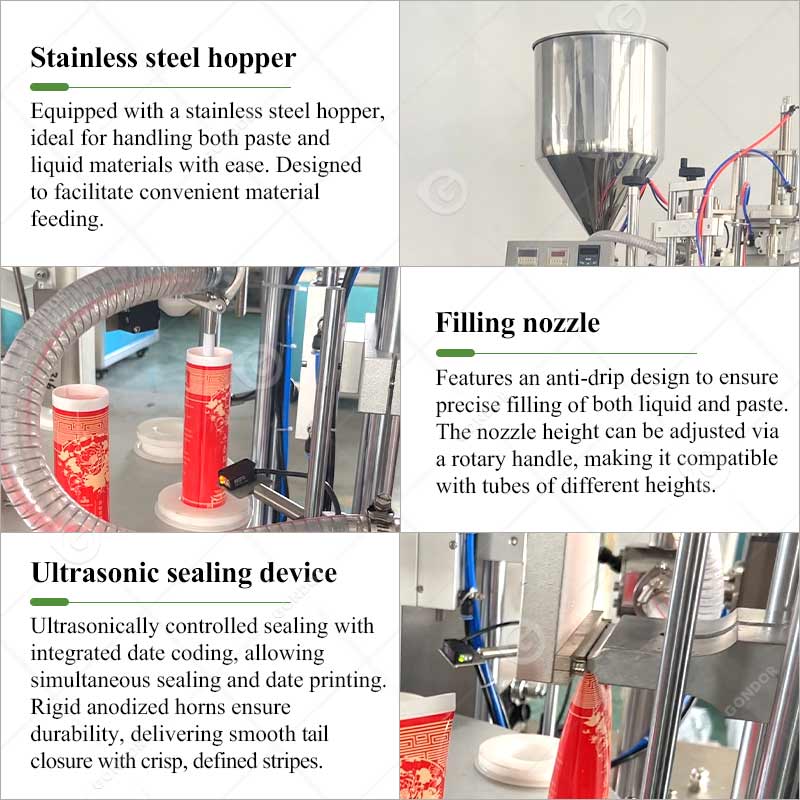
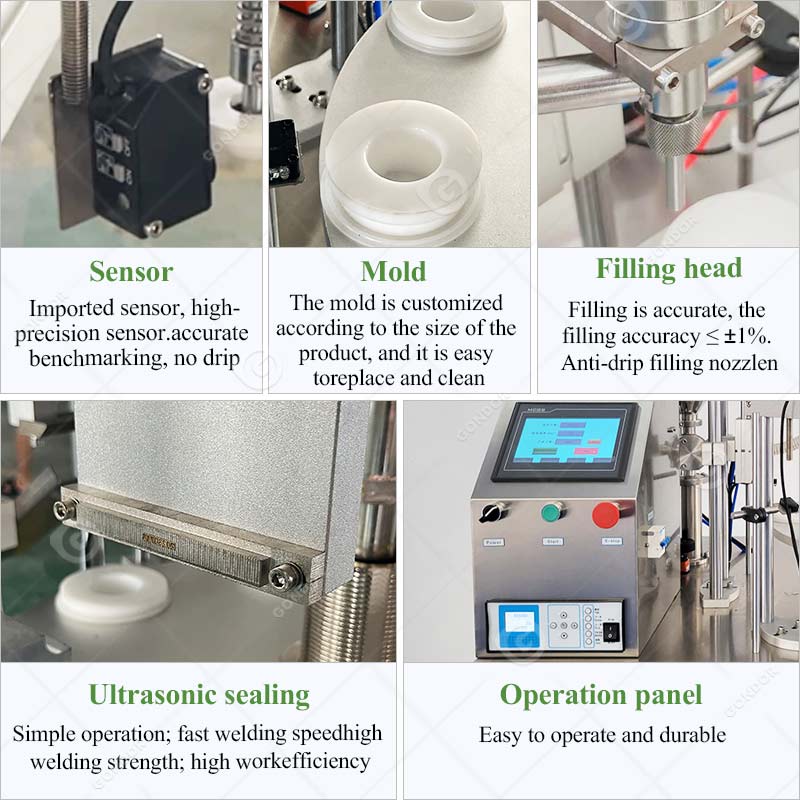
- Filling error held within ±1%. Vertical filling motion paired with a suck-back nozzle keeps paste off the tube wall and off the machine. A clean sealing zone directly lowers the reject rate from product trapped in the tail.
- Ultrasonic sealing, no chiller needed. Unlike heat sealing, ultrasonic welding fuses the laminated material by high-frequency vibration. The seal is fast, neat and stable, and no chilled-water circuit is required, which keeps the workshop utility list short.
- Colour mark registration with date coding in the same pass. The mark sensor resists interference and locates the print accurately. Production dates are stamped while the tail is sealed, so no separate coding step is needed.
- Custom nests by tube diameter, short changeover. Tube nests are made to the tube diameter, swap without special tools and clean down quickly. A shop running several tube sizes changes nests and keeps producing.
- One operator, low workload. Parameters are set on the PLC screen, counting is automatic, and the operator only tops up tubes and collects finished product. No skilled sealing hand is required.
Engineering Design
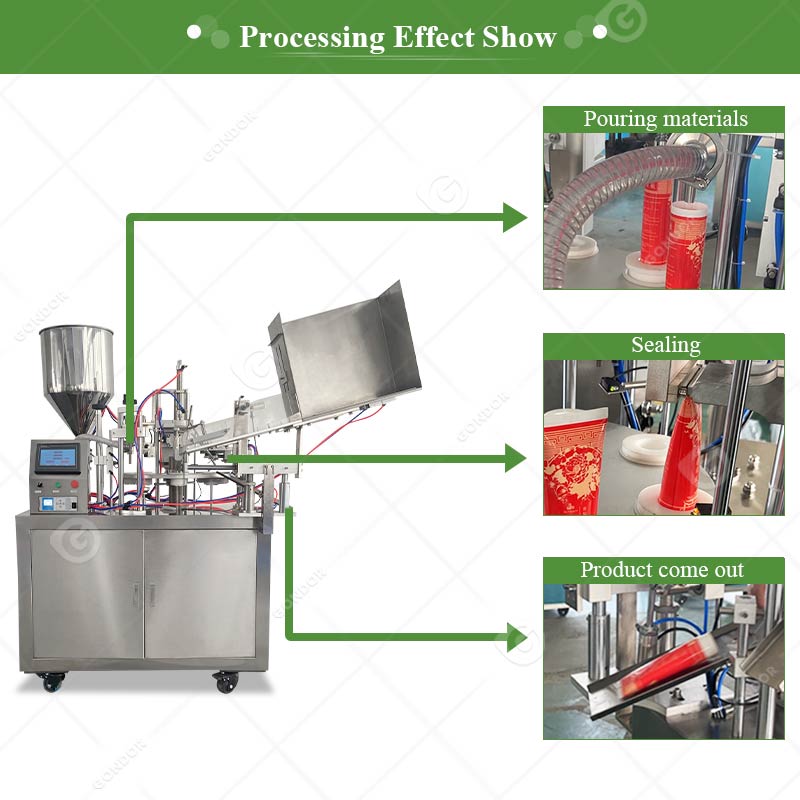
Rotary table and cycle time. The eight-station table is the backbone of the machine, with nests spaced around its rim. The table indexes one station, locks, and every actuator works inside the stationary window. Clean separation between motion and dwell is the structural reason it holds 60 tubes per minute. When comparing machines, count the stations rather than the filling heads: eight stations give feeding, registration, filling, sealing, cutting and discharge their own space, and the cycle steps do not crowd each other.
Filling system. The 304 stainless hopper is lidded, the product path is short, and strip-down for cleaning is straightforward. The vertical filling head suits viscous pastes: the nozzle travels down near the tube bottom and fills on the way up, so paste traps no air. The suck-back nozzle retracts the last drop at the end of each dose, which is what stops dripping onto the nests.
Sealing system. The ultrasonic horn and anvil clamp the tail and fuse it under vibration. The horn is aluminium alloy to keep reciprocating weight low. Against the heat-sealing route, there is no hot-plate warm-up and no chiller, so both the utility cost and the failure points of long-term operation are fewer.
Control system. A PLC with a microcomputer chip runs the cycle. Fill volume, speed and count are set on the touch screen and production data can be reviewed. The machine needs a compressed air supply for the sealing and actuator cylinders; a standard workshop air line covers it.
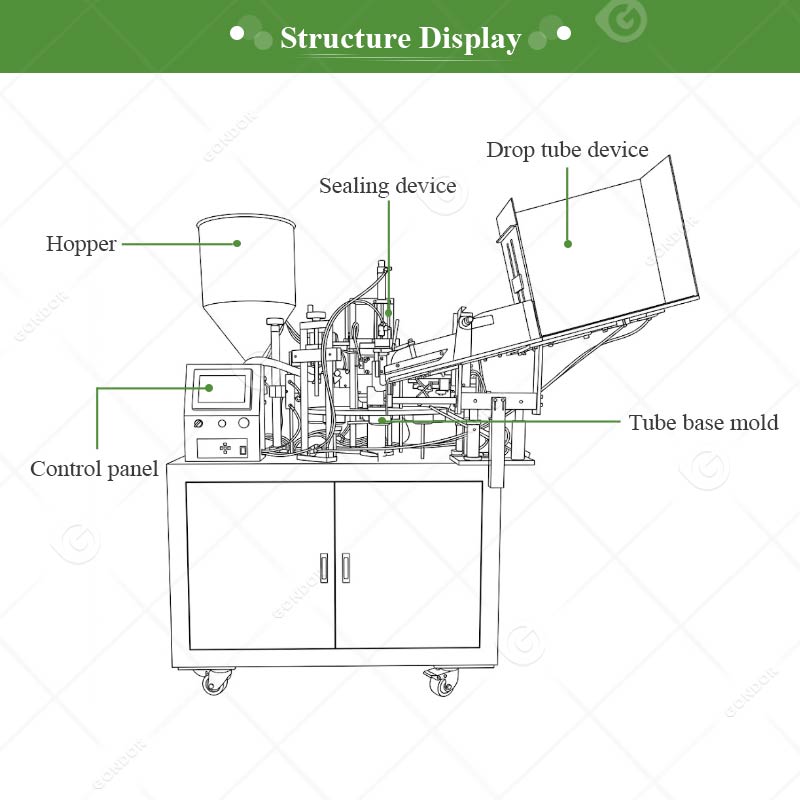
Structure breakdown (six parts)
| No. | Part | Function |
|---|---|---|
| 1 | Control panel | PLC parameter setting, start/stop and counter display |
| 2 | Filling device | Vertical metered dosing with suck-back anti-drip |
| 3 | Hopper | 304 stainless product hopper with lid |
| 4 | Sealing device | Ultrasonic horn for tail welding |
| 5 | Drop tube device | Nozzle guide and residual suck-back |
| 6 | Tube base mold | Custom nest per tube diameter, holds and locates the tube |
Operating Procedure
- Pre-start. Connect the air line and power, check the hopper level, and confirm the nests match the tube diameter of the shift.
- Parameter setting. Set fill volume, running speed and count target on the PLC screen. Verify the fill volume once against paste density.
- Trial run. Run a dozen tubes, weigh a sample to check the dose, and inspect seal appearance and code position. Go into continuous production once all pass.
- Continuous production. Top up tubes and paste at intervals, and watch seal quality. For a size change, stop, change nests, and re-verify.
- Clean-down. At the end of the run, drain the hopper and product path, strip the dosing parts for cleaning, and wipe the table and nests clean for the next shift.
Where a Tube Filling and Sealing Machine Fits in the Line
Cosmetics and personal care. Hand cream, facial cleanser, hair dye and conditioner are this machine’s home ground. A soft tube sells on appearance, and registration accuracy plus a flat seal decide how it looks on the shelf.
Food pastes and sauces. Laminated tubes for condensed milk, jam, sesame paste and seasoning pastes. Product-contact parts are 304 stainless steel, cleaning is thorough, and flavours do not carry over between runs. Central kitchens packing small sauce portions are a steady use case.
Daily chemical and household care. Shoe polish, glue and sachet-style care products. Materials range from near-water to thick paste, and the machine covers them by changing nests and adjusting the dose, with no dedicated machine per product.
Adhesives and industrial pastes. High-viscosity materials such as sealant and grease are exactly what the suck-back nozzle and short product path are built for. Seal strength keeps the tube from leaking in storage.
Small brands and contract packers. Multiple sizes, small batches and frequent changeovers are where fast nest changes and single-operator running turn small orders into margin.
How to Choose the Right Tube Filling and Sealing Machine
- Start with tube diameter and length. Tubes from 10 to 50 mm in diameter and 50 to 240 mm in length are covered. Outside that range needs custom nests and clamping; send sample tubes for evaluation first.
- Then fill volume. The standard range is 5 to 250 ml. Near the limits, verify accuracy with your actual paste, and convert the set value by weight for dense materials.
- Then material behaviour. Products with particles, separation tendency or temperature sensitivity need hopper and product-path adjustments. Describe the material fully before ordering.
- Then workshop air. The machine needs compressed air for sealing and actuators. Confirm stable pressure and flow before installation; shops without an air line should plan a compressor at the same time.
- Then guarding. Workshops needing operator isolation or dust control should choose the guarded version.
Limits worth stating plainly. The machine covers plastic laminated and aluminum-plastic laminated tubes; plain aluminum and rigid tubes are outside its range. It is rated at up to 60 tubes per minute, and real output depends on tube size and paste flow: small thin tubes run faster, large-volume viscous pastes run slower. A stable compressed air supply is required, because unstable air pressure directly hurts seal consistency.
Tube Filling and Sealing Machine FAQ for Buyers
1. What tube diameters and lengths does it cover?
Standard coverage is 10 to 50 mm in diameter and 50 to 240 mm in length, with a maximum processing height of 200 mm. Sizes outside this range can be handled with custom nests; send sample tubes for evaluation.
2. What filling accuracy can it hold?
The official figure is an error within ±1%. Real accuracy depends on paste flow and the set volume. One trial run with your material gives the true number.
3. How does it seal, and is the seal strong?
Ultrasonic sealing. The horn vibrates at high frequency and fuses the laminated material under pressure. The seal is fast, strong, neat and free of filaments. Compared with heat sealing, no chiller is needed and long-term utility costs are lower.
4. Can it stamp the production date on the tail?
Yes. The production date and batch number are stamped while the tail is sealed and cut, and the coding position follows the registration system, so it never lands on the artwork.
5. How long does a size change take?
Change the nests, adjust the fill volume and the tail length, and you are ready. Nests swap without special tools. Actual changeover time depends on your product spread; on-site training covers it during the first installation.
6. Are there air supply requirements?
Yes, a compressed air supply is required for sealing and the actuators. A standard workshop line is sufficient, but unstable pressure affects seal consistency, so confirm the supply before installation.
7. What if we cannot operate the machine when it arrives?
An operation manual and video demonstration ship with the machine, and routine parameter setting and nest changes can be taught over video call. For problems that cannot be handled remotely, the after-sales team can come to your site.
8. Can it be customized to our tubes and material?
Yes. Tube nests are custom made to your tube diameter, and OEM and ODM projects are accepted. Sample tubes and material samples let engineering confirm the configuration before quotation.
How We Take a Tube Filling and Sealing Order From Here
If your tube specification, fill volume and material behaviour are already clear, send those three items over and we will return a machine configuration, the mould plan and a quotation. To see the result first, send sample tubes and material, and we will trial-fill at the factory and send back finished tubes with close-up photos of the seal and the code.
Contact
Henan Gondor Machine Co., Ltd. Website inquiry form, WhatsApp or email. Replies within 24 hours on working days.
Related Equipment
- 3-in-1 Filling and Capping Machine — for small rigid bottles rather than soft tubes.
- Liquid Filling Production Line — when the pack is a bottle at 100 units a minute.
- Vacuum Emulsifying Mixer — prepares the cream or paste that this machine fills.
Send Us Your Tube Filling and Sealing Requirements
Send us the daily volume, the product and the container or pack format you are working with, and we will come back with a model recommendation, a utility list and a price.