

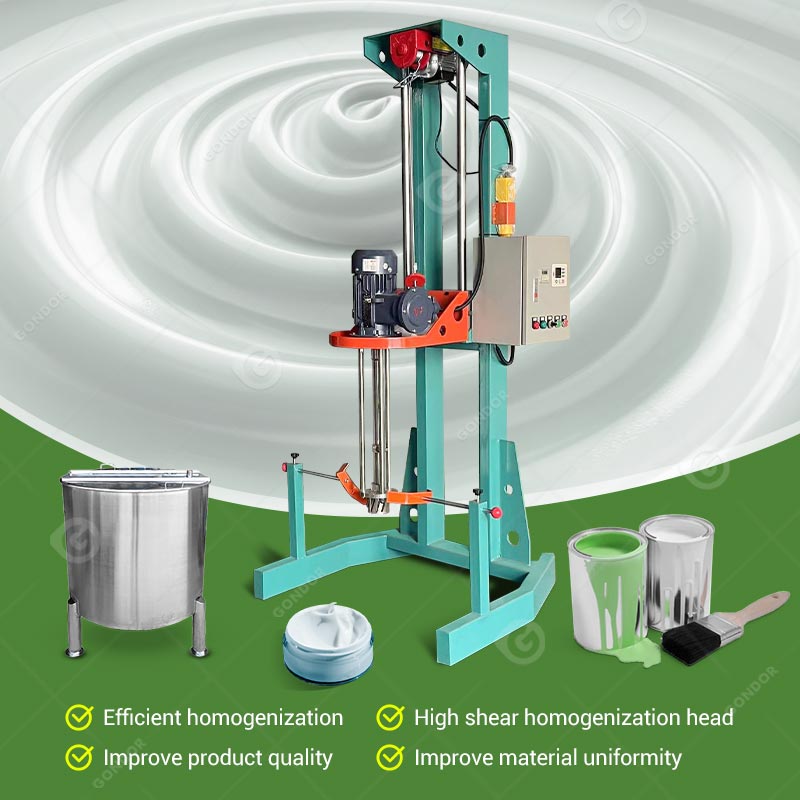
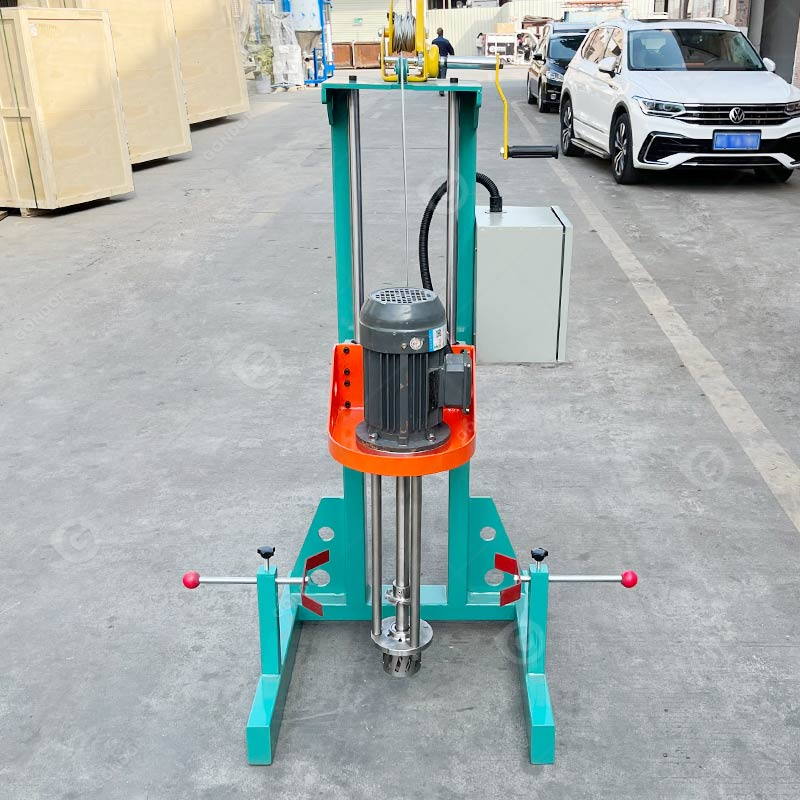
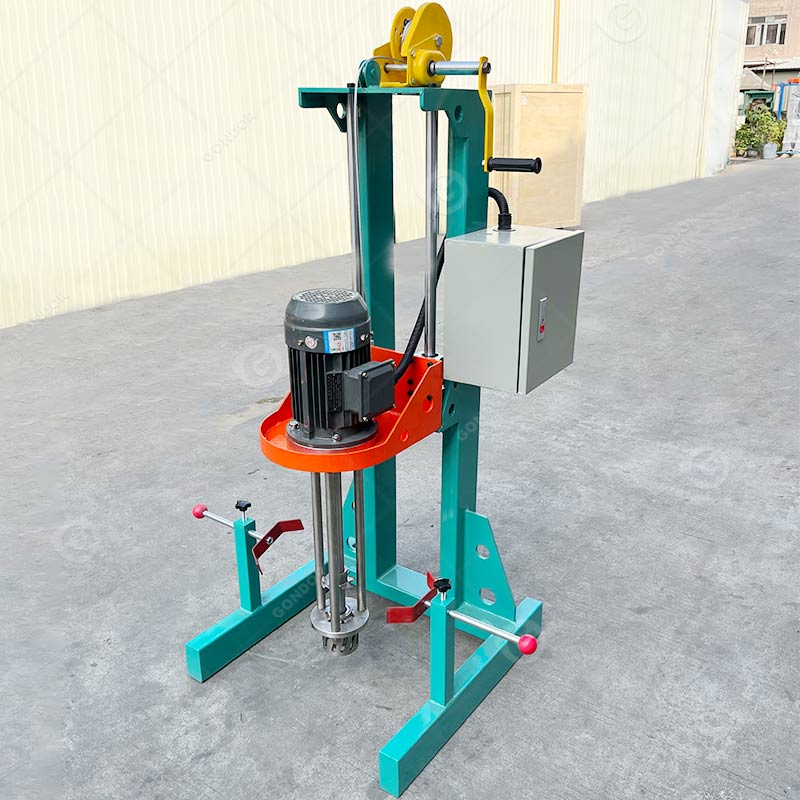
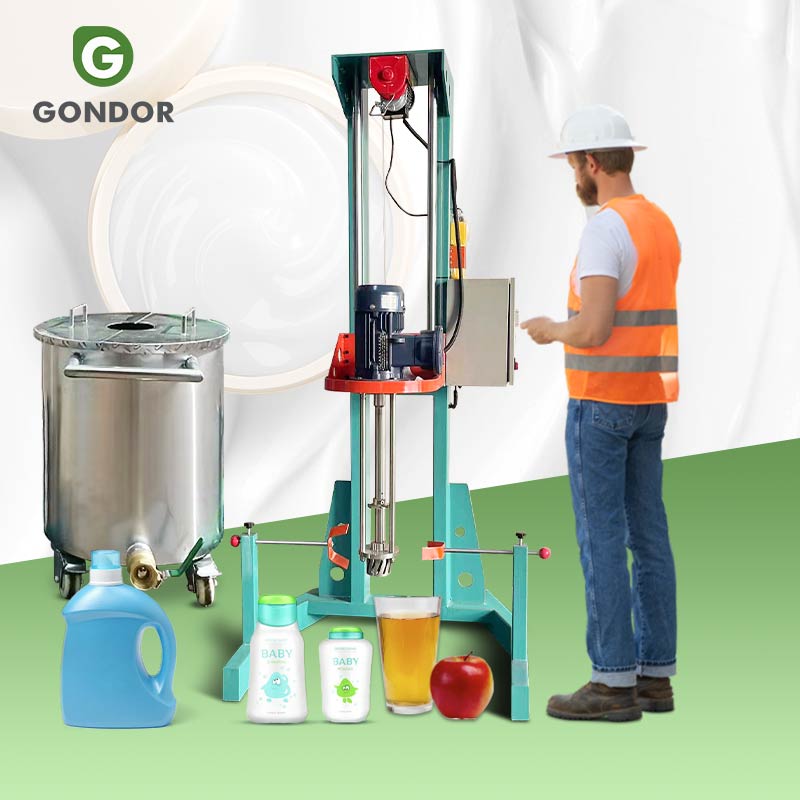
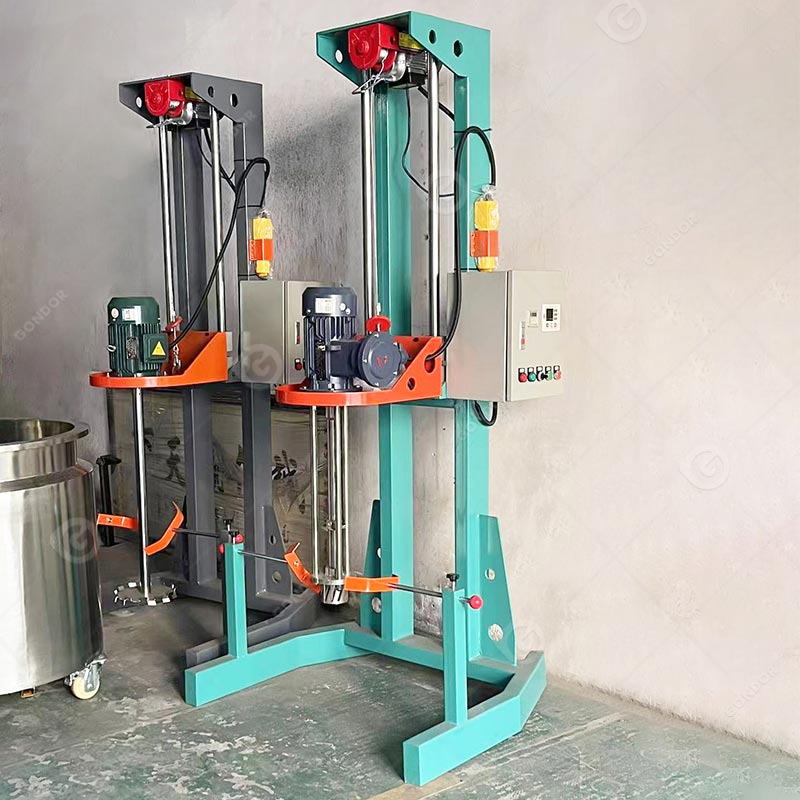
A 50-500 L lift-type high-shear disperser at 2.2-7.5 kW, covering trial batches and mid-volume runs without changing vessels.
Where a High Shear Homogenizer Earns Back Its Cost
A development lab and a production line often share one workshop. A new formula needs a five-litre trial batch to check stability; volume production then asks for several hundred litres per shift. A line like this cannot justify a several-thousand-litre tank, and a hand stirrer cannot reach the required fineness. The machine in between is this high shear homogenizer.
The working pattern is direct. A covered vessel holds the material and rolls under the machine. A clamping device locks it in place, the dispersing head travels down its lifting track into the liquid, and a high-speed disk shears, disperses and homogenizes the batch in one run. When the cycle ends the head rises, the vessel rolls away and the next one rolls in, with almost no dead time between batches.
The unit covers five ratings from 50 to 500 L with motors from 2.2 to 7.5 kW. The spindle runs at 2880 r/min with inverter control, the lifting stroke covers 400 to 600 mm, and electric or pneumatic lifting is available. An optional heating belt wraps the vessel for 0 to 100 °C temperature control. Cosmetics lotion, paint and ink, adhesives and resins, and dairy blending all fall inside its duty range.
High Shear Homogenizer Models, Rotor Speed and Motor Ratings
Five-rating comparison (per the official parameter table)
| Item | 50 L | 100 L | 200 L | 300 L | 500 L |
|---|---|---|---|---|---|
| Charge volume | 50 L | 100 L | 200 L | 300 L | 500 L |
| Motor power | 2.2 kW | 3 kW | 4 kW | 5.5 kW | 7.5 kW |
| Dimensions | 800×900×2150 mm | 800×900×2150 mm | 800×900×2150 mm | 970×1240×2500 mm | 1100×1420×2550 mm |
| Machine weight | 130 kg | 136 kg | 150 kg | 220 kg | 280 kg |
| Packing size | 900×1000×2350 mm | 900×1000×2350 mm | 900×1000×2350 mm | 1070×1340×2700 mm | 1200×1520×2750 mm |
| Packing weight | 145 kg | 156 kg | 170 kg | 240 kg | 300 kg |
General parameters
| Item | Specification |
|---|---|
| Model | Quoted per order |
| Voltage | 380 V / 50 Hz |
| Spindle speed | 2880 r/min, inverter controlled |
| Lifting method | Electric / pneumatic |
| Lifting stroke | 400 to 600 mm |
| Heating | Vessel heating belt, 0 to 100 °C |
| Material | Stainless steel product-contact parts (specific grade quoted with the offer) |
| Certification | ISO 9001, ISO 14001, ISO 45001, CE, BSCI, ETL |
| OEM / ODM | Accepted |
| Core component warranty | 1 year |
Working Principle of a High Shear Homogenizer
In short. Material goes into a covered vessel and rolls into position, where the clamp locks it. The dispersing head travels down the lifting track until the disk sits below the surface. The motor spins the disk at high speed; material is drawn into the disk center, flung across the toothed edge and refined by intense shear. When fineness is reached, the head rises, the vessel rolls out, and the material moves to the next station.
Product Performance Advantages
- A high-shear head with batch fineness under control. A rated 2880 r/min spindle and toothed disk deliver the tip speed needed for a stable emulsion, and inverter speed lets one machine cover pre-mixing through fine dispersing at different shear levels.
- Vessel-type structure: changing product means changing the vessel. Without a fixed tank to clean, color changes in cosmetics or paint trials mean swapping the whole vessel. Cross-contamination risk stays low and batch gaps stay short.
- Customizable disk and paddle. Disk form and paddle type follow the viscosity and target fineness. Low-viscosity lotion and high-viscosity paste use different disk profiles, and this level of customization does not carry tooling-scale cost.
- Electric or pneumatic lifting. Electric lifting runs on mains power alone; pneumatic lifting is fast and holds position well, and gets the nod when the workshop has a compressed air supply.
- Optional heating from 0 to 100 °C. The vessel heating belt covers temperature-controlled processes such as resin pre-polymerization and paste melting, while routine ambient dispersing is unaffected.
- Small footprint for lines and labs alike. The 50 L rating stands only 800×900×2150 mm, fitting a lab corner or a slot beside the production line.
Engineering Design
Lifting system. A lifting track and switch form the frame, with a 400 to 600 mm stroke. The electric option drives directly from the motor; the pneumatic option runs on compressed air. Choose by the workshop’s utility conditions.
Drive system. A copper-winding motor with inverter, rated at 2880 r/min. Copper windings carry a better temperature margin through long shifts, and the inverter adds soft starting, protecting the disk from shock torque on high-viscosity loads.
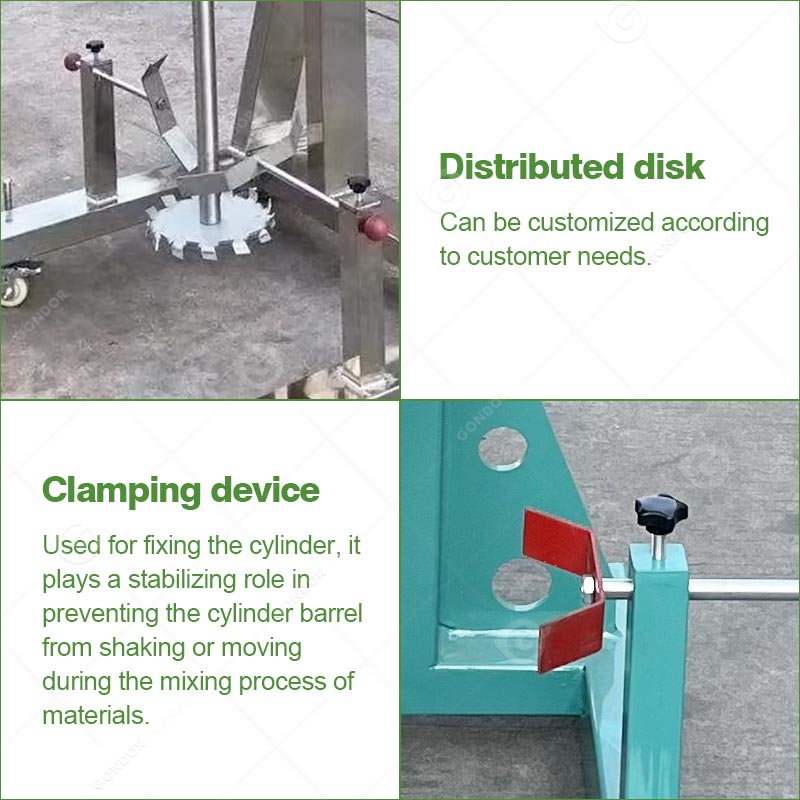
Dispersing system. The stirring shaft ends in the dispersing disk, and the tooth profile at the edge sets shear intensity. The source data notes the disk can be customized per customer requirements: multi-layer toothed disks for thick paste, standard disks for thin lotion.
Fixing system. The clamping device grips the vessel body. Dispersing viscous material loads the vessel hard, and clamp lock-down decides how steadily the machine runs.
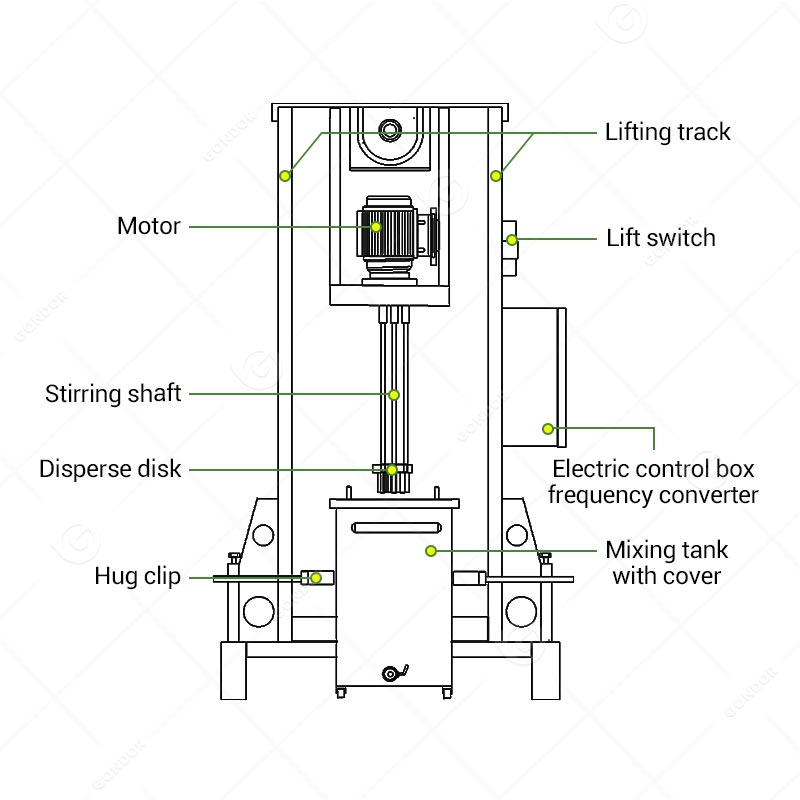
Structure breakdown
| No. | Part | Function |
|---|---|---|
| 1 | Mixing tank with cover | Holds the material; covered transfer keeps foreign matter out |
| 2 | Lifting track | Guides head travel, 400-600 mm stroke |
| 3 | Motor | Copper-winding motor driving the stirring shaft |
| 4 | Stirring shaft | Transmits torque to the dispersing disk |
| 5 | Disperse disk | High-speed shear at the toothed edge; customizable |
| 6 | Lift switch | Controls head up and down |
| 7 | Control box and VFD | Speed control, start and stop, overload protection |
| 8 | Clamping device | Locks the vessel against shaking during dispersing |
Operating Procedure
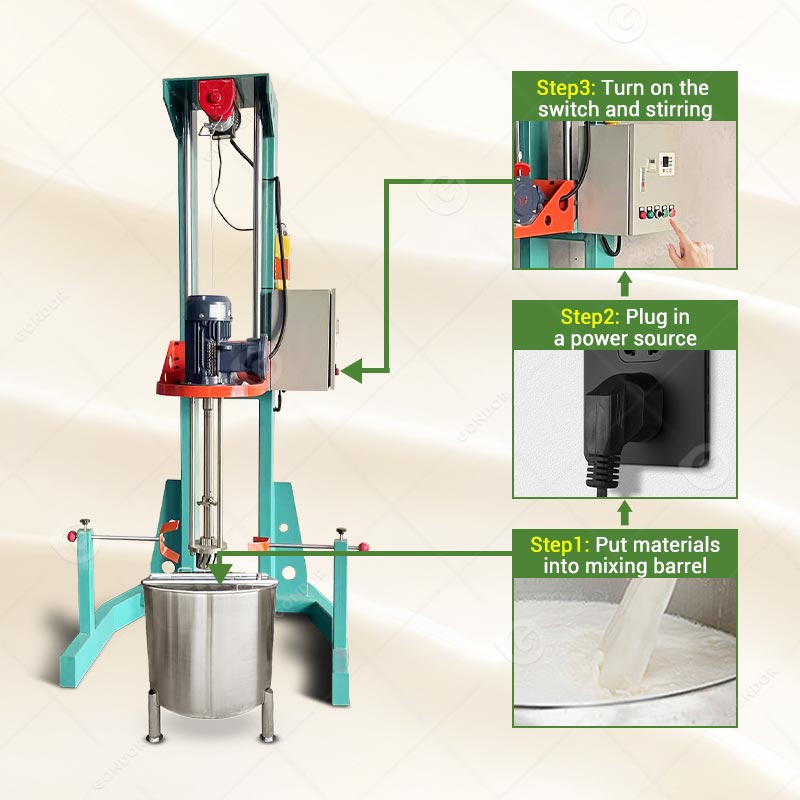
- Charging. Pour material into the covered vessel and roll it under the machine.
- Fix and lower. Lock the clamp and press the lift switch to bring the head to working depth.
- Set and start. Set speed and heating temperature per the process card, start dispersing, and watch through the lid opening.
- Sample check. Stop at time, sample for fineness or flow, and extend the cycle if the spec is not met.
- Raise and discharge. Return the head to the top position, release the clamp, and roll the vessel to the next station.
- Cleaning. Clean disk and vessel wall before changing product; same-category continuous runs clean per shift.
Where a High Shear Homogenizer Is Used
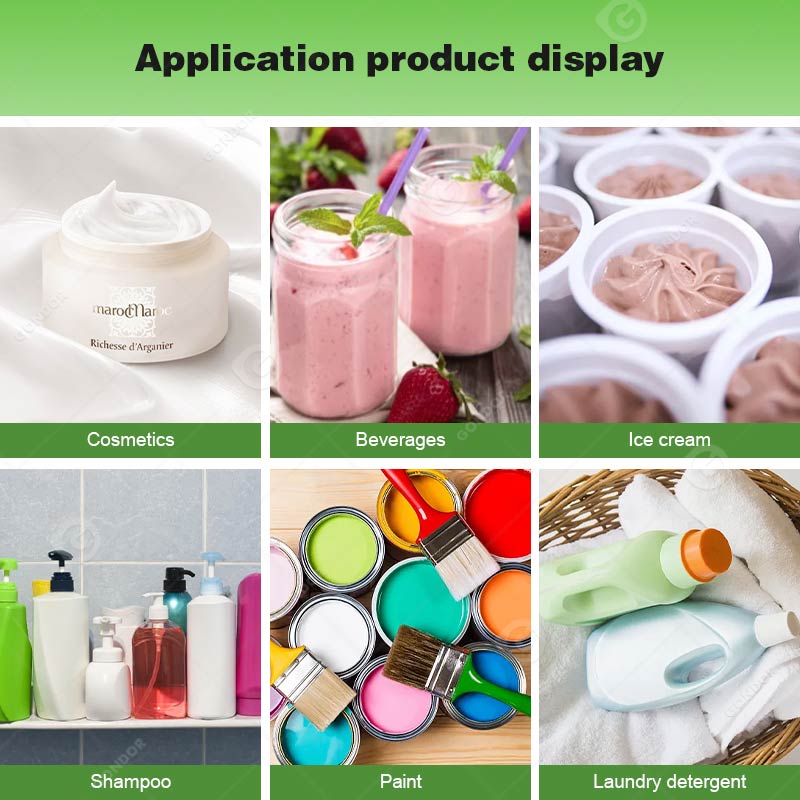
Cosmetics and daily chemical sampling and small batches. Lotion, cream and shower gel in small production runs and formula trials. The vessel structure changes product fast, and one machine covers the transition from R&D to volume production.
Paint, ink, pigment and dye. These materials live and die by fineness and uniformity, and the disk’s shear decides color consistency from batch to batch. It is the most traditional territory for dispersing machines.
Resin, adhesive and emulsion polymerization. Dispersing and pre-emulsification of medium to high-viscosity material, with the heating belt holding temperature so melting and dispersing finish in one vessel.
Dairy and beverage blending. Small and mid-batch blending of milk bases and protein drinks, with lower cleaning pressure than fixed-tank machines between batches.
Customization
Disk form and paddle type are customized to the material; lifting is electric or pneumatic; heating is optional per process; body material, surface finish and panel language follow OEM and ODM orders. Customer logo printing is supported. Tooling is quoted with the offer.
Commercial Information
| Item | Details |
|---|---|
| Minimum order quantity (MOQ) | 1 set |
| Lead time | quoted with the offer (stock machines and custom machines differ; per quotation) |
| Packing | Waterproof membrane inner wrap plus standard wooden case outer packing, suited to ocean freight |
| Trade terms | Quoted per order |
| Port of shipment | Main ports in China (commonly Qingdao, Shanghai, Ningbo, Tianjin, Guangzhou); specific port per quotation |
Quality Inspection and After-Sales
Pre-shipment video inspection and a mechanical test report are provided, with an English manual shipped alongside. The core component (motor) carries a one-year warranty with online technical support. Faults are diagnosed remotely first; on-site repair is arranged when needed, and overseas projects can include an engineer for installation and operator training. The source data lists no separate wear-parts schedule; inspect the disk and bearings by duty intensity and cover common parts in the first order.
Choosing the Right High Shear Homogenizer
- Size the rating by the largest single batch. Five ratings run from 50 to 500 L. A common practice is to choose at about eighty percent of the routine maximum batch, leaving surface for foam and vortex.
- Size power and disk by viscosity. Thin lotion is served by 2.2 to 4 kW; high-viscosity paste wants 5.5 kW or more with a multi-layer toothed disk. Do not run a small motor at heavy load.
- Size lifting by utilities. Choose pneumatic with a stable air supply and electric without one; processing capacity is the same either way.
- Size heating by process. Processes that need melting or temperature holding take the heating belt option; routine ambient dispersing need not pay for it.
High Shear Homogenizer Questions Buyers Ask
1. Is this machine batch or continuous?
Batch. One vessel runs at a time and the next rolls in after it. It suits many varieties in small volumes. For continuous, high-volume, low-viscosity homogenizing, look at the high-pressure homogenizer; for large-volume high-viscosity emulsifying, look at the vacuum emulsifying tank.
2. Does pneumatic lifting need an air compressor?
The pneumatic option runs on compressed air. If the workshop has no air supply, a compressor is needed; share your utility conditions at selection stage.
3. How fine can the emulsion get?
Fineness depends on disk type, speed and cycle time. The standard configuration meets routine lotion and paint requirements; for special targets, send a sample for a trial run and confirm with data.
4. Is the vessel included?
The vessel is a configured accessory matched to the rating, with cover included. Custom vessels or a head-only configuration are confirmed per quotation.
5. What is the MOQ?
One set. Pricing for volume orders is negotiated separately.
6. Can our logo go on the machine?
Yes. Logo printing and panel language are configured per OEM order.
7. How is export installation arranged?
Overseas installation is available, with an engineer on site for setup and free operator training. Routine faults are diagnosed remotely first, with on-site service when needed.
8. How is this different from the large vacuum emulsifying mixer and the high-pressure homogenizer?
This unit is a high-shear head over a movable vessel, batch sizes of 50 to 500 L, for medium to high-viscosity material. The large vacuum emulsifying mixer is a fixed tank taking 300 to 5000 L per batch with vacuum and jacket. The high-pressure homogenizer is a continuous in-line unit at the 20 MPa class for low-viscosity liquids such as milk and juice. Each has its own territory.
What Happens Next With a High Shear Homogenizer Enquiry
Send over your material type, single batch volume, viscosity range and target fineness, and we will propose a power rating, disk type and lifting method. If fineness is the worry, send a sample for a trial run and let the data speak.
Contact
Henan Gondor Machine Co., Ltd. Website inquiry form, WhatsApp or email. Replies within 24 hours on working days.
Related Equipment
- High-Pressure Homogenizer — for continuous, low-viscosity duty at 20 MPa instead of batch dispersing.
- Vacuum Emulsifying Mixer — the next step up, 300 to 5000 L per batch with vacuum and a jacket.
- Mixing Tank — holds the blended base before or after the dispersing pass.
Get High Shear Homogenizer Pricing
Send us the daily volume, the product and the container or pack format you are working with, and we will come back with a model recommendation, a utility list and a price.