


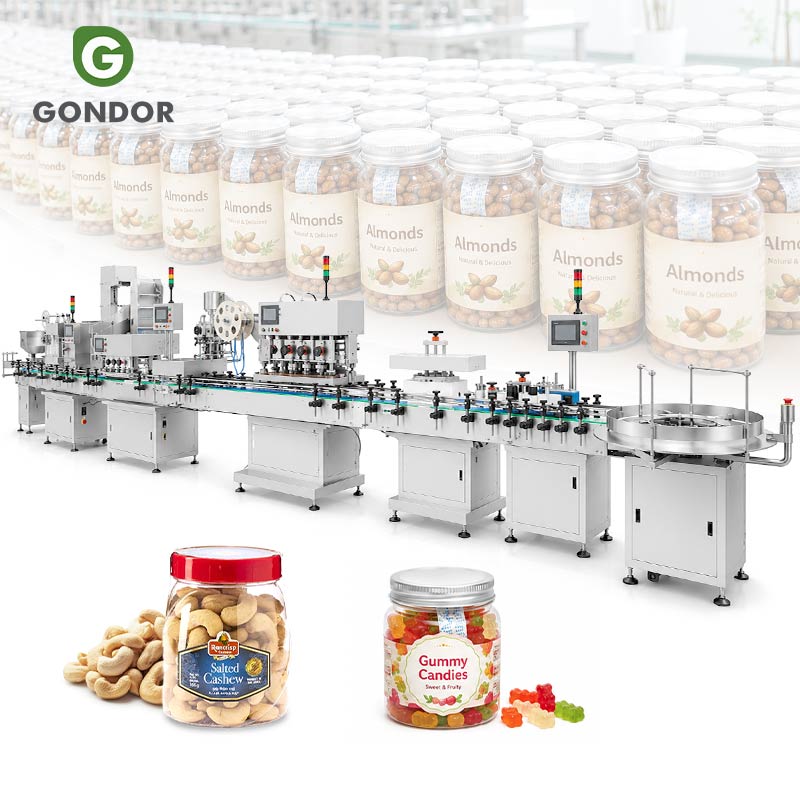
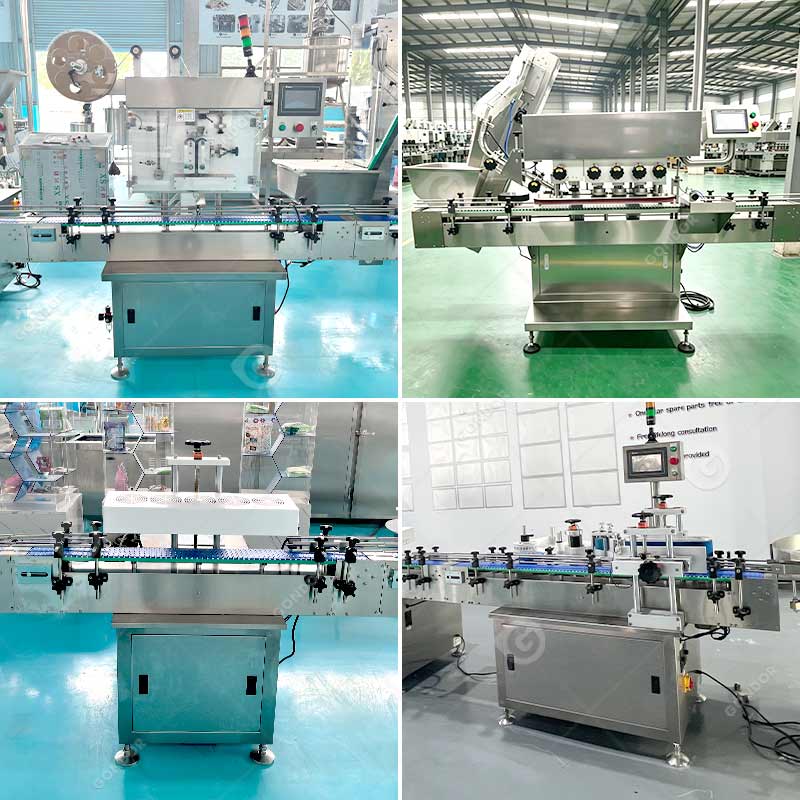
Unscrambling, photoelectric counting, capping and labeling on one automatic line at ≥99.5% accuracy, without adding operators in peak season.
Seven People Around One Counting Table Is What a Counting Bottling Line Replaces
For products bottled by the piece, manual counting is close to a hard ceiling: one table, a few trays and seven or eight workers fill only so many bottles a day, and the error rate climbs after the first two hours. Candy and nut processors feel this hardest in peak season, when a manual crew simply cannot keep up with orders.
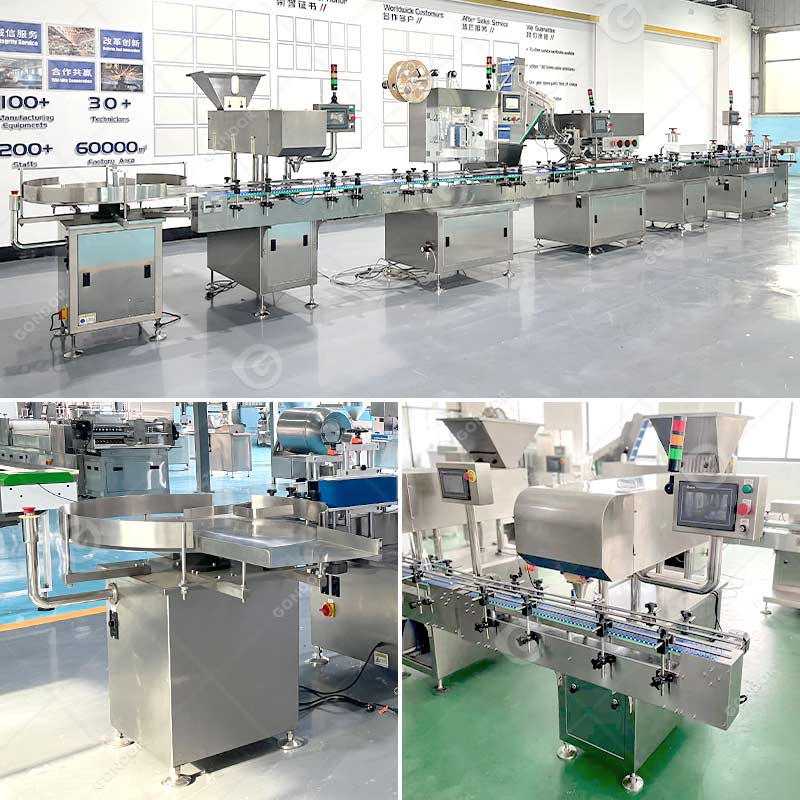
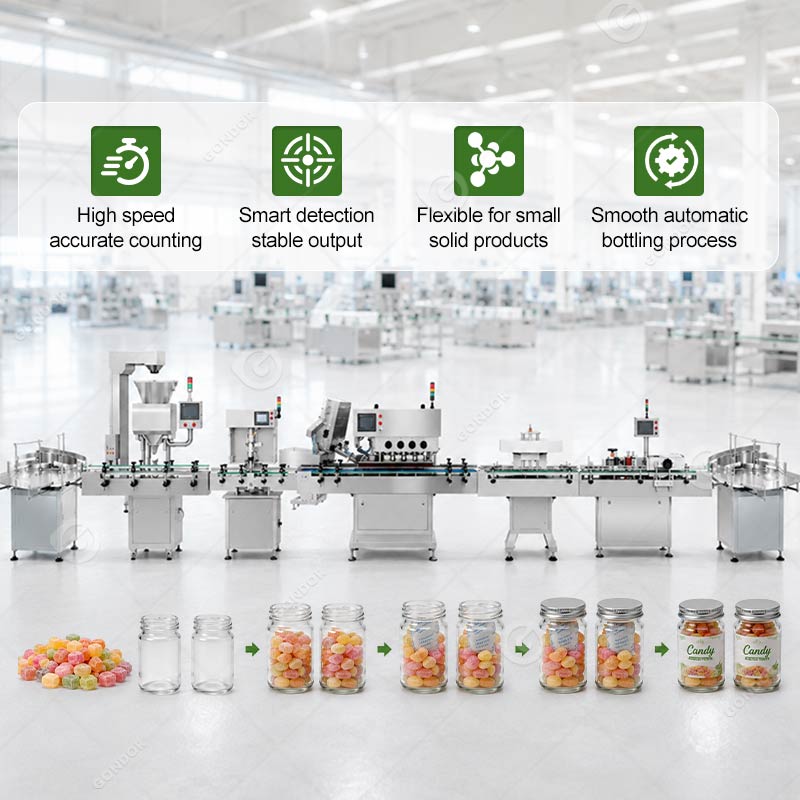
This counting bottling line strings every stage into one flow. Empty bottles are unscrambled and fed automatically, material is lifted into the counting machine, pieces are counted by photoelectric sensors and dropped per preset quantity, desiccant is inserted automatically, and capping, induction sealing and labeling follow in sequence, with bottles gathered at the end ready for cartoning. The counting station uses electronic infrared detection at ≥99.5% accuracy, with every channel counting independently. A range of 1 to 9999 pieces per bottle covers everything from chewing gum to nuts, and 4 to 16 channels are chosen against your output target.
Counting Bottling Line Technical Data, Line Length and Output
Line overview (line-level figures)
| Item | Specification |
|---|---|
| Line type | Fully automatic counting bottling line |
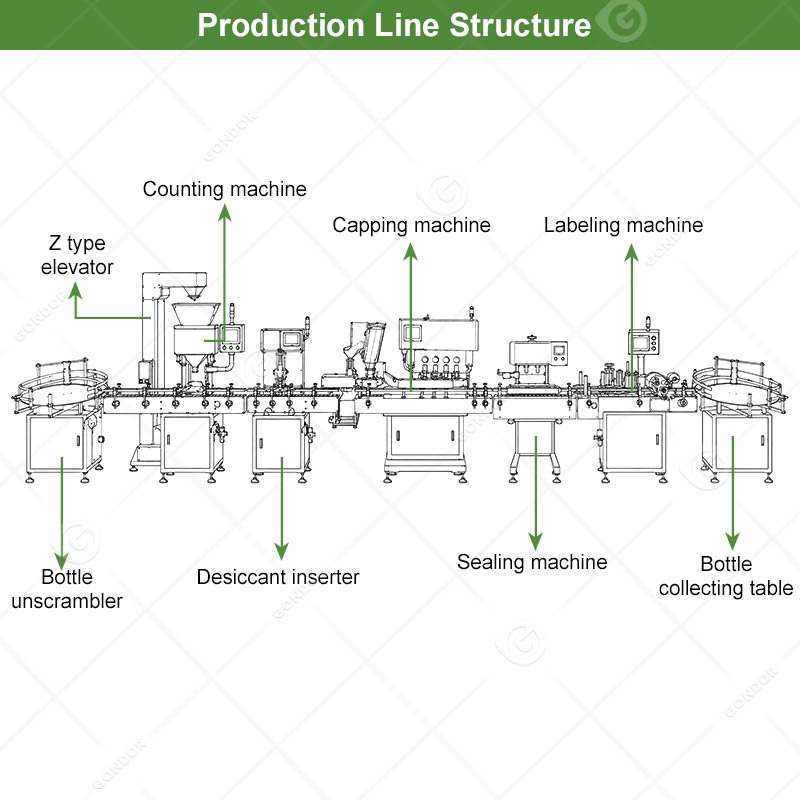
| Stations | Unscrambling, lifting, counting, desiccant insertion, capping, induction sealing, labeling, collecting |
| Counting station speed | 40-90 bottles/min |
| Count accuracy | ≥99.5% |
| Counting range | 1-9999 pcs/bottle (adjustable) |
| Counting channels | 4 / 8 / 12 / 16, optional |
| Counting method | Electronic infrared photoelectric sensing |
| Applicable materials | Candy, gummies, chewing gum, chocolate beans, nuts, seeds, beans, small snacks, hardware pieces |
| Applicable containers | 10-500 ml round and square bottles; plastic, glass |
| Voltage | 110 V / 220 V / 380 V |
| Line power | 5.35 kW |
| Line dimensions | 12380×1360×2380 mm |
| Line weight | 2355 kg |
| Automation | Fully automatic |
| Certification | CE, ISO 9001, ISO 14001, ISO 45001, BSCI, ETL |
| OEM / ODM | Accepted |
Note: the line is recorded under the internal code GD-ACBL. Station codes (LPJ, SLJ, GZJ, XGJ, FKJ, TBJ series) are used for spare parts and retrofit communication, and private labeling is available.
Station specifications (per the official single-machine data sheets)
| Station | Applicable bottles | Speed | Power supply | Air | Dimensions | Weight |
|---|---|---|---|---|---|---|
| Unscrambler LPJ-200A | Diameter 20-100 mm, height 30-160 mm, round bottles | ≥3000 bottles/hour (50 ml bottle); about 60-80 bottles/min (e.g. 50 mm diameter, 50-150 mm high) | Single phase AC220 V±10%, 50 Hz; 0.5 kW | 0.6 MPa | 1700×850×1100 mm (packed 1860×1010×1260 mm) | 280 kg (packed 320 kg) |
| Feeding / collecting turntable | 10-300 ml round and square plastic bottles | 40-100 bottles/min; count accuracy ≥99.5% | AC220 V, 50 Hz; 0.2 kW | 0.6 MPa | Turntable diameter 800 mm (customizable); about 800×800×1000 mm | 260 kg |
| Z type elevator | Customized to the material | Follows the counting station | AC110 V, 60 Hz; 0.7 kW | 0.6 MPa | 2700×598×2385 mm | n-a |
| Counting machine SLJ-16A (16 channels) | Diameter 20-60 mm, height 30-120 mm, 10-300 ml round or square plastic bottles | 40-90 bottles/min (e.g. about 80 bottles/min at 60 pcs/bottle, depending on material and neck) | AC220 V, 50 Hz; 1.1 kW | 0.6 MPa | 1560×1360×1450 mm (packed 1670×1470×1570 mm); conveyor 850±50 mm from floor; 60 L hopper | 600 kg (packed) |
| Desiccant inserter GZJ-120A | Diameter <120 mm, height 35-130 mm, round or square bottles | 20-100 bottles/min | n-a | 0.6 MPa | 1360×700×1600 mm (packed 1520×870×1810 mm); ribbon Φ300-350, width 50-70 mm, length 30-45 mm (customizable) | 310 kg (packed) |
| Capping machine XGJ-160B | Cap diameter 20-75 mm, bottle height 50-150 mm, 20-500 ml round, oval, square or flat bottles | 50-150 bottles/min | AC220 V, 50 Hz; 1.2 kW | 0.6 MPa | 2500×1100×1850 mm (packed 2660×1310×2150 mm); hopper 600×500×550 mm (about 80 L); missing-foil rejection | 680 kg (packed 850 kg) |
| Induction sealer FKJ-200A | Diameter <120 mm, height 95-220 mm, neck 20-70 mm or 70-120 mm, 15-500 ml | 50-120 bottles/min | AC220 V, 50 Hz; 2 kW | 0.6 MPa | 1560×772×1175 mm (packed 1720×910×1360 mm) | 140 kg (packed) |
| Labeling machine TBJ-120A | Round bottles <120 mm diameter, height <120 mm, 15-500 ml | 30-120 bottles/min | AC220 V, 50 Hz; 0.15 kW | 0.6 MPa | 1900×940×1450 mm (packed 2160×1100×1660 mm); conveyor 850±50 mm from floor | 395 kg (packed) |
How a Counting Bottling Line Routes a Bottle From Unscrambler to Case
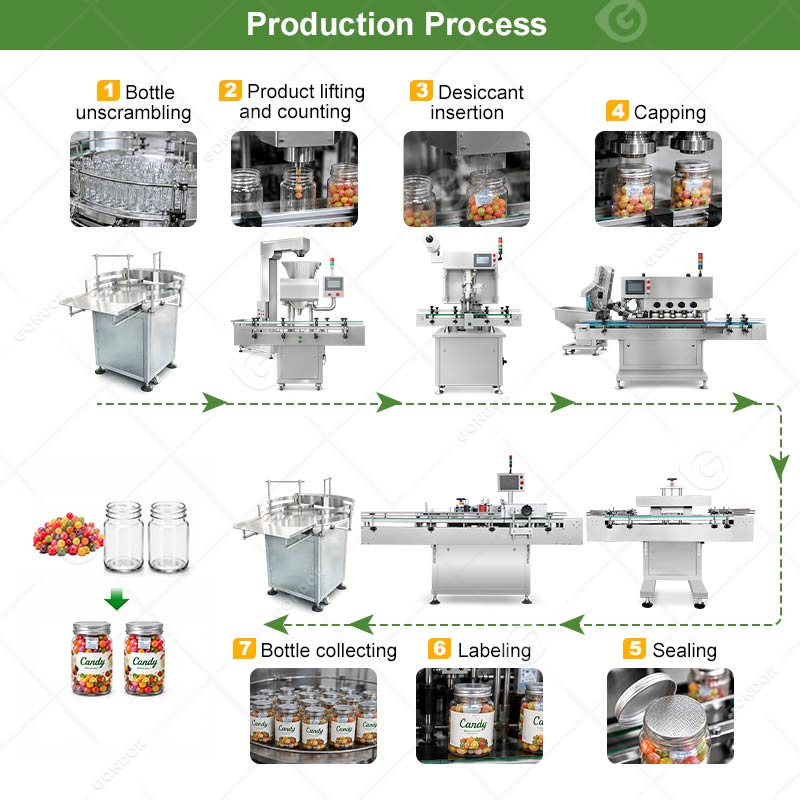
In short. Loose empty bottles are lined up by the unscrambler onto the conveyor. Material is lifted by the Z type elevator into the counting hopper, vibrated into the counting channels piece by piece, and dropped as a batch once the preset count is reached. Filled bottles then pass desiccant insertion, capping, induction sealing and labeling, and are gathered at the collecting table. Stations are interlocked: no bottle means no count, no insertion and no capping, and abnormality stops the line.
Product Performance Advantages
- Every channel counts on its own, at ≥99.5% accuracy. Electronic infrared sensors count piece by piece, with channels independent of each other. For candy and nuts sold by count, accuracy is the complaint rate.
- Nothing moves without a bottle. Counting, insertion and capping all carry no-bottle detection: no bottle, no discharge, no desiccant, no capping. Abnormal bottles are rejected, and loss and rework stay low.
- Product changes are parameter changes. Pieces per bottle, vibration frequency and conveyor speed are set on the touch screen. Bottle changes adjust gates and conveyor parts, so even mixed small batches keep moving.
- Desiccant insertion never jams. A twin four-roller drive feeds the ribbon, cuts to length in sync with the line, reads the color mark, and cuts accurately.
- Sealing works with rejection upstream. The capper’s missing-foil sensor ejects unlined bottles before sealing, so poorly sealed bottles never reach the carton.
- Stations stand alone or scale as needed. All eight stations work as independent machines. Buy only the missing ones, and leave the standard conveyor interface open for coders, checkweighers and cartoners later.
Station Engineering
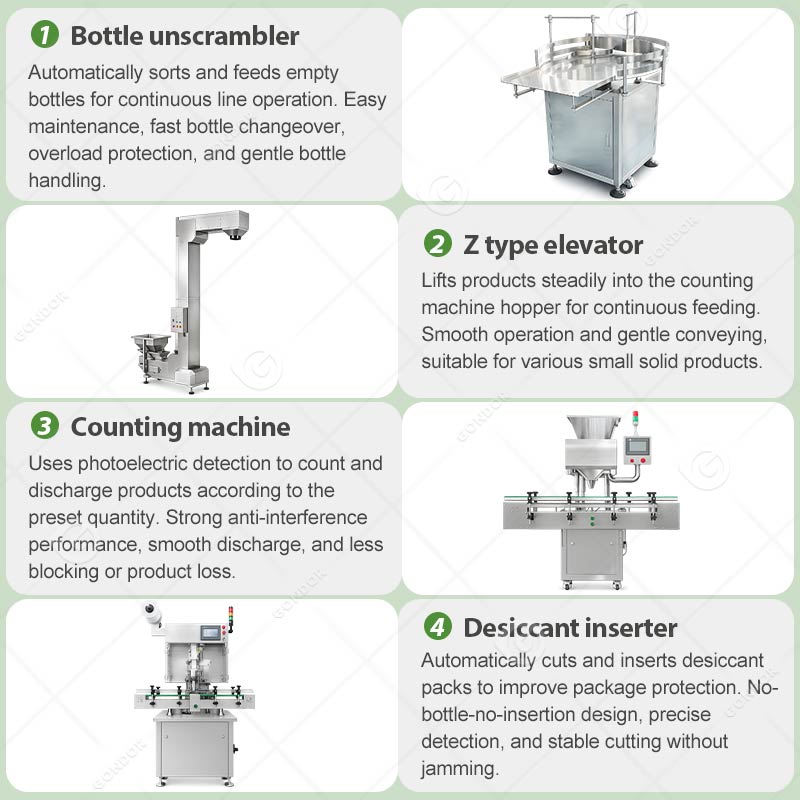
Bottle unscrambler (internal code LPJ-200A). Rotary table with elastic turning plates, gentle on bottles, quick format change and overload protection. At 40 to 100 bottles/min it outruns the counting station, so the front end never starves the line.
Z type elevator. Hopper-type continuous lifting in SS304, with hopper and speed customized to the material, keeping breakage and bruising minimal.
Counting machine (internal code SLJ-16A). A 16-channel electronic counter at 40 to 90 bottles/min, 1 to 9999 pieces per bottle and a 60 L hopper. Channel count sets the capacity ceiling, with 4, 8, 12 and 16 channels to choose from. This station sets the pace of the whole line, and every other station is sized faster than it.
Desiccant inserter (internal code GZJ-120A). Single head, 20 to 100 bottles/min, taking ribbon 50 to 70 mm wide and 30 to 45 mm long, customizable.
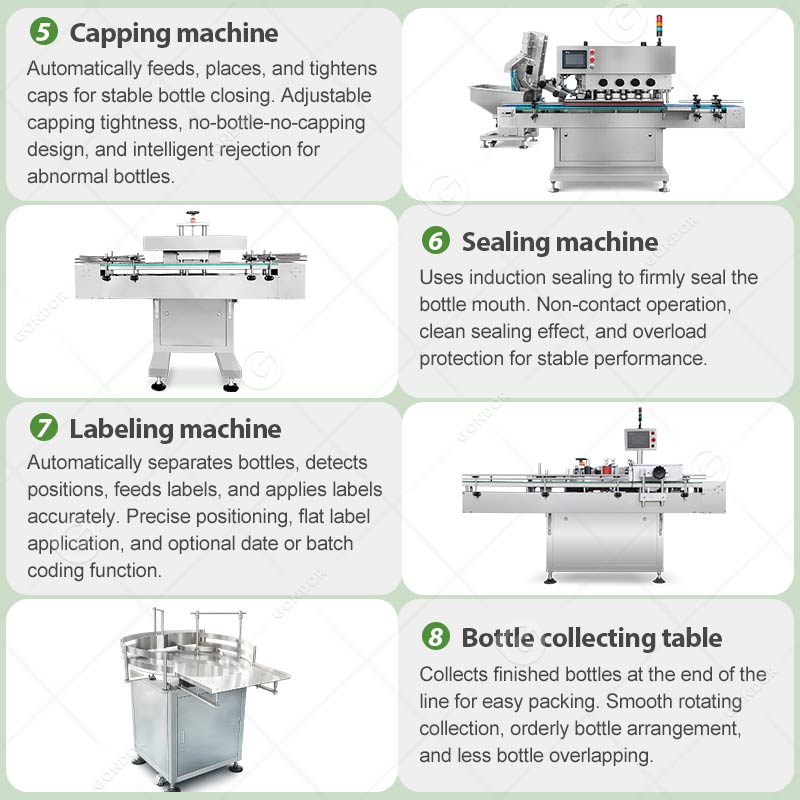
Capping machine (internal code XGJ-160B). 50 to 150 bottles/min, cap diameter 20 to 75 mm, adjustable torque, an 80 L cap hopper, and missing-foil rejection.
Induction sealing machine (internal code FKJ-200A). Air or water cooled induction head, 50 to 120 bottles/min, non-contact heating for a firm, moisture-tight seal.
Labeling machine (internal code TBJ-120A). 30 to 120 bottles/min for round bottles, optional date and batch coding, label position fine-tuned on the screen.
Collecting table. Rotary gathering for orderly bottles at the cartoning point.
Rate logic. Line speed follows the counting station at 40 to 90 bottles/min. The desiccant inserter (20 to 100) and labeler (30 to 120) dip below typical counting rates at their lower ends, so plan capacity on the counting station and check the slowest station floor for extreme bottle formats.
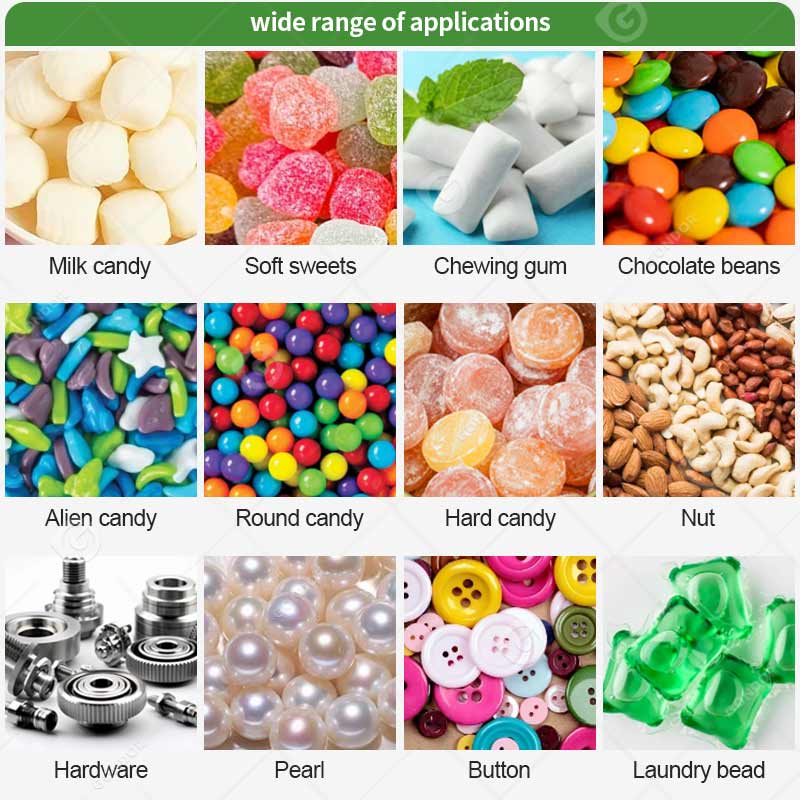
Product Types a Counting Bottling Line Can Handle
Candy and snack foods. Counting and bottling of hard candy, gummies, chewing gum, chocolate beans and small snack pieces. This is the line’s home ground.
Nuts and roasted snacks. Kernels of peanut, pistachio and sunflower bottled by the piece, where counting accuracy is directly tied to fair settlement by count.
Seeds and beans. Quantitative counting and filling of seeds, beans and raisins.
Hardware and light-industry small parts. Counting of screws, washers and plastic pieces into bottles or boxes. Metal piece counting is a natural extension of this line.
Contract packaging centers. Toll packers handling counting and bottling for many brands, where fast changeover between small mixed batches pays off.
Specifying a Counting Bottling Line Against Your Carton Count
Fix three things before choosing the channel count.
- Material and count per bottle. Material name, piece size and target pieces per bottle. These two items decide channel count and vibratory feeding configuration.
- Bottle and cap. Diameter, height, capacity, cap diameter and closure method, whether induction sealing is required. These decide the compatibility range of the unscrambler, capper, sealer and labeler.
- Target capacity. Bottles per minute. Calculate on the counting station at 40 to 90 bottles/min, and plan peak season against the upper limit so the line is not born saturated.
Limits worth stating plainly. The line is built for rigid bottles of 10 to 500 ml, and irregular large pails are outside the standard range. Count accuracy is settled by trial data, and transparent or strongly reflective pieces must be confirmed in advance. The line is about 12.4 m long, so confirm straight-line floor space or allow a turning layout before installation.
Customization, Commercial Terms and After-Sales
Customization. OEM and ODM are both accepted. Channel count (4, 8, 12, 16), elevator hopper, conveyor length, voltage and language interface are configured to order. Coders, checkweighers, cartoners and other downstream machines can be integrated. MOQ is one line, and a custom channel count or conveyor length is quoted with the offer.
Commercial terms. MOQ is one line. Standard lead time is 16 to 30 days (16 days for one line, 30 days for up to five lines, subject to production scheduling). Export packing is a waterproof membrane inside a plywood case. Trade terms are FOB, CIF or DAP as agreed.
Inspection and after-sales. Pre-shipment video inspection and a mechanical test report are provided. Core components carry a one-year warranty with lifetime technical support. Faults are diagnosed remotely first, and engineers are dispatched for on-site installation, commissioning and operator training when needed. Spare channels, sensors, belts and cap chucks stay available after the warranty period and can be quoted with the line.
Counting Bottling Line Questions From First-Time Buyers
1. Which materials can this line count?
Candy, gummies, chewing gum, chocolate beans, nuts, seeds, beans, small snack pieces, and hardware such as screws and washers. Transparent or strongly reflective pieces need a sample confirmation.
2. What is the line speed?
The counting station runs at 40 to 90 bottles/min and sets the pace. Real output depends on pieces per bottle, material flow and neck diameter, and heavy counts run slower.
3. How is counting accuracy guaranteed?
Electronic infrared photoelectric counting with independent per-channel detection at ≥99.5%. A sample trial on your material is the recommended proof.
4. How long does a bottle changeover take?
Adjust gates, conveyor and capper lift. A practiced team finishes within one shift. A material change is mostly counting parameters and vibration frequency.
5. Can I drop a station?
Yes. All eight stations are modular and independent. Keep or remove stations as your process requires, for example skipping desiccant insertion or induction sealing.
6. What site conditions are required?
Power at 110, 220 or 380 V per order. Most stations need a 0.6 MPa air supply. The line is about 12.4 m long and 1.36 m wide, with no special floor load requirement.
7. Can I add coding or cartoning later?
Yes. The conveyor is a standard interface and accepts coders, checkweighers, cartoners and palletizers.
8. How are warranty and after-sales arranged?
Core components carry a one-year warranty with lifetime technical support. Remote diagnosis comes first, and engineers go on site when needed. Pre-shipment video inspection and a mechanical test report are included.
From Line Layout to Counting Bottling Line Start-Up
Send over the material name, piece size, pieces per bottle, bottle format and target capacity, and we will propose a channel configuration with a line quotation. A sample trial verifies accuracy and speed in one pass, with the counting log and filled bottles arriving before any configuration decision.
Contact
Henan Gondor Machine Co., Ltd. Website inquiry form, WhatsApp or email. Replies within 24 hours on working days.
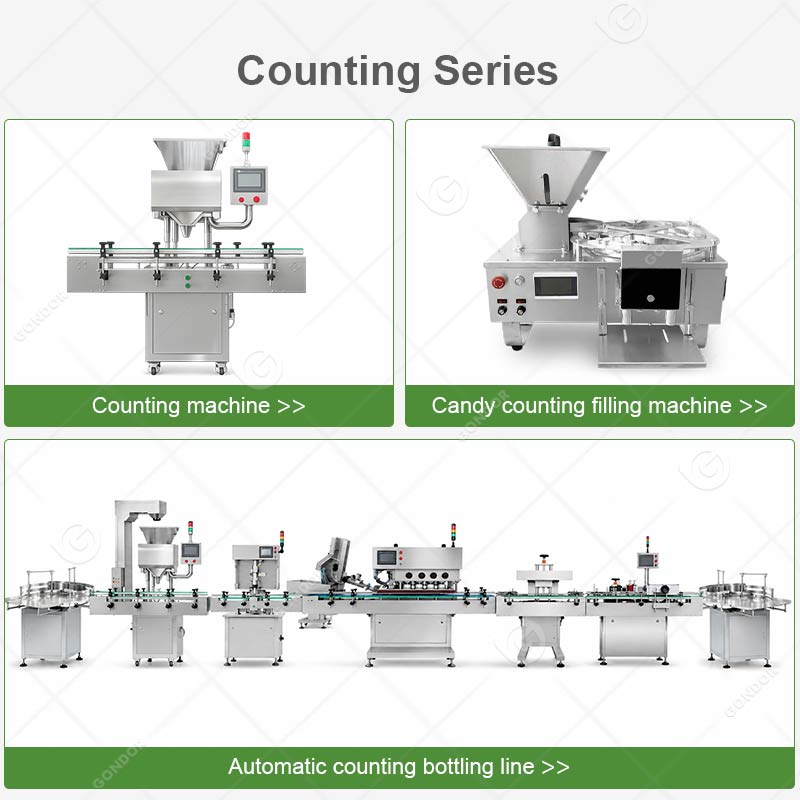
Related Equipment
- Counting Machine — the counting station on its own, when capping and labeling already exist
- Powder Filling Production Line — for products weighed into the bottle instead of counted
- Liquid Filling Production Line — the same station sequence for liquid fills
- Complete Water Bottling Line — treatment, blowing and filling from 3,000 bottles an hour
Request Counting Bottling Line Pricing and Layout Drawing
Send us the daily volume, the product and the container or pack format you are working with, and we will come back with a model recommendation, a utility list and a price.





