

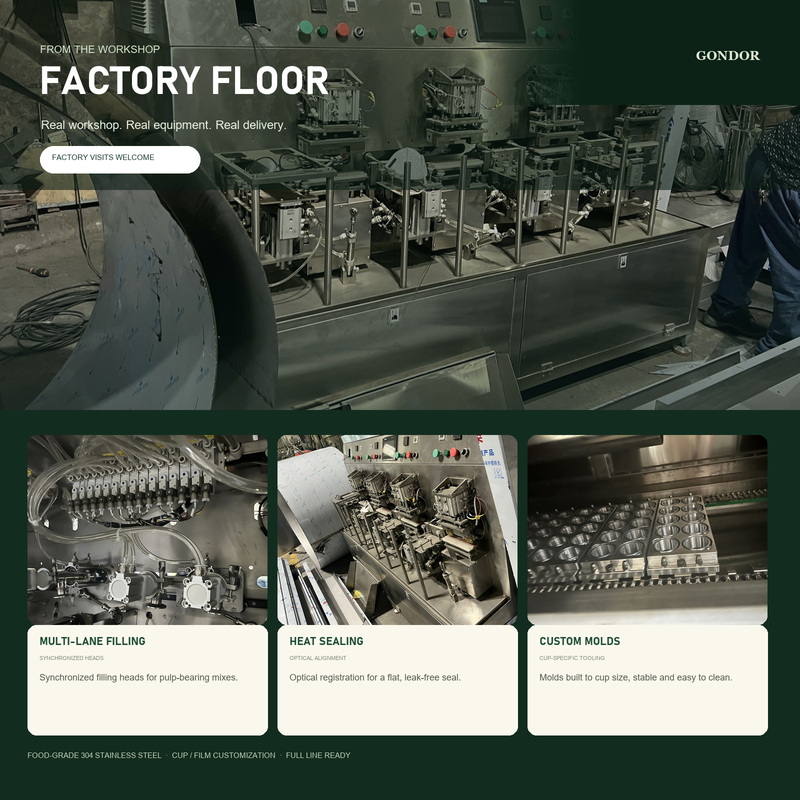
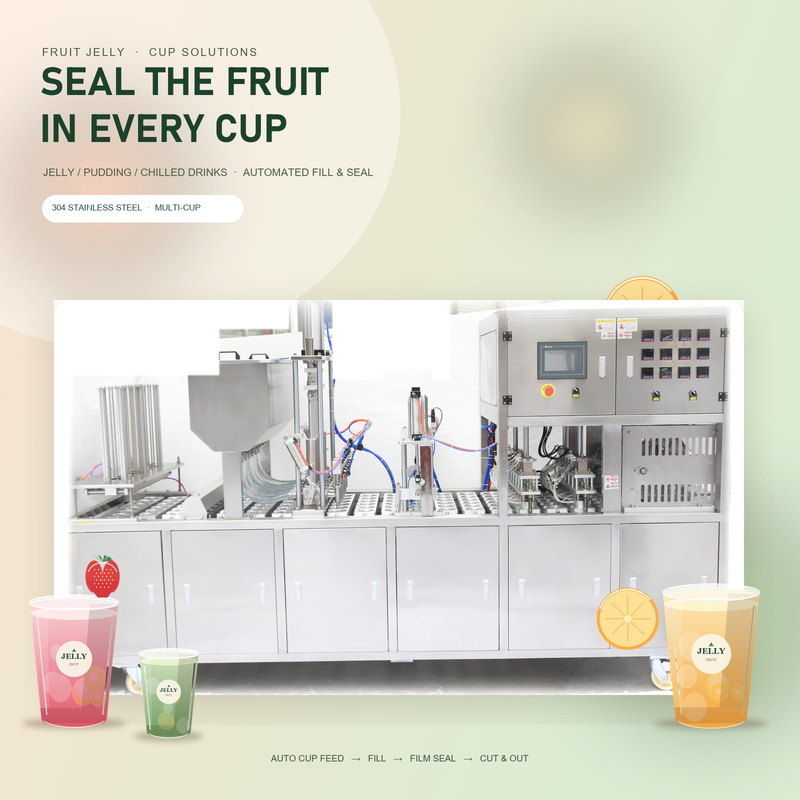
A jelly and pudding filling and sealing machine that synchronizes dose with film position, giving a flat seal with no leakage and no misaligned cups.
Half of a Jelly Cup Quality Is Decided in One Second of Sealing
For gelled products like jelly and pudding, texture is set at the batching stage, but appearance is decided at sealing. Hand filling gives uneven doses, and manual heat sealing runs tight one moment and loose the next. The usual complaints pile up: bubbles under the film, weak seals that leak, crooked lidding, cups slipping out of position. A retail customer judges the whole batch by the first look at the seal, flat and centered or not.
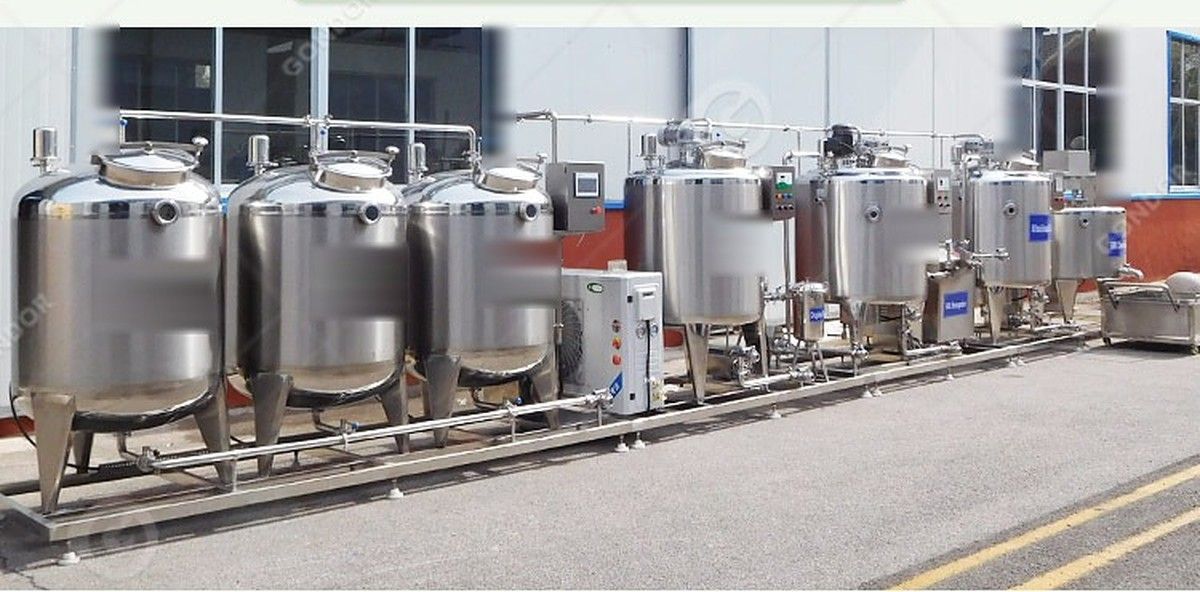
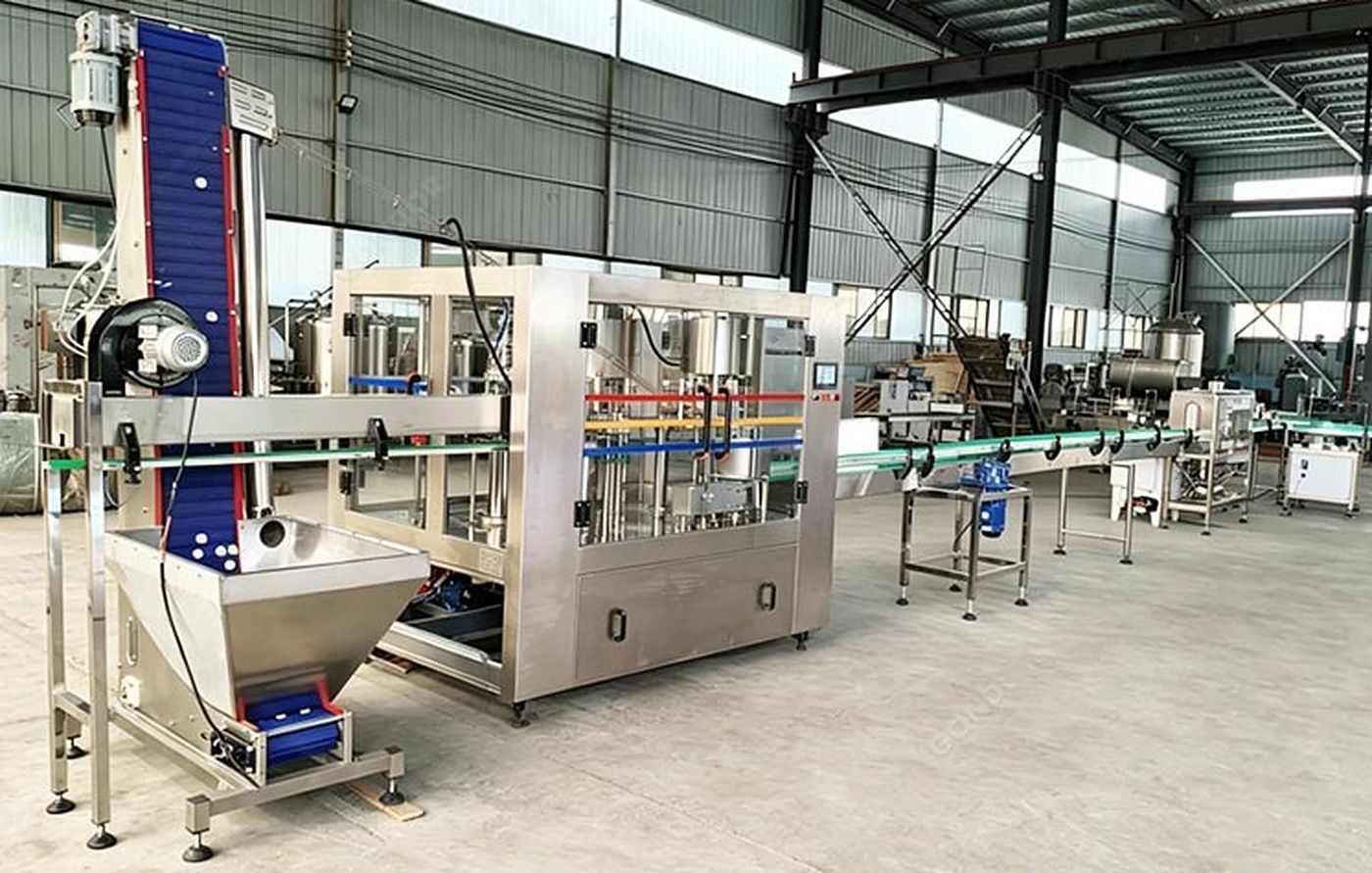
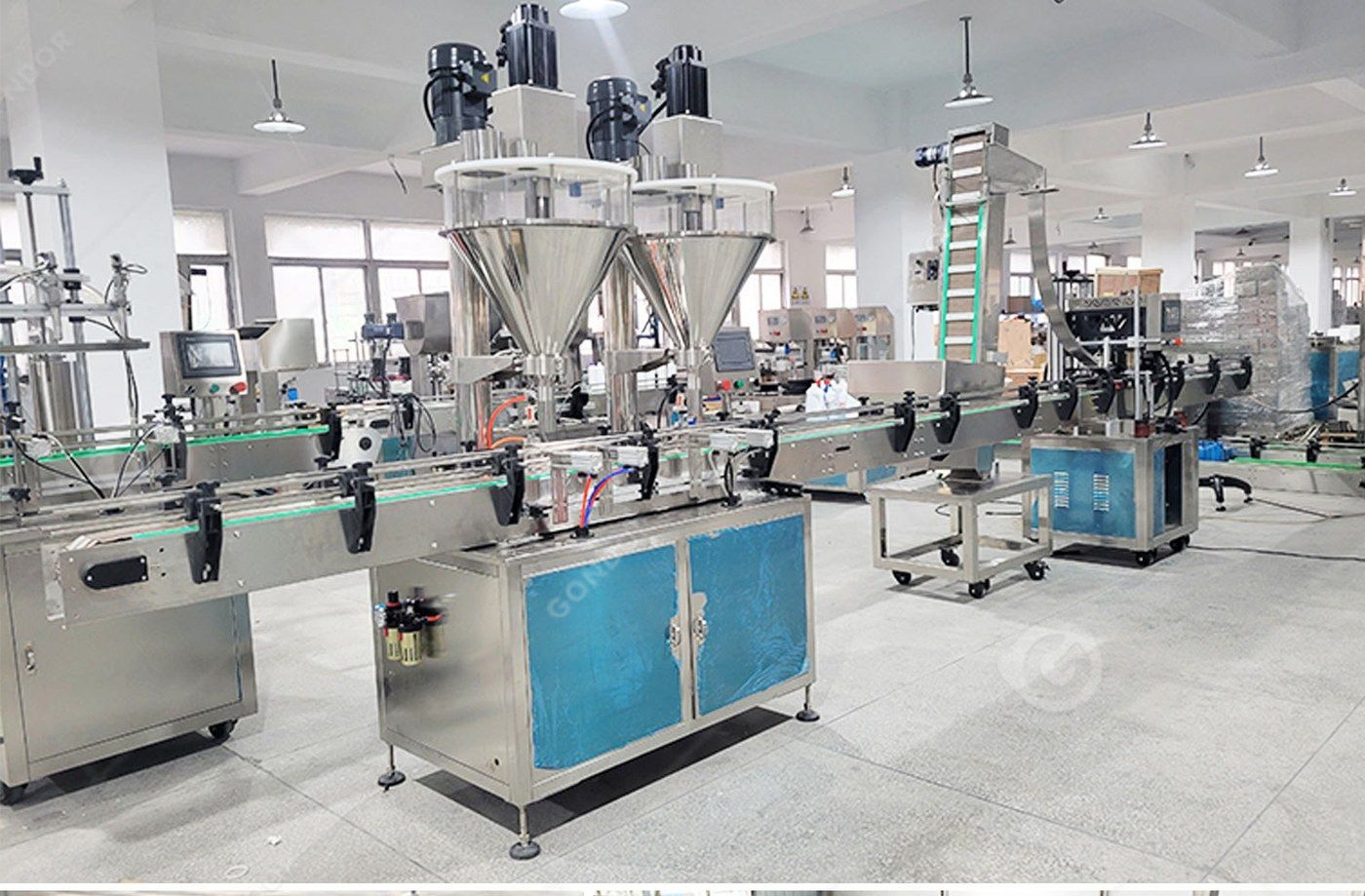
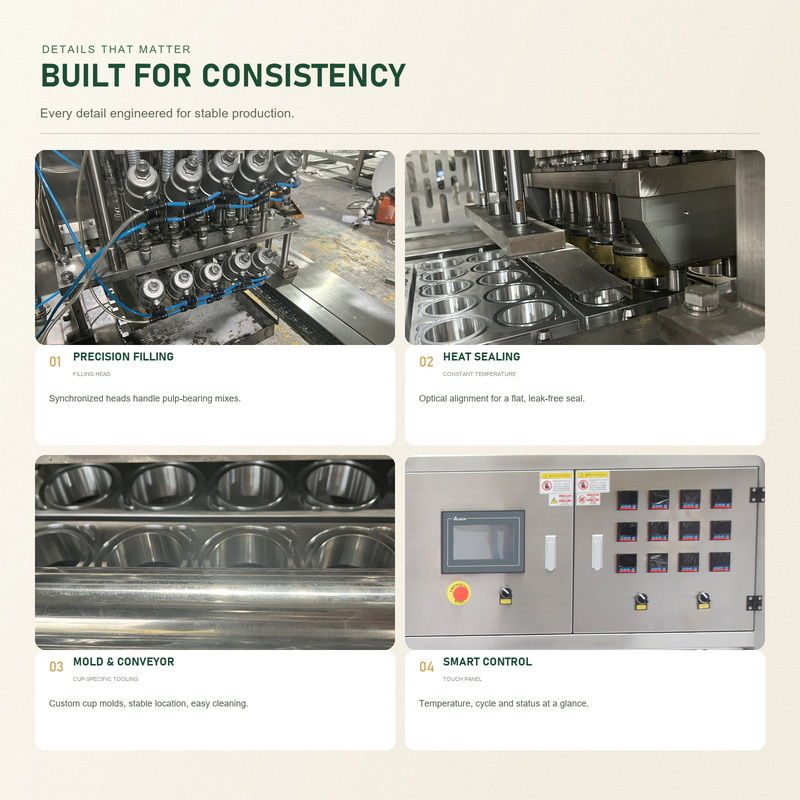
The core station of a jelly making line is exactly this filling and sealing step. The machine strings automatic cup dropping, dosing, film feeding, heat sealing, edge trimming and cup discharge into one automatic cycle. A microcomputer controller runs the rhythm with a high-precision photo-sensing positioning system that recognizes the cup format and calibrates the sealing position, replacing the old pattern of manual filling, hand sealing and hand trimming. The body is food grade 304 stainless steel, waterproof, rustproof and resistant to acid and alkali. One boundary worth stating: this machine handles filling and sealing only. Upstream dissolving and batching needs a melting and holding tank, and downstream setting needs a water-cooling conveyor; the three machines form a complete jelly line.
Jelly Cup Filling and Sealing Machine Specifications
The source material provides no parameter data per model. The table below lists the parameter items for the three machine types; specific values await official confirmation.
General parameters
| Item | Specification |
|---|---|
| Body material | Food grade 304 stainless steel |
| Control | Microcomputer control with high-precision photo-sensing positioning |
| Applicable materials | Thin liquid, semi-fluid and fruit-pulp jelly liquids |
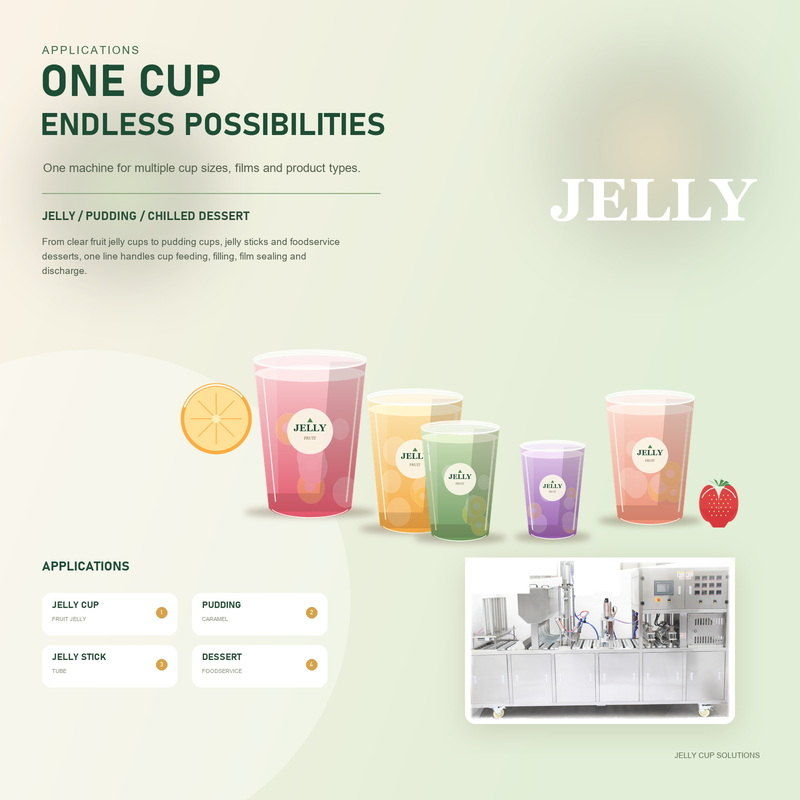
| Applicable products | Jelly, pudding, frozen drinks and other gelled foods |
| Certification | Quoted per order |
| OEM / ODM | Quoted per order |
How a Jelly Cup Filling and Sealing Machine Runs a Cup Cycle
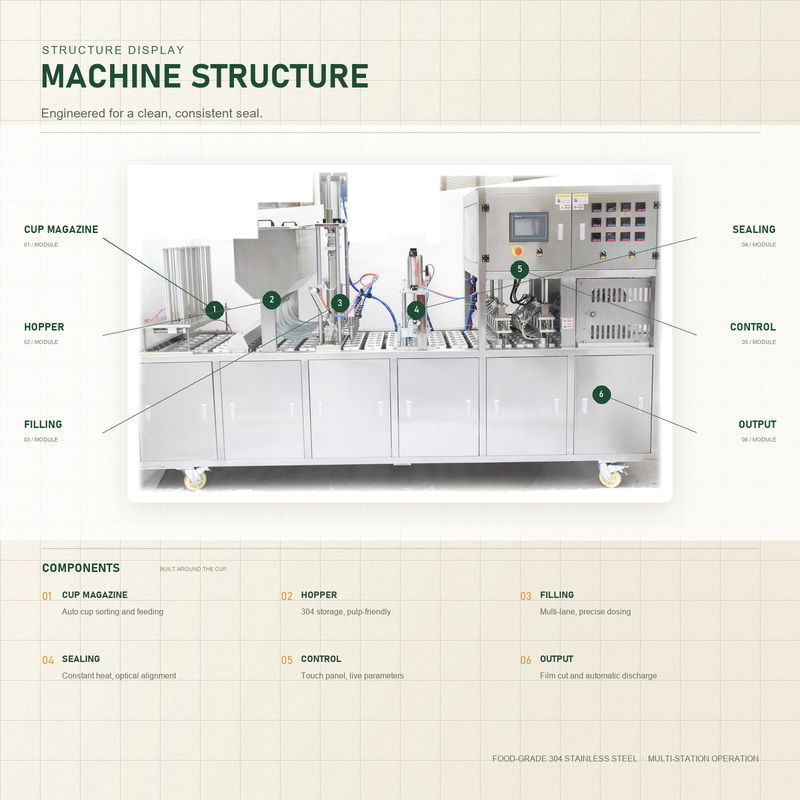
In short. One cycle runs through six motions: a cup drops automatically into the cavity, the dosing pump fills the jelly liquid, the film roll feeds and covers the cup mouth, the heat-sealing head bonds film to rim at constant temperature, the cutter trims the excess film, and the finished cup discharges. The microcomputer schedules the rhythm and photo sensors verify cup and film position cup by cup, correcting any drift on the fly. That is the structural basis of a seal that sits flat without bubbles.
Product Performance Advantages
- Stable sealing quality, reject rates pushed down. Precision constant-temperature heat pressing plus photo registration give a seal that holds: no leakage, no bubbles, no film lift. Uniform appearance also means more consistent shelf performance.
- Fully automatic from end to end, labor only at both sides. Nobody touches the product between cup dropping and discharge, metered dosing cuts material loss, and over long batch runs both labor cost and scrap rate come down.
- One machine for multiple cup sizes, films and product types. Switching molds and film rolls changes the spec, so jelly, pudding and frozen drinks do not each need their own machine.
- 304 stainless body, hygiene compliant and easy to clean. Product-contact parts meet food production hygiene requirements; the body resists water, rust and acid-alkali, and routine washdown leaves no dead corners.
- Three machine tiers from corner shop to mass production. A semi-automatic tabletop version, a fully automatic all-in-one and an inline multi-station high-speed version cover the range, each running standalone or docking into a jelly line.
Engineering Design and Operating Procedure
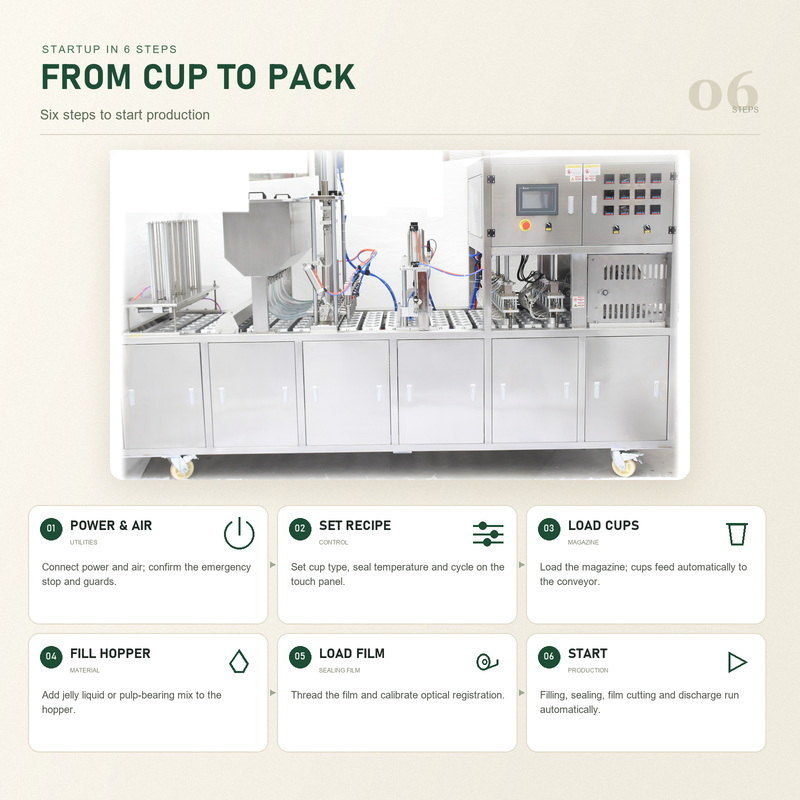
Structure. Four functional units make up the machine: filling position, sealing position, control panel and waste film recovery unit. The panel centralizes dosing volume, sealing temperature and cycle settings, and the recovery unit winds up trimmed film automatically so the station stays clean without stopping the line.

What photo positioning is worth. Whether a seal sits straight depends on how accurately film and cup align. The photo-sensing system checks every cup and self-corrects, turning a job that used to depend on a veteran’s hands into a stable machine output. It is the key component against crooked film and cup misalignment.
Operating procedure. 1 Power on, set dosing volume, sealing temperature and cycle rate, and preheat the sealing head. 2 Load cups, film and product liquid. 3 The machine runs cup dropping, filling, sealing, trimming and discharge automatically. 4 Sample per-cup weight and seal appearance at intervals. 5 At the end of a run, drain the feed line and clean all product-contact parts.
What a Jelly Cup Filling and Sealing Machine Handles
Mid-size processing. Small and mid-size food plants, central kitchens, snack food workshops and chain dessert supply chains producing cup desserts to a standard, in stable volumes for store channels.

Large-scale industry. Jelly manufacturers, mass-production food plants and export-oriented food processing bases, docking into a full automatic jelly line for continuous high-speed output.
Retail counters and front-shop back-kitchen. The semi-automatic tabletop version suits small retail and made-to-order settings, with a small footprint and a short learning curve.
Line integration. A melting and holding tank upstream handles batching and holding, a water-cooling conveyor downstream handles setting, and this machine fills and seals in between: three machines, one complete jelly line.
Sizing and Selection of a Jelly Cup Filling and Sealing Machine
Pick by production format. Corner shops and counters look at the semi-automatic tabletop version; mid-size factories running standardized batches look at the fully automatic all-in-one; mass-production plants and export bases look at the inline multi-station high-speed version with line-docking interfaces reserved. Output and power ratings depend on the cup format and the dosing head count, so they are confirmed against your sample cup.
Customization. The machine adapts to multiple cup sizes, films and product categories, with molds custom-made per cup format. OEM and ODM scope, tooling lead time and MOQ is quoted with the offer.
Quality Inspection and After-Sales
Pre-shipment inspection. Video inspection and a mechanical test report are provided before dispatch.
Warranty and technical support. Core components carry a one-year warranty with lifetime technical support; faults are diagnosed remotely first.
Wear parts. The source material lists no dedicated wear parts; suggested spare list and supply cycle are quoted with the machine.
Jelly Cup Filling and Sealing Questions Buyers Ask
1. Can this machine produce jelly on its own?
This machine covers filling and sealing, the core stations of a jelly line. Upstream dissolving and batching needs a melting and holding tank, and downstream setting needs a water-cooling conveyor; the three machines form the complete line.
2. Can it fill jelly with fruit pulp?
Yes. Thin liquids, semi-fluids and recipes with fruit pulp pieces are all within range, with dosing set on the microcomputer. For unusually large pieces or long fibers, send a sample for a trial run first.
3. Can it fix bubbles, leaks and crooked film?
That is exactly what the machine is built for. A constant-temperature sealing head keeps bonding strength even on every cup, and photo-sensing registration calibrates film position cup by cup. The chronic faults of hand sealing, weak seals, bubbles, crooked film and cup misalignment, are engineered out one by one.
4. How do I choose among the three machine types?
Match your production format: corner retail takes the semi-automatic tabletop version, mid-size factories take the fully automatic all-in-one, and mass-production or export plants take the inline multi-station high-speed version. Output figures follow the cup format and head count, so ask for the figure that matches your cup before deciding.
5. Is switching cup sizes and films troublesome?
Cup changes mean a mold change, films change by roll, and the microcomputer resets dosing and sealing temperature. Adapting to multiple cups, films and product types on one machine is the point of this equipment; no per-category machine purchase is needed.
6. Can it dock into my existing line?
Yes. The machine is designed for line integration: a melting and holding tank feeds it from upstream and a water-cooling conveyor takes over downstream. Send your existing equipment parameters and we confirm interface compatibility.
7. What does routine maintenance involve?
Drain the feed line and clean product-contact parts at the end of production, keep the sealing head and cutter clean, and check the photo sensors for liquid splashes. The source material lists no dedicated wear parts; build a service log by actual shift pattern.
8. Can you build a custom machine under our brand?
OEM and ODM scope, tooling lead time and MOQ are confirmed against your sample and pack format. Send cup samples and your capacity requirements and we will respond with a project assessment.
Getting Started With a Jelly Cup Filling Project
If your product category, cup format and target output are already clear, send those three items with photos of your cups and we will propose the machine tier, line configuration and a formal quotation. To check sealing quality first, send cups and film for a factory trial run and we will mail back sealed sample cups for your inspection.
Contact
Henan Gondor Machine Co., Ltd. Website inquiry form, WhatsApp or email. Replies within 24 hours on working days.
Related Equipment
- Liquid Filling Production Line — bottles rather than cups, 10 to 1000 ml
- 3-in-1 Filling and Capping Machine — rotary small-dose filling for 5 to 30 ml bottles
- Tube Filling and Sealing Machine — tube filling with ultrasonic sealing
- Mixing Tank — for dissolving and holding the jelly batch upstream
Ask for Jelly Cup Filling and Sealing Machine Pricing
Send us the daily volume, the product and the container or pack format you are working with, and we will come back with a model recommendation, a utility list and a price.