



Jelly Cup Filling and Sealing Machine
Cheese that smears, stretches around a wire or breaks into crumbs may be arriving at the cutter in the wrong condition. The cutting grid matters, but product temperature, moisture, block geometry and feed motion can be equally important.
Before replacing a cutter or increasing its speed, identify whether the defect begins in the cheese, the tooling or the way the block enters the cutting zone.
How a wire-grid cutter forms portions
A positioned cheese block moves toward a cutting frame. Tensioned wires or a suitable grid divide it at a defined spacing. A second cutting direction or a further pass may be needed to produce the final cubes or sticks, depending on the machine arrangement.
The grid determines nominal spacing. It cannot straighten an irregular block or restore a cheese structure that is too soft for the selected process. The discharge arrangement must also preserve portions after the cut, since pieces can stick or break while falling into a collection bin.
Start by recording the product condition
Take samples from the beginning, middle and end of the run. Record cheese variety, block dimensions, core temperature and time out of cold storage. A surface temperature alone can miss a warmer or colder centre.
If early blocks cut well but later ones smear, investigate warming while blocks wait at the infeed. If defects occur in only one batch, compare moisture and firmness with the accepted batch before changing machine settings.
There is no universal cutting temperature for all cheeses. The correct range must be established with the actual product, portion size and tooling.
Match the visible defect to the next check
| Observation | First checks |
|---|---|
| Glossy smears on cut faces | Product softness, surface warming and material accumulating on wires |
| Broken corners and excessive crumbs | Product brittleness, cutting force, wire condition and abrupt feed motion |
| Unequal portions across the block | Infeed alignment, block squareness and grid spacing |
| Pieces stick together after cutting | Product surface condition, discharge height and collection method |
| A defect repeats at the same position | Individual wire condition, frame alignment and the local feed path |
These checks narrow the cause. They do not replace an inspection of the specific cutter by qualified personnel.
Why wire condition changes the result
A loose, damaged or fouled wire can deflect instead of following a stable cutting line. Inspect tooling with the machine stopped and isolated under the equipment procedure. Replace or tension wires to the manufacturer's specification rather than compensating by forcing blocks through faster.
Frame alignment also matters. If the frame meets one edge of the block first, cutting force becomes uneven and the block may shift. Check alignment after tooling changes and verify that guides support the full block geometry.
Keep feeding and collection consistent
An operator pushing blocks by hand at different rates introduces another variable. Stable feed motion helps the cutting frame act on comparable material under comparable conditions.
Collection can hide the benefit of a clean cut. A deep bin may compress fresh portions, and a long drop may damage corners. Check the product immediately after the cutting zone and again after collection. If it is acceptable at the first point and damaged at the second, focus on discharge handling.
A useful sample trial
Run a documented comparison using the intended cheese and final grid. Keep the same block preparation while changing one machine variable at a time. Weigh acceptable portions, crumbs and offcuts separately so the trial measures saleable yield rather than only feed rate.
Photograph the cut faces and record cleaning interruptions. A short demonstration that avoids the normal buildup on tooling does not show how a full production run will behave.
Use a trial that separates cheese effects from machine effects
Prepare comparable blocks from the same cheese batch and record their dimensions before cutting. Compare them at two or more product conditions within the handling range approved for that cheese. Keep the grid, feeding method and collection arrangement unchanged during the first comparison.
If the improvement follows product condition while machine settings remain fixed, the next investigation should focus on conditioning and waiting time. If the same defect remains at the same grid position across all blocks, the tooling or feed path becomes a stronger candidate.
Avoid changing temperature, grid spacing and feed rate at once. A successful combination may be useful, but it does not tell the operator which variable must be controlled during later production. A small comparison with clearly recorded inputs often produces a more useful operating specification than a long demonstration with undocumented adjustments.
Measure portion geometry as well as appearance
Nominal wire spacing describes the tooling. The actual portion can also be influenced by the starting block, deflection and product movement during cutting. Measure portions from the edges and centre of several blocks using the same method.
Record the range of dimensions and whether pieces remain square enough for the intended pack. A photograph of one attractive portion cannot establish consistency across a full block. If the commercial requirement concerns net pack weight, connect the cutting result to that later packing requirement rather than assuming uniform appearance guarantees uniform mass.
An irregular outer block creates edge pieces that differ from the central portions. Decide whether those edges count as saleable product, another SKU or rework before calculating yield. That classification can change the apparent benefit of a proposed cutting pattern.
Turn crumbs and offcuts into a clear material balance
For illustration, imagine 100 kg of incoming cheese produces 94 kg of accepted cubes, 4 kg of usable offcuts and 2 kg of crumbs unsuitable for the main pack. The main-product yield is 94%, while the proportion with another usable destination is different.
Do not describe the full 98 kg of recoverable material as accepted cube output. Equally, do not treat usable offcuts as having no value if the operation already has an approved destination for them. Record categories separately so a purchasing decision reflects the actual business process.
Include material remaining on the belt, grid and collection equipment at the end of the run. A short trial can overlook residue that becomes significant over a shift or changes the cleaning interval.
Check the changeover between portion sizes
A machine may change size by replacing a grid or cutting frame. Ask the supplier to demonstrate the complete change, including removal, cleaning access, installation, alignment and the first accepted product from the new setup.
Store tooling so its identity and condition are clear. Similar-looking frames can produce different dimensions, and a damaged wire can be difficult to notice when the frame is installed hurriedly. Agree on how the operator checks the tooling before release for production.
If the plant regularly switches between cheese varieties, repeat the assessment with the variety that is most difficult to handle. A change in product firmness may matter more than the nominal change in cube size.
Include the upstream and downstream waiting periods
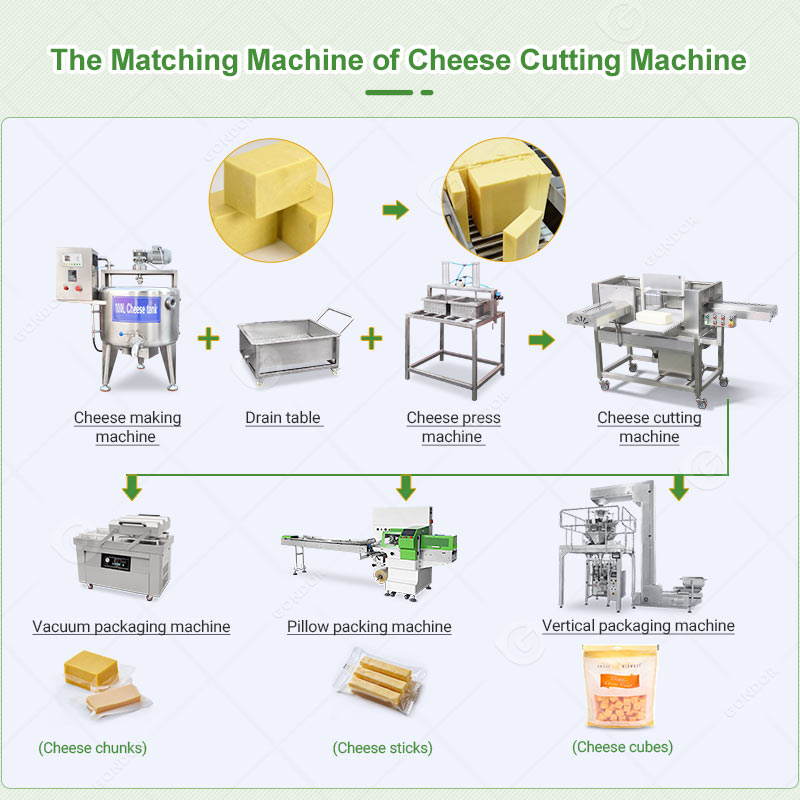
The small dairy workflow helps place cutting after cheese preparation and before packing. Record how long blocks wait before cutting and how long portions wait before their final package. These intervals can change handling behaviour even when the cutter itself runs consistently.
Specify collection-bin depth, transfer distance and the rate required by packing. The cutter's accepted output should match the receiving process without compressing portions in an unmanaged queue. A practical trial follows the cheese far enough to show whether the portions still meet the intended specification when they reach packaging.
The [cheese cutting machine page](/product/cheese-cutting-machine/) shows the available cutting arrangement. To assess suitability, [send the cheese variety, block size, current cutting temperature, target portion dimensions and defect photos](/contact/). Those details make a sample test more useful than a request for an unspecified kilograms-per-hour rating.
Related guides
Related Products


Sizing equipment for your line?
Send the product, the batch size and the utilities you have. We reply with the model, the cycle time and what the cooling side needs.



