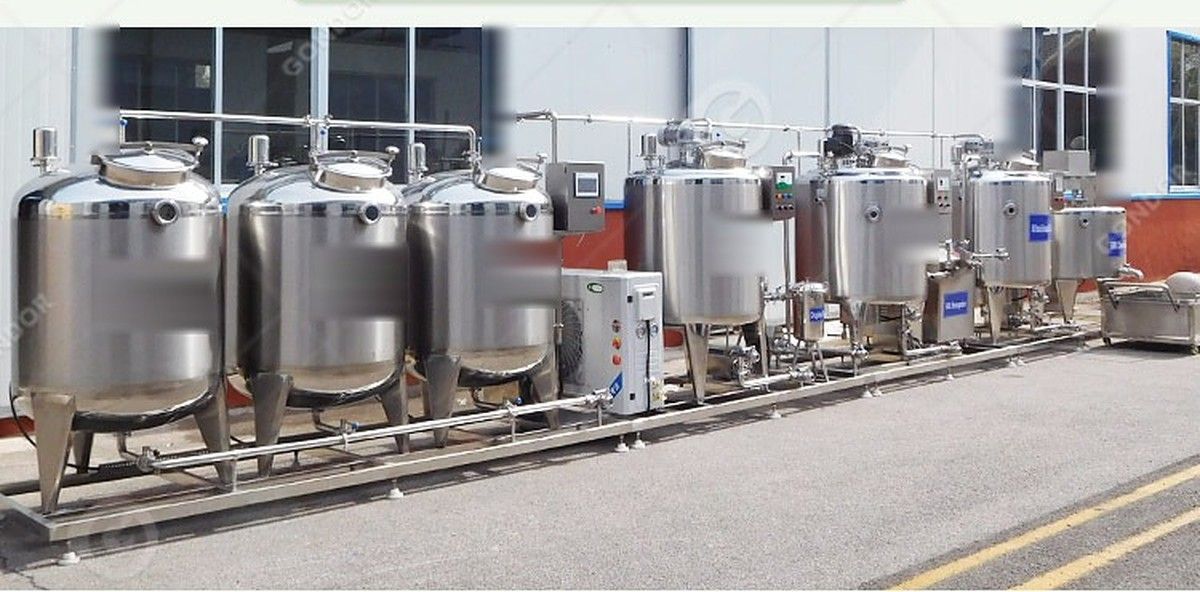


Milk Pasteurizer Machine
At a Glance
| Item | Detail |
|---|---|
| Core spec | 50-5000 L in nine sizes |
| What sets it apart | Impeller matched to viscosity; PTFE wall scraper |
| Pain point solved | Burnt bottom, caked wall and a thin tail at discharge |
A 50-5000 L stainless jacketed mixing tank in nine sizes with viscosity-matched impellers, giving the whole batch a full circulation path.
When a Mixing Tank Cannot Hold Uniformity, the Whole Batch Is Lost
In a sauce plant, the fear is rarely that the mixer cannot turn. It is that the batch comes out uneven. A layer scorched on the bottom, a ring stuck to the wall, a floating patch on top; the first drum runs thin and the last runs thick, and one production batch delivers two textures. Manual stirring and simple agitators share one root cause: the material never forms a complete circulation inside the vessel, so shear and turnover happen only in pockets.
The mixing tank exists to fix uniformity. A motor drives the agitator to build axial and radial flow throughout the vessel, bringing materials of different density and viscosity together over and over. Where the process needs temperature control, a heating or cooling jacket is fitted; where particle size matters, a homogenizer head is added. Nine models from 50 L to 5000 L, single-wall or jacketed construction, and a choice of paddle, frame, scraper, disperser and homogenizer agitation, all configurable to the material.
Mixing Tank Capacity, Dimensions and Power Ratings
Nine-model comparison (per the official parameter table)
| Working volume | Design volume | Jacket thickness | Heating elements (qty × unit power) | Agitator power | Agitator speed | Homogenizer power | Homogenizer speed |
|---|---|---|---|---|---|---|---|
| 50 L | 60 L | 4-3-2.5 mm | 1×9 kW | 0.55 kW | 0-63 r/min | 1.5 kW | 0-3000 r/min |
| 100 L | 120 L | 4-3-2.5 mm | 2×9 kW | 1.5 kW | 0-63 r/min | 2 kW | 0-3000 r/min |
| 200 L | 240 L | 4-3-2.5 mm | 2×6 kW | 1.5 kW | 0-63 r/min | 4 kW | 0-3000 r/min |
| 300 L | 360 L | 5-4-2.5 mm | 2×6 kW | 2.2 kW | 0-63 r/min | 4 kW | 0-3000 r/min |
| 500 L | 600 L | 4-3-2.5 mm | 2×9 kW | 3 kW | 0-63 r/min | 4 kW | 0-3000 r/min |
| 1000 L | 1200 L | 6-5-3 mm | 4×9 kW | 4 kW | 0-63 r/min | 7.5 kW | 0-3000 r/min |
| 2000 L | 2400 L | 6-5-3 mm | 4×12 kW | 7.5 kW | 0-63 r/min | 11 kW | 0-3000 r/min |
| 3000 L | 3600 L | 6-5-3 mm | 8×12 kW | 11 kW | 0-63 r/min | 15 kW | 0-3000 r/min |
| 5000 L | 6000 L | 8-6-3 mm | 8×12 kW | 11 kW | 0-63 r/min | 18 kW | 0-3000 r/min |
General parameters
| Item | Specification |
|---|---|
| Voltage | 380 V / 220 V, customizable |
| Vessel material | Stainless steel or carbon steel; product contact 304 / 316L optional |
| Construction | Single-wall or jacketed; vertical standard, horizontal optional |
| Heating | Electric (medium: water or thermal oil) or steam; cooling available |
| Agitation | Paddle, frame, scraper, disperser, homogenizer; other impellers customizable |
| Control | Bilingual button panel; independent speed, timer and temperature; touch screen optional |
| Motor options | VFD stepless speed control optional; explosion-proof motor customizable |
| Outlet | Sanitary DN50 butterfly valve; type and position customizable |
| Core component warranty | 1 year |
Note: figures above cover jacketed models with heating and homogenizing. Single-wall models carry no heating elements or homogenizer as standard; both are available as options. Volumes and structures are available as custom builds.
Inside a Mixing Tank: How the Agitation Path Moves the Batch
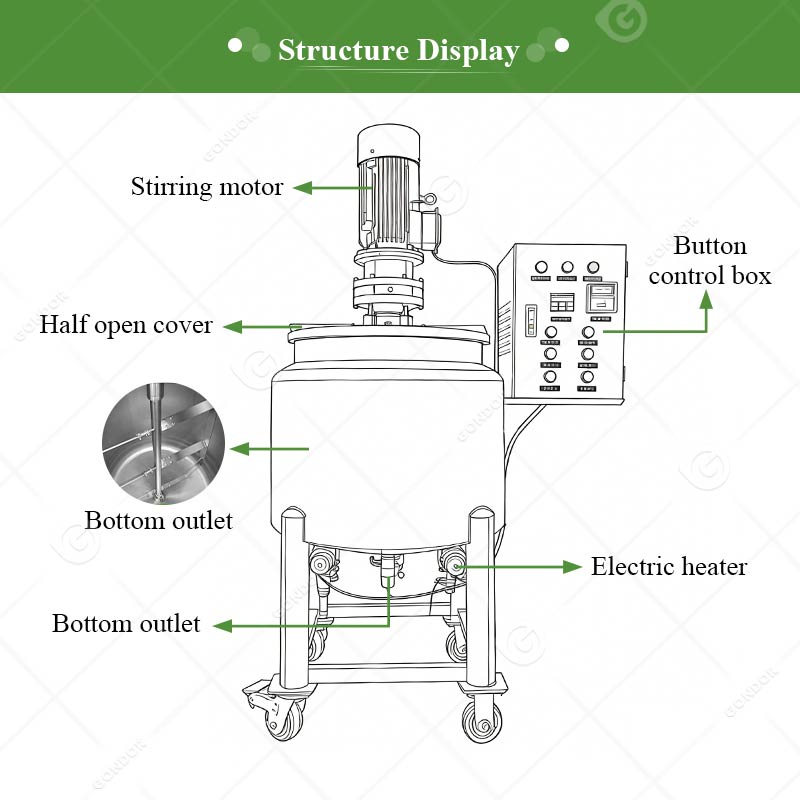
In short. The working cycle splits into four stages: charging, mixing, temperature control where the process needs it, and discharge with cleaning. Material goes in through the top opening per recipe, and the agitator turns under motor drive, generating shear force and fluid flow that blend the batch. Jacketed models hold the material at process temperature through a heating or cooling medium. When mixing is done, the product drains from the bottom outlet and the tank is cleaned for the next batch. Agitator type, speed and whether temperature control is needed all follow from viscosity and process target, and these are the three questions to settle before anything else.
01
Charging
Material is charged through the half-open cover. The half-open design balances charging convenience with dust protection, and liquid material can also be pumped in through a pipe port.
02
Mixing
The motor drives the impeller through the shaft, producing axial flow and radial flow. Axial flow turns the material over vertically; radial flow spreads it across the horizontal plane. Combined, the two flows keep exchanging material between every region of the tank. Low-viscosity liquids run well with paddle or propeller impellers. Medium and high-viscosity materials need frame or scraper agitators, where a PTFE scraper continuously sweeps wall material back into the flow, preventing wall build-up and settling. Where emulsification or particle size reduction is the goal, disperser or homogenizer agitation takes over, with a speed range of 0 to 3000 r/min.
03
Heating or cooling, where fitted
Jacketed models run a heating or cooling medium through the vessel jacket. Electric models heat the medium (water or thermal oil) with bottom heating elements; steam models take plant steam directly; cooling processes run a cooling medium through the same jacket. Mixing and temperature control run together, and heat transfer with agitation is on a different level from a static vessel. For candy cooking or dairy formulation, temperature control without agitation does not get the job done.
04
Discharge and cleaning
The mixed product drains through the bottom DN50 sanitary outlet with a butterfly valve controlling flow. Residue rinses out, and the scraper construction keeps the wall from holding material, so cleaning takes far less effort.
Product Performance Advantages
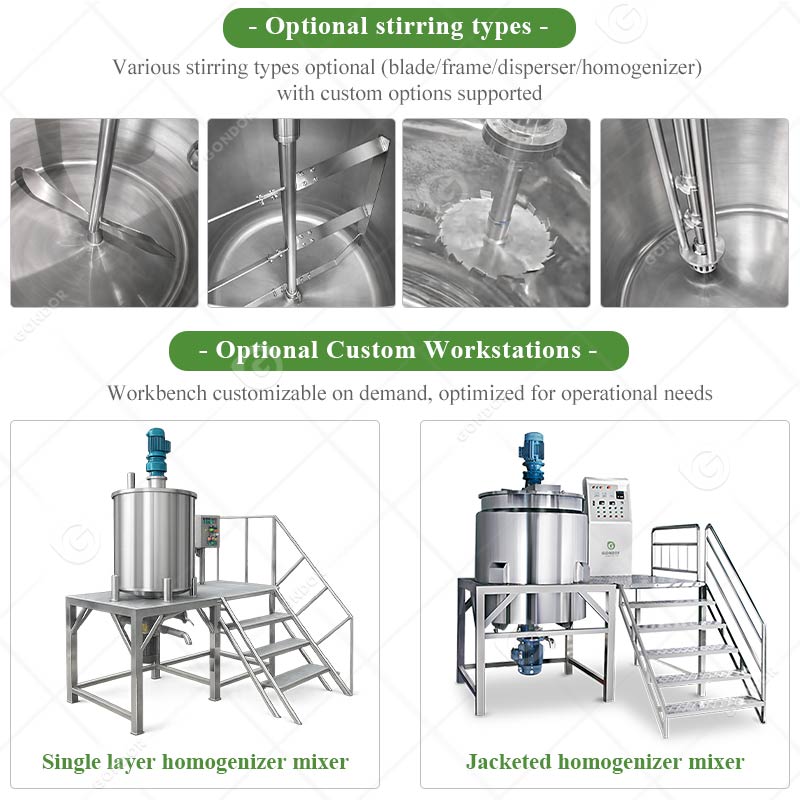
- Agitation matched to the material, uniformity as the outcome. Paddle, frame, disperser and homogenizer types are available, with other impeller forms customisable. Low-viscosity liquids through high-viscosity pastes each get a proper answer, rather than one machine forcing its way through everything.
- PTFE wall scraper, no wall build-up. Medium and high-viscosity materials tend to stick, scorch and cake on the vessel wall. The scraper sweeps wall material back into the flow continuously, mixing more evenly and cleaning down with less work.
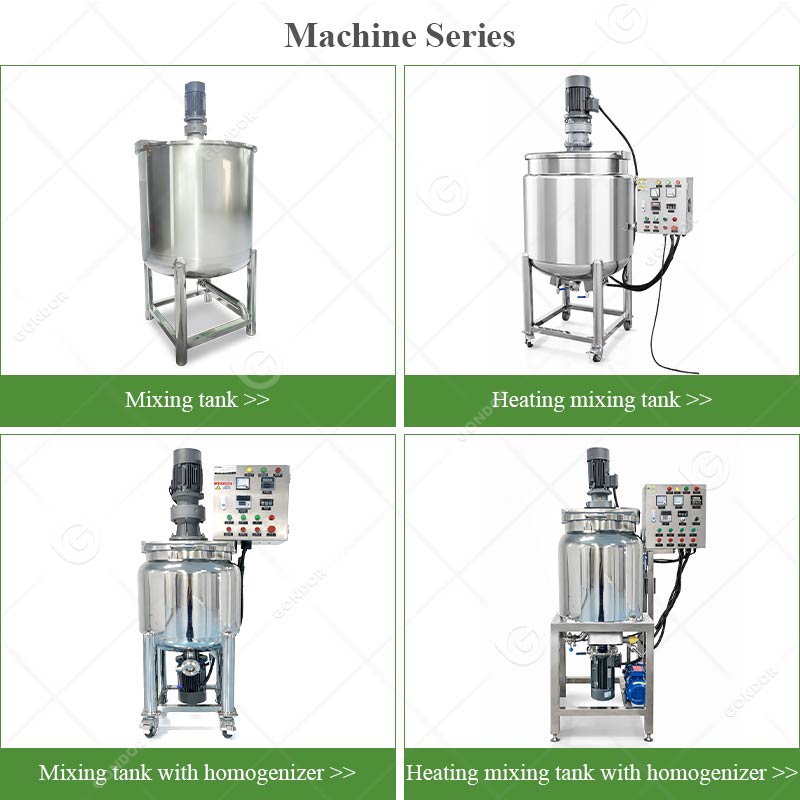
- Modular heating, cooling and homogenizing options. Electric or steam heating, jacket cooling and a homogenizer head combine to requirement. Four base configurations (mixing tank, heated mixing tank, mixing tank with homogenizer, heated mixing tank with homogenizer) cover most line needs.
- Nine sizes from 50 to 5000 L. 50 to 200 L serves laboratories and pilot work, 500 to 2000 L handles workshop batches, and 3000 L upwards meets line-scale duty, with power and agitation matched to volume.
- Sanitary discharge with a choice of materials. A sanitary DN50 butterfly outlet ships as standard, and product-contact parts come in stainless steel (304 or 316L optional), ready to tie into sanitary pipework in food, dairy and personal care plants.
- Plain controls with room to grow. A bilingual button panel runs speed, timer and temperature independently. Variable frequency drive is optional for stepless speed control, a touch-screen upgrade is available, and explosion-proof motors are available on request.
Engineering Design and Operation
Vessel construction. Single-wall or jacketed. Jacketed models form a medium layer between shell and inner vessel, with heating elements at the bottom and medium charged through the inlet valve (water or thermal oil). Insulation is added where specified. Vertical cylindrical form is the standard; horizontal execution is available on request.
Agitation system. The agitator motor mounts on top. A branded motor runs steadily, with optional VFD for stepless speed control and explosion-proof versions on request. The shaft carries an impeller selected by viscosity and process target: paddle for low viscosity, frame or PTFE scraper for medium and high viscosity, disperser disc or homogenizer head for emulsification. For very high-viscosity duty, a ribbon agitator is available: helical blades push material along the axis, handling pastes and slurries without settling or separation.
Discharge and control. A sanitary DN50 outlet with butterfly valve sits at the bottom, with an optional elbow for smoother discharge. Valve type, port size, outlet height and side outlet are all customisable. The bilingual button panel controls mixing, homogenizing and heating independently, with a touch-screen upgrade available.
Two common 500 L configurations (for reference; order configuration governs)
| Item | Sealed jacketed mixing tank (electric heating) | Single-wall mixing tank |
|---|---|---|
| Agitator motor | 7.5 kW, 4-pole, 50 Hz, VFD 0 to 1450 r/min | 2.2 kW, 4-pole, 50 Hz, 45 r/min |
| Product-contact material | Stainless steel 304 | Stainless steel 304 |
| Vessel size | 900 mm dia. × 1290 mm high (with head) | 900 mm dia. × 1000 mm high |
| Impeller | Frame type | Frame type |
| Heating | 18 kW (3 elements), 2.0 mm jacket, rock wool insulation | n-a |
| Outlet | 2-inch 316 ball valve | 2-inch 316 ball valve, 500 mm floor clearance |
| Control | Start/stop/emergency/timer/heating/temperature display/auto holding | Start/stop/emergency |
| Power | 380 V three-phase | 380 V three-phase |
Operating procedure.
- Preparation and inspection. Clean the vessel and confirm the agitator, valves and electricals are sound.
- Charging. Load materials per recipe.
- Mixing. Start the agitator and set speed to the material; on temperature-controlled models, set the target temperature and heating or cooling follows automatically.
- Discharge and cleaning. Drain the finished batch, rinse the vessel and impeller, and check the scraper for wear.
Where a Mixing Tank Fits in Your Production Line
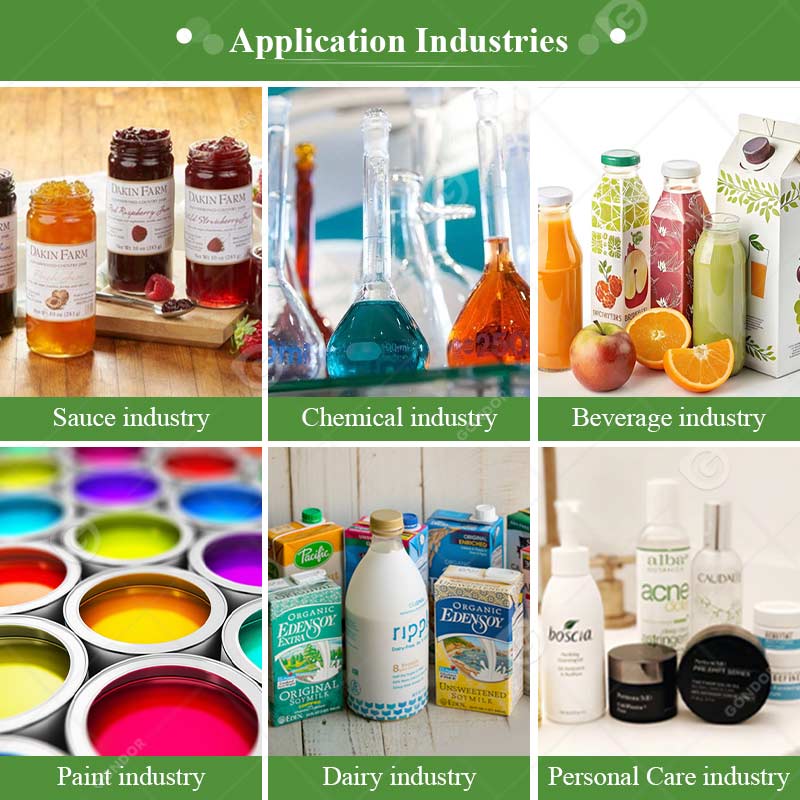
Sauce industry. Mixing and cooking of tomato paste, chilli sauce, sesame paste and seasoned sauces. These medium-to-high-viscosity, wall-sticking materials pair naturally with scraper agitation and electric heating, and the 500 to 2000 L models are the most frequent picks in sauce plants.
Dairy and beverages. Milk formulation, reconstitution, juice blending and syrup dissolving. The sanitary outlet and 304/316L construction meet the pipework standards of these industries, and the tank drops into milk and yogurt lines downstream.
Personal care and daily chemicals. Shampoo, shower gel, creams and lotions. Choose homogenizer agitation or a homogenizer head; the 0 to 3000 r/min range covers most emulsification duties.
Chemical and paint. Paints, inks, adhesives and detergent solutions. Chemical duty allows carbon steel vessels, explosion-proof motors and custom sealing, with material selected against corrosion.
Laboratory and pilot work. The 50 to 200 L models with VFD serve formulation development and small-batch validation. Scaling up keeps the same agitation form, so process parameters transfer cleanly.
How to Specify a Mixing Tank Around Your Viscosity
Ask about the material first, then the output.
- Viscosity picks the impeller. Water-thin liquids (juices, solutions) take a paddle. Medium and high viscosities (sauces, pastes) take frame or PTFE scraper types. Emulsification takes disperser or homogenizer. Very high-viscosity slurries take the ribbon type. When unsure, describe the material state to engineering.
- Output picks the volume. Size by batch quantity: 50 to 200 L for pilot and small batches, 500 to 2000 L as the workshop workhorse, 3000 L and above for line duty. Note the working volume sits one step below the design volume, so do not charge to the design mark.
- Process picks the options. Cooking, dissolving and holding need heating (electric or steam by site conditions). Cooling duties need the jacket. Emulsifying needs the homogenizer head.
- Environment picks the accessories. Chemical rooms with explosion requirements order the explosion-proof motor. Processes needing records upgrade to the touch screen. Discharge arrangement (height, side outlet, elbow) follows the downstream equipment.
Limits worth stating plainly. This is a mixing and blending unit, not a pressure reactor, and pressurised chemical reaction is outside its design scope. The homogenizer range is fixed at 0 to 3000 r/min; high-shear demands beyond that need separate confirmation. The table above describes jacketed models with heating and homogenizing, and the corresponding items do not apply to single-wall models.
Customization Capability
- OEM / ODM: Accepted. Tank capacity, agitator type, motor power and structure are all customisable to production needs.
- Structure: Single-wall or jacketed, vertical or horizontal, with platform; discharge type and position customizable.
- Configuration: Heating method (electric/steam), cooling, homogenizer, VFD, explosion-proof motor and touch screen combined to requirement.
- Tooling lead time: quoted with the offer
Quality Inspection and After-Sales
- Pre-shipment inspection: Factory video inspection and a mechanical test report are provided.
- Warranty: One year on core components.
- Spare parts support: Impellers, scrapers, seals and heating elements are supplied long-term; the specific spare list and pricing are confirmed with after-sales.
- Service model: Online remote support. Faults are diagnosed remotely first, with on-site service arranged when needed.
Mixing Tank Questions Buyers Ask Before They Order
1. What materials can this mixing tank process?
Liquids and semi-liquids: solutions, suspensions, emulsions and viscous mixtures, depending on the agitator configuration. Low viscosity takes a paddle; medium and high viscosity take frame or scraper types; emulsifying takes disperser or homogenizer. Charging dry powder directly needs the dissolving process confirmed first.
2. What material is the tank made of?
Stainless steel or carbon steel, selected by process requirement and material characteristics. Food, dairy and personal care normally take 304; corrosive materials take 316L; non-food chemical duty can use carbon steel to hold cost down.
3. Can the mixing speed be adjusted?
Yes. The agitator runs 0 to 63 r/min as standard, with optional VFD for stepless adjustment to viscosity and mixing target. The homogenizer runs 0 to 3000 r/min under independent control.
4. Is heating or cooling available?
Yes. Jacketed models support electric heating (water or thermal oil medium) or steam heating, and a cooling medium can run through the same jacket. Temperature-controlled processes should take the jacketed construction; single-wall models do not suit temperature duty.
5. Will high-viscosity material stick to the wall?
Choose the PTFE scraper agitation and the problem goes away. The scraper sweeps wall material back into the flow continuously, reducing build-up, preventing settling and scorching, and cutting cleaning effort noticeably.
6. Can the outlet be modified for my line?
Yes. A sanitary DN50 butterfly valve ships as standard, and valve type, port size, outlet height, side outlet and elbow discharge are all customisable. Send the downstream equipment interface dimensions with the order.
7. Can the machine be customized?
Yes. Volume, agitator type, motor power, heating method, control panel and structure are all customizable, supporting both batch and continuous process configurations, and OEM/ODM projects are accepted.
8. How are warranty and after-sales handled?
Core components carry a one-year warranty, a mechanical test report ships with each unit, and video pre-shipment inspection is supported. After-sales respond online and spare parts are supplied long-term; faults are diagnosed remotely first, with on-site service when the site cannot resolve them.
From Inquiry to Mixing Tank Installation
If material state (viscosity, with or without particles), batch quantity per run and process requirements (heating, cooling, homogenizing) are settled on your side, send those three items and we will recommend a model, impeller type and configuration with a quotation. For unusual materials, describe them or send a sample, and we will match the agitation scheme to the material.
Contact
Henan Gondor Machine Co., Ltd. Website inquiry form, WhatsApp or email. Replies within 24 hours on working days.
Related Equipment
- Fermentation Tank — holds the blended base at a steady temperature once mixing is finished.
- Vacuum Degasser — pulls air out of the mix straight after this tank, before filling.
Request Mixing Tank Pricing and Lead Time
Send us the daily volume, the product and the container or pack format you are working with, and we will come back with a model recommendation, a utility list and a price.
Related guides


Sizing equipment for your line?
Send the product, the batch size and the utilities you have. We reply with the model, the cycle time and what the cooling side needs.