

High-Pressure Homogenizer
These are the questions that arrive before a quotation, grouped the way they usually come up: capacity first, then utilities, then cleaning and materials, then delivery and installation.
Answers are written for small and mid-size dairies running batch equipment. Where an answer depends on your site, the article says what to check rather than guessing.
Capacity and batch planning
How much milk can a 200 L pasteuriser process in a day?
Multiply the usable volume by the number of completed batches, then subtract transfer losses. A 200 L vessel is normally filled to a working volume below the nominal figure, and each batch includes heating, holding, cooling, draining and cleaning.
If a full cycle takes around two hours and the shift allows four completed cycles, the day produces roughly 700 to 800 L of treated milk, not 200 L multiplied by eight. The tank size is the starting point, the cycle time decides the rest.
Why is the working volume lower than the tank volume?
Headspace is needed for agitation, foam and thermal expansion. Filling to the rim leaves no room for the product to move, and a partially covered agitator can pull air into the batch. Most vessels specify a minimum and a maximum working volume, and both matter: too little product and the impeller runs in air, too much and it splashes into the headspace.
Can one pasteuriser serve both yogurt and cheese milk?
Usually yes, with different targets. Drinking milk, cultured product and cheese milk are cooled to different temperatures and held for different times. What changes is the setpoint and the cooling supply, not necessarily the vessel. Check that the controller can store the recipes you need and that the cooling side can reach the lowest target you plan to run.
How do I match a fermentation tank to my pasteuriser?
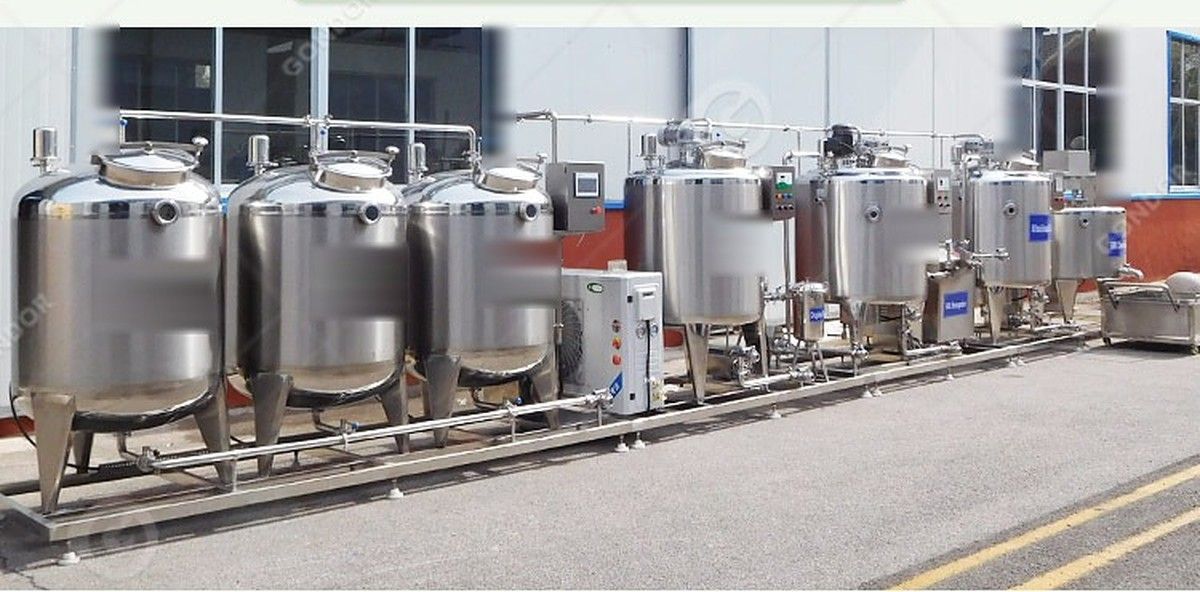
Work backwards from the packing shift. If the filler runs four hours at a fixed output, the fermentation volume has to cover that run plus the fill level the agitator needs. A tank that is too large for the batch gives poor temperature uniformity at low fill; a tank that is too small forces a second fermentation and pushes packing to the next day.
Utilities
Electric heating or steam?
Electric heating suits small batch vessels where steam is not available and the electrical supply can carry the load. Steam heats faster per unit of installed capacity and is the usual choice once several vessels run at once. The decision is usually made by the site, not the machine: what the building can supply and what the utility costs.
What electrical supply does a small pasteuriser need?
It depends on the heating capacity, which depends on the volume and the required heat-up time. Ask for the connected load in kW and the supply configuration (single or three phase, voltage, frequency) before comparing quotes. Two machines with the same tank size can differ by a large margin in installed power.
How cold does the cooling water need to be?
Cooling stops being effective as the product approaches the water temperature. Mains water can take the first part of the drop, but reaching a low final temperature needs chilled water, glycol or a refrigeration unit. Tell the supplier the water temperature and flow you actually have, not the best case.
Can a batch tank be used for UHT?
No. UHT requires a continuous process with defined holding tubes, pressure and aseptic downstream equipment. A jacketed vessel with a temperature controller is a batch pasteuriser, and treating it as anything else creates a compliance problem rather than a product.
Materials, cleaning and hygiene
Is 304 stainless steel enough?
For most dairy contact surfaces, 304 is the standard choice. 316 is specified where the product is more aggressive, where cleaning chemicals are harsher, or where the buyer’s own standard requires it. Ask which parts are 304 and which are 316 rather than accepting a single grade for the whole machine.
How is the equipment cleaned?
Small batch vessels are usually cleaned by hand or with a simple spray ball, while larger lines use a CIP circuit with caustic and acid stages. What matters at the buying stage is access: manways, drain points, radii, and whether the pipes can be drained completely. A machine that cannot be drained properly will not clean properly, whatever the cleaning procedure says.
What finish should contact surfaces have?
Smooth, continuous welds and a finish that can be cleaned without trapping residue. Ask how internal welds are treated and whether they are ground and polished. This is one of the differences that does not show in a photograph.
Delivery, installation and support
How long does delivery take?
It depends on the configuration and the current production schedule, and it changes through the year. The honest answer is a date confirmed against a specific specification and deposit, not a general figure quoted before the machine is defined. Ask for the lead time in writing with the quotation.
Who installs and commissions the line?
Small skid-mounted units are often installed by the buyer with remote support. Larger lines are usually commissioned on site by the supplier, with operator training included. Confirm what is included before the order: supervision days, travel, utilities preparation and the acceptance test all belong in the scope.
What spare parts should be kept on site?
Seals, gaskets, a temperature probe, a set of fuses and any product-specific wear part. The list follows the machine, so ask for the recommended spares list with the quotation rather than after the first failure.
Can I buy a single machine instead of a full line?
Yes. Many customers start with one stage, usually pasteurising or filling, and add equipment as volume grows. The constraint is compatibility: check connection sizes, heights and control interfaces so the next machine can be added without rebuilding the first one.
Asking a better question
A useful enquiry includes four things: the product, the daily volume, the utilities available, and the pack format. With those, the answer is usually a specific model and a specific cycle time. Without them, every reply has to start with the same questions.


Sizing equipment for your line?
Send the product, the batch size and the utilities you have. We reply with the model, the cycle time and what the cooling side needs.