

Counting Bottling Line
At a Glance
| Item | Detail |
|---|---|
| Core spec | 30-45 cycles per minute, accuracy better than 0.5% |
| What sets it apart | Screw matched to the powder; a new weight is a parameter change |
| Pain point solved | Accuracy drifts the moment the powder changes |
Servo screw dosing at 30-45 cycles per minute with accuracy better than 0.5%, where a powder change is a screw parameter change, not a new machine.
Dosing Error Usually Hides Inside the Auger of a Powder Filling Machine
Anyone who has run powder filling knows the pattern: one machine fills milk powder steadily, then drifts the moment it switches to coffee powder. The difference is not in the operator’s hands. It sits inside the metering auger. How much powder one auger revolution displaces depends on pitch, diameter and bulk density. A mismatched auger makes the revolution count meaningless.
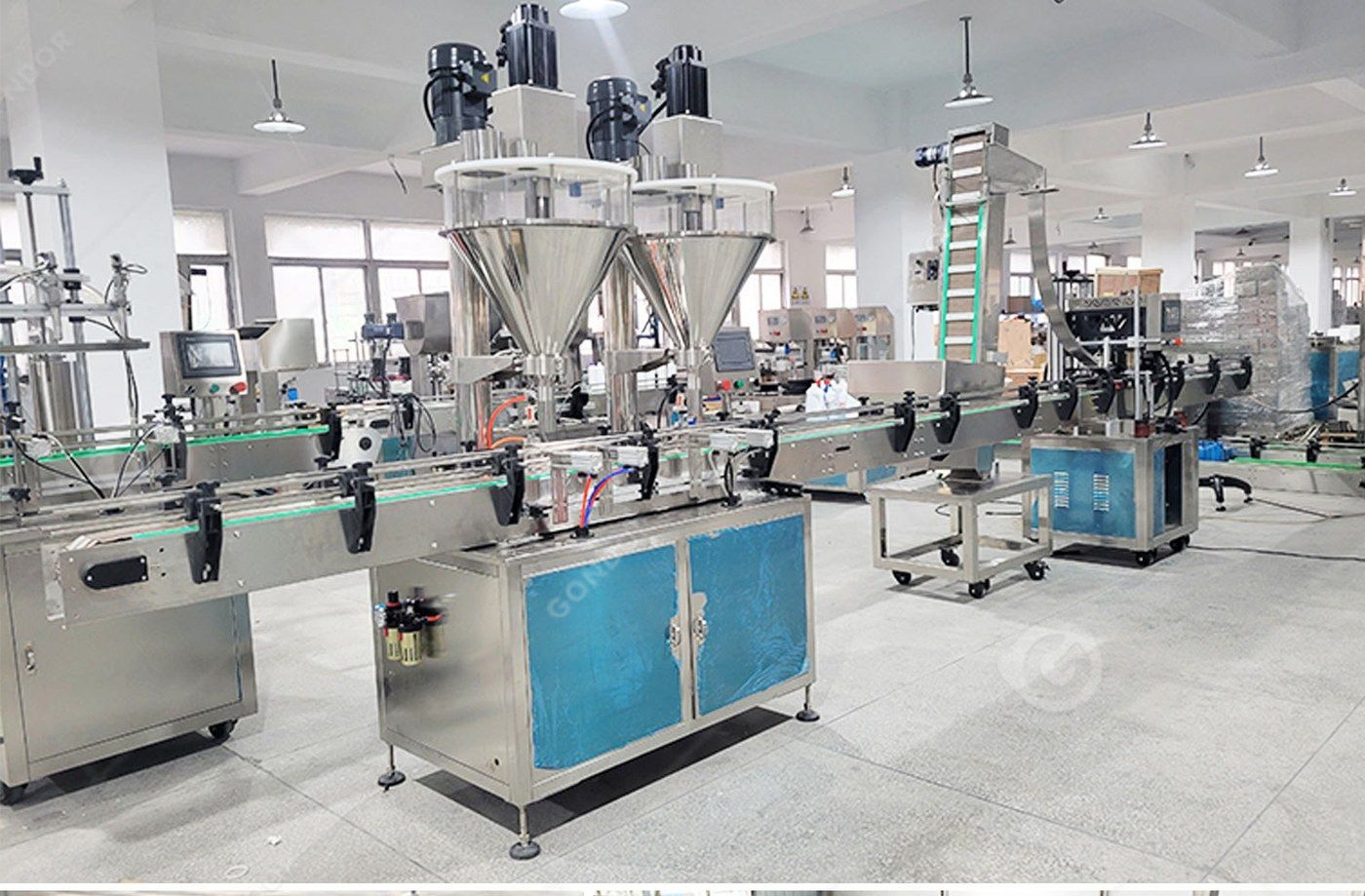
This powder filling machine builds dosing on a servo motor plus metering auger. The servo controls revolutions, the auger sets displacement per revolution, and the fill weight is the product of the two, which can be calculated and verified. Per the official data sheet, it fills 10 to 2000 g within a weighing range of 1 to 6000 g, at better than 0.5% accuracy and 30 to 45 fills per minute, with a 75 L hopper. Powder is agitated in the hopper before entering the auger channel, so weight stays steady over long runs.
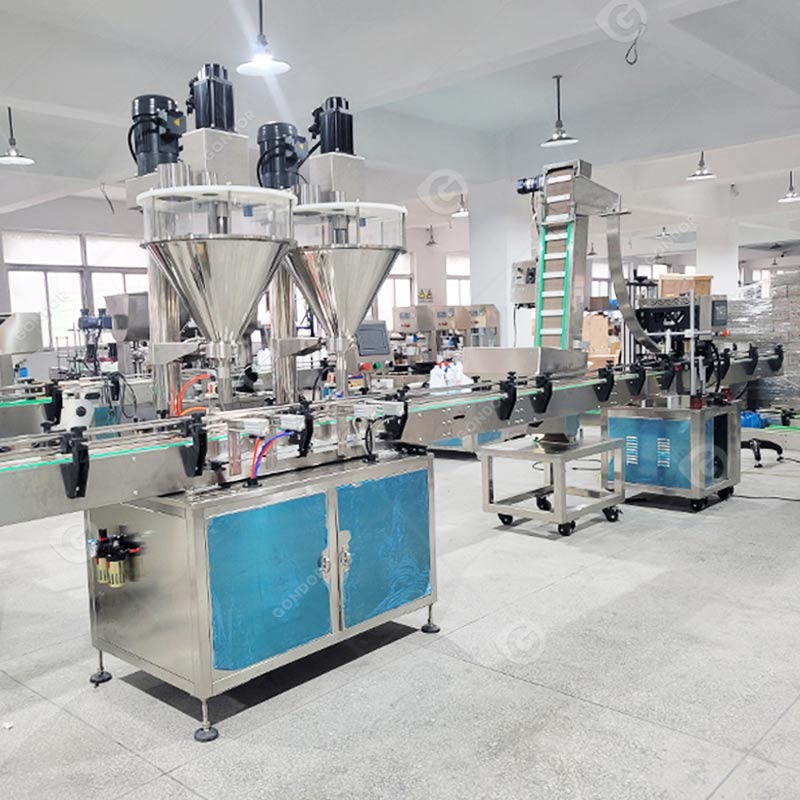
It fits two kinds of buyers. One already owns unscrambling, capping and labeling equipment and only lacks the dosing station. The other has not grown into a full line yet, but hand filling has stopped being an option. The machine takes about 3 m of floor length, weighs 150 kg, and stands on an ordinary workshop floor.
Powder Filling Machine Capacity, Accuracy and Power
GD series main machine (per the official data sheet)
| Item | Specification |
|---|---|
| Model | GD-8 |
| Applicable material | Fine powders (milk powder, coffee, spices, protein powder, flour, etc.) |
| Fill weight | 10-2000 g |
| Weighing range | 1-6000 g |
| Filling accuracy | <0.5% |
| Filling speed | 30-45 fills/min |
| Hopper capacity | 75 L |
| Power supply | 380/220 V, 50-60 Hz |
| Installed power | 1.8 kW |
| Machine weight | 150 kg |
| Dimensions | 3000×1060×2000 mm |
| Product-contact material | Food grade 304 stainless steel, SUS316 series optional |
| Control | PLC with touch screen |
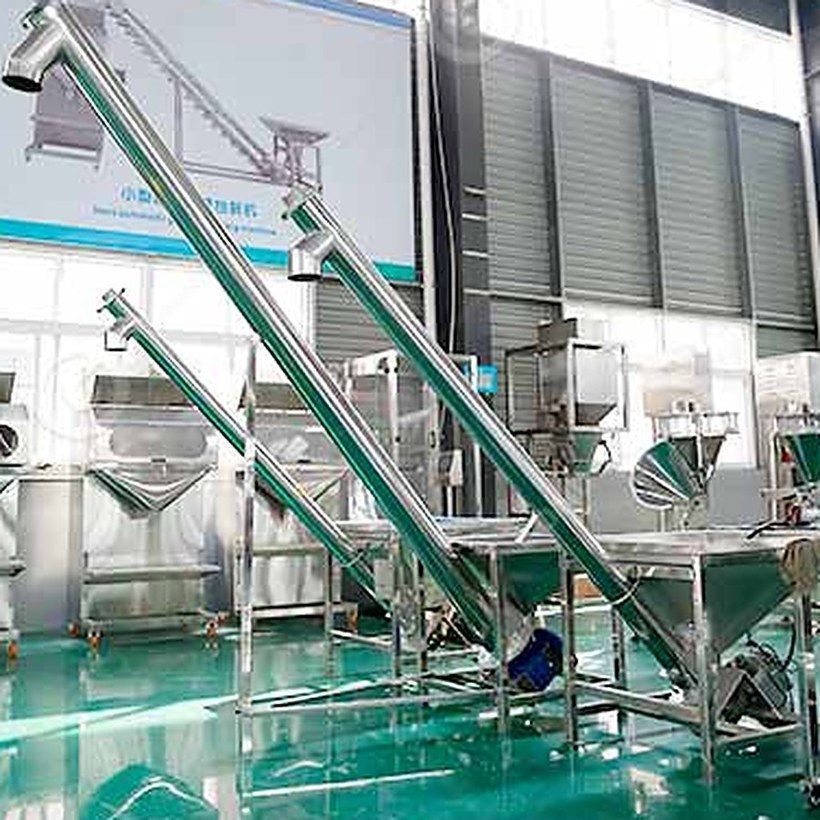
| Feeding option | Screw elevator available (0.75 kW, φ141 mm auger, 3000×850×2400 mm) |
| Pre-shipment video inspection | Provided |
| Mechanical test report | Provided |
| Core component warranty | 1 year |
| OEM / ODM | Accepted |
Note: fill weights beyond the auger coverage require a change of auger set, confirmed in the order specification.
Inside a Powder Filling Machine: Auger, Agitator and Load Cell
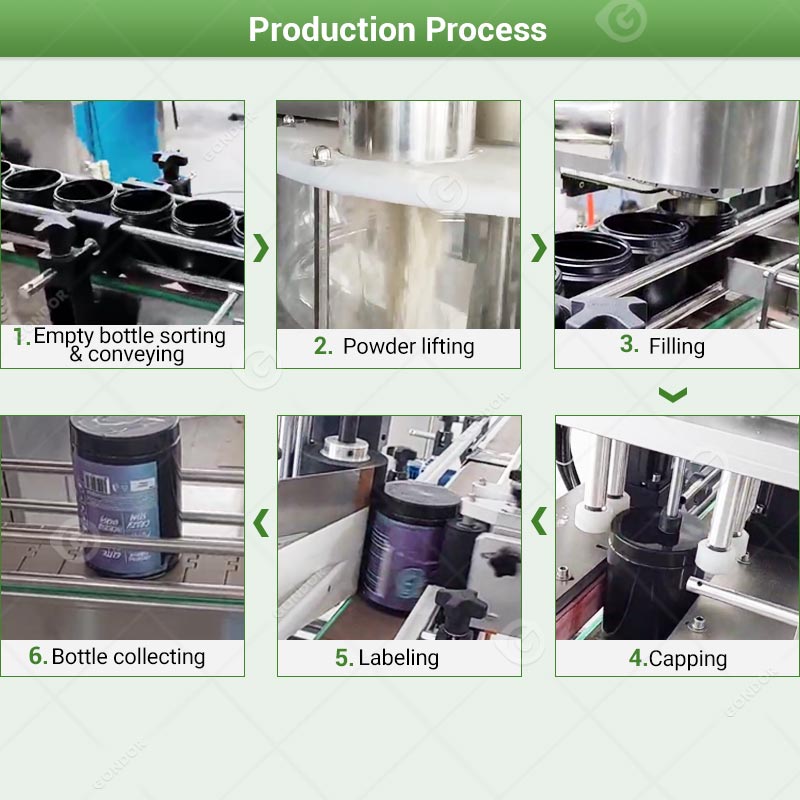
In short. Powder is poured into the 75 L hopper and kept loose and even by the agitator. Once a container is positioned, the servo motor drives the metering auger for a programmed number of revolutions, pushing the measured dose through the filling head into the container. Displacement per revolution is fixed, so the revolution count sets the fill weight: changing grams means changing a parameter, and only a wide format jump calls for a different auger set. The machine discharges nothing when no container is detected, and alarms on low material.
01
Feeding and agitation
Powder enters the 75 L hopper, where the agitator keeps turning to prevent caking and bridging. Material drops by gravity from the hopper bottom into the auger channel. This is the first condition for stable dosing: powder must arrive at the auger channel at a consistent bulk state.
02
Metering
The servo motor turns the metering auger. Displacement per revolution is determined during calibration, the controller converts the target weight into revolutions, and the servo executes against that count with closed-loop control. Unlike time-based discharge, revolution control is immune to voltage fluctuation and momentary flow variation.
03
Filling
With the container in place, the filling head opens and the auger pushes powder through it. The head has an anti-drip structure that prevents stringing and dripping at cutoff, keeping the area around the neck clean.
04
Feedback and rejection (optional)
A weighing feedback option reads the actual weight of each container back to the controller, alarming or rejecting out-of-tolerance fills. Whether you need the feedback loop depends on your tolerance and on whether a checkweigher sits downstream.
Product Performance Advantages
- Accuracy is printed in the data sheet, not promised verbally. Better than 0.5% at 30 to 45 fills per minute. For products sold by weight, such as milk powder and seasoning, accuracy is profit.
- Changing grams means changing a number. Within the coverage of one auger, the target weight is entered on the touch screen. Fill 200 g of coffee powder today and 500 g of protein powder tomorrow without touching a mechanical part.
- No container, no discharge. The sensor sees no container and the machine dispenses nothing, so powder never falls onto the conveyor. Low material triggers an alarm, keeping empty containers out of the finished goods.
- Fast washdown, no flavour carryover. Product-contact parts are food grade 304 stainless steel, and the hopper, auger and filling head come apart quickly for cleaning. Switching from chili powder to milk powder fits into a shift break.
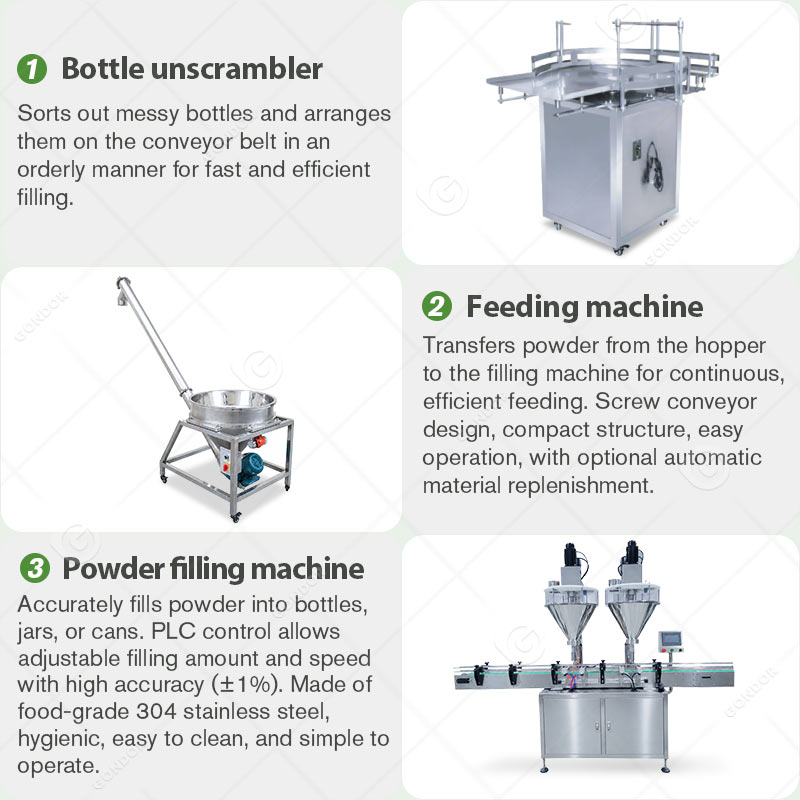
- Drops into any line. Infeed and outfeed direction plus conveyor height adjust to your layout, so connecting to an existing unscrambler, capper or labeler is routine work.
Structure and Design
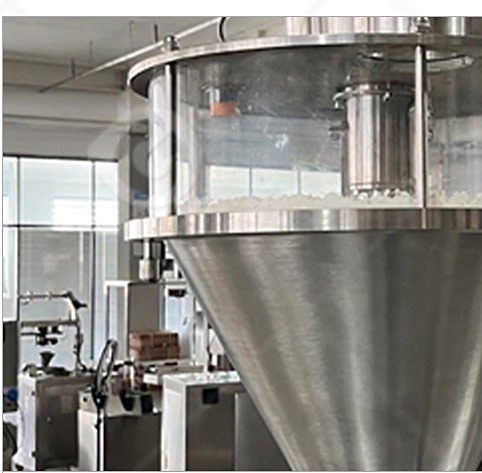
Metering unit. Servo motor plus metering auger is the core of the machine. The auger is specified to your material, and displacement per revolution is calibrated before delivery. Starch, milk powder and chili powder differ in bulk density by a wide margin, and one auger cannot dose them all equally. Declare the material honestly at inquiry.
Hopper and agitator. The 75 L hopper with agitator sets how often you refill. At 75 L you cover a small fraction of a shift to a full shift depending on bulk density.
Filling head. Anti-drip structure with no stringing at cutoff. Nozzle diameter follows the container neck, and necks far apart in size need a head change.
Conveyor and positioning. The belt speed is adjustable, and a gate positions each container under the filling point. Align the belt height with upstream and downstream machines to join a line.
Electrical control. PLC with a touch screen for target weight, revolutions and speed. Recipe storage holds multiple parameter sets, and a product change is a recipe call.
Structure breakdown (five parts)
| No. | Part | Function |
|---|---|---|
| 1 | Hopper | Stores material with agitation, keeping it loose and even |
| 2 | Metering auger | Servo-driven, fixed displacement per revolution, revolutions set the dose |
| 3 | Filling nozzle | Guides metered powder into the container, anti-drip design |
| 4 | Conveyor and positioning | Conveys containers and stops them at the filling point |
| 5 | Control cabinet | PLC and touch screen for parameter setting and recipe storage |
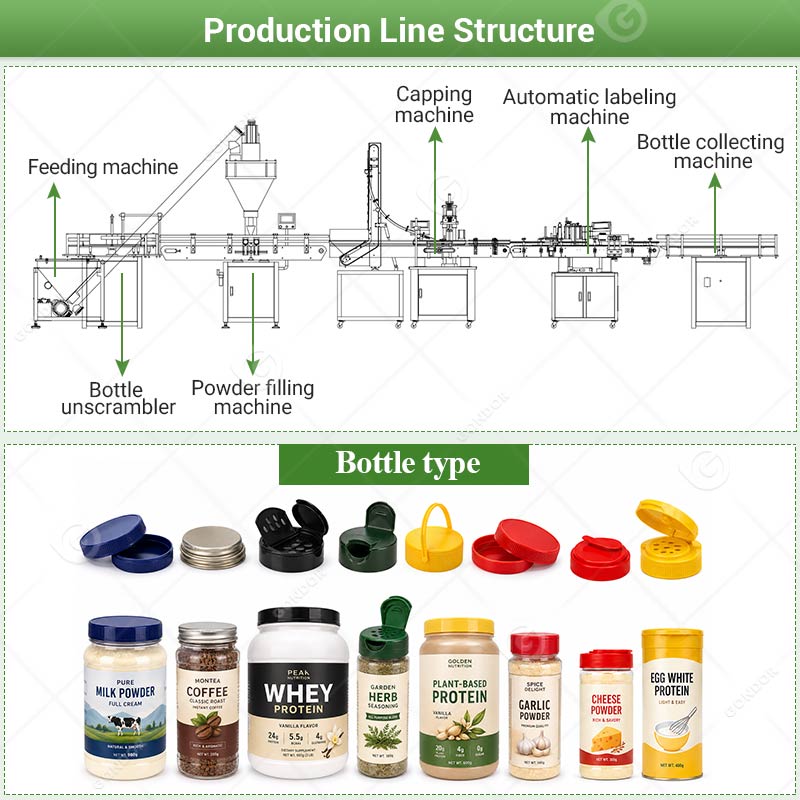
Operating Procedure
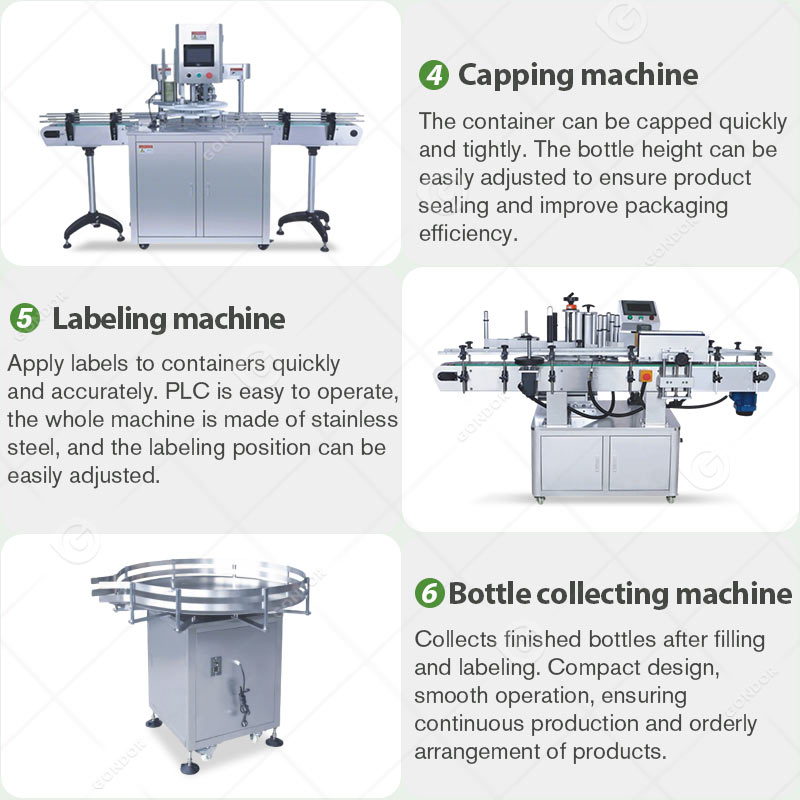
- Start and parameter setup. Power on, call up or enter target weight, revolutions and conveyor speed on the touch screen.
- Charging. Pour powder into the hopper and confirm the agitator runs normally and the level is adequate.
- Trial fill and calibration. Fill a few containers and check the weight. Within tolerance, move to continuous production; otherwise fine-tune the revolution count.
- Continuous production. Containers are positioned and filled one by one. The operator refills material and spot-checks weight at intervals.
- Close-out cleaning. Empty the hopper, remove the detachable parts for cleaning, and wipe the auger and nozzle dry at the end of the shift.
Typical Applications for a Powder Filling Machine
Dairy and nutrition. Quantitative bottling of milk powder, protein powder and nutrient powders, where the weight tolerance is tight and this machine earns its keep.
Instant drinks. Coffee, cocoa and solid drink mixes. These powders pick up moisture easily, and hopper agitation with closed feeding keeps them workable.
Spices and seasoning. Chili powder, pepper, curry and mixed seasoning. In dusty, irritating environments we recommend the dust extraction port.
Bakery ingredients. Flour, starch and premix powders across wide weight spans, covered by changing auger sets on one machine.
Household and industrial fine powders. Laundry detergent, cleaning powder and pigment powders outside the food category, with SUS316 series contact parts available.
How to Specify a Powder Filling Machine Around Your Powder
Three steps to a configuration.
- Declare the material. Powder name, bulk density, flowability, and whether it cakes or absorbs moisture. These three items decide auger form, hopper configuration and agitation strength.
- Declare the format. Main fill weight, container neck diameter and target speed. Weight decides the auger, neck decides the nozzle, and speed decides whether upstream and downstream keep up.
- Declare the line conditions. Infeed and outfeed direction, conveyor height and parameters of neighbouring machines. This step decides the retrofit effort when the machine drops into an existing line.
Limits worth stating plainly. Auger metering suits free-flowing fine powders. Materials with poor flow, fibre content or heavy caking need a filling trial first. The rated 30 to 45 fills/min holds at small to medium weights, and a 2000 g heavy fill runs much slower. Accuracy figures rest on pre-delivery calibration and trial data.
Customization, Commercial Terms and After-Sales
Customization. OEM and ODM are both accepted. The metering auger is specified to your material, the nozzle to your neck, and product-contact material can be SUS304, SUS316 or SUS316L. Weighing feedback with rejection is available as a module. MOQ is one set, and a custom auger set or nozzle is quoted with the offer.
Commercial terms. MOQ is one set. Lead time follows the auger set and the options ordered and is confirmed in the offer. Export packing is a waterproof membrane inside a plywood case sized to the machine. Trade terms are FOB, CIF or DAP as agreed.
Inspection and after-sales. Pre-shipment video inspection and a mechanical test report are provided. Core components carry a one-year warranty with lifetime technical support. Faults are diagnosed remotely first, and an engineer is dispatched when the issue cannot be settled remotely. Metering augers, nozzles and drive belts stay available after the warranty period; quote the spare set with the machine so the first one ships in the same case.
Powder Filling Machine Questions Buyers Ask
1. How is the 0.5% accuracy verified?
Displacement per revolution is calibrated against your material before delivery, and the factory test report records measured data. You can also send a sample for a filling trial, and we mail back the filled samples with the weight log.
2. Do I need to change the auger for a different fill weight?
Within one auger’s coverage, changing a parameter is enough. A change of auger set is needed only when the weight span exceeds the displacement range. Report both your minimum and maximum weights at inquiry so the sets are complete from the start.
3. Which powders can it fill?
Milk powder, protein powder, coffee, cocoa, flour, starch, spice and seasoning powders, plus laundry detergent and cleaning powder. Materials with poor flow should go through a sample trial first.
4. Can it handle caked material?
Light caking is broken up by hopper agitation. Heavily caked material needs pre-screening or a recipe change first; the machine is not a crusher.
5. Can it connect to my existing line?
Yes. Infeed and outfeed direction plus conveyor height are adjustable. Send the conveyor parameters of your current equipment and we will confirm the interface.
6. Does it need compressed air?
The standard configuration is mainly electric, and any auxiliary action that needs air is listed in the order specification. Prepare power and air supply according to that document.
7. How are warranty and after-sales arranged?
Core components carry a one-year warranty with lifetime technical support. Faults are diagnosed remotely first, and an engineer is sent when remote diagnosis is not enough. Pre-shipment video inspection and a mechanical test report are included.
From Inquiry to Powder Filling Machine Installation
Send over the powder name, target weight, container diameter and planned capacity, and we will propose an auger configuration with a filling trial plan. A sample trial is the fastest verification: trial data and filled samples first, configuration decision after.
Contact
Henan Gondor Machine Co., Ltd. Website inquiry form, WhatsApp or email. Replies within 24 hours on working days.
Related Equipment
- Powder Filling Production Line — the same filler built into a six-station line at 40 bottles a minute
- Counting Machine — for products sold by the piece rather than by weight
- Liquid Filling Machine — servo piston filler for liquids and pastes
- Mixing Tank — for premixing and holding the powder batch upstream
Request Powder Filling Machine Pricing
Send us the daily volume, the product and the container or pack format you are working with, and we will come back with a model recommendation, a utility list and a price.
Related guides


Sizing equipment for your line?
Send the product, the batch size and the utilities you have. We reply with the model, the cycle time and what the cooling side needs.