

Complete Water Bottling Line
At a Glance
| Item | Detail |
|---|---|
| Core spec | 10-200 L in six sizes |
| What sets it apart | Indirect water-bath heating with a water-cooling circuit; temperature and time both set |
| Pain point solved | Milk that cannot be sold the same day is poured away |
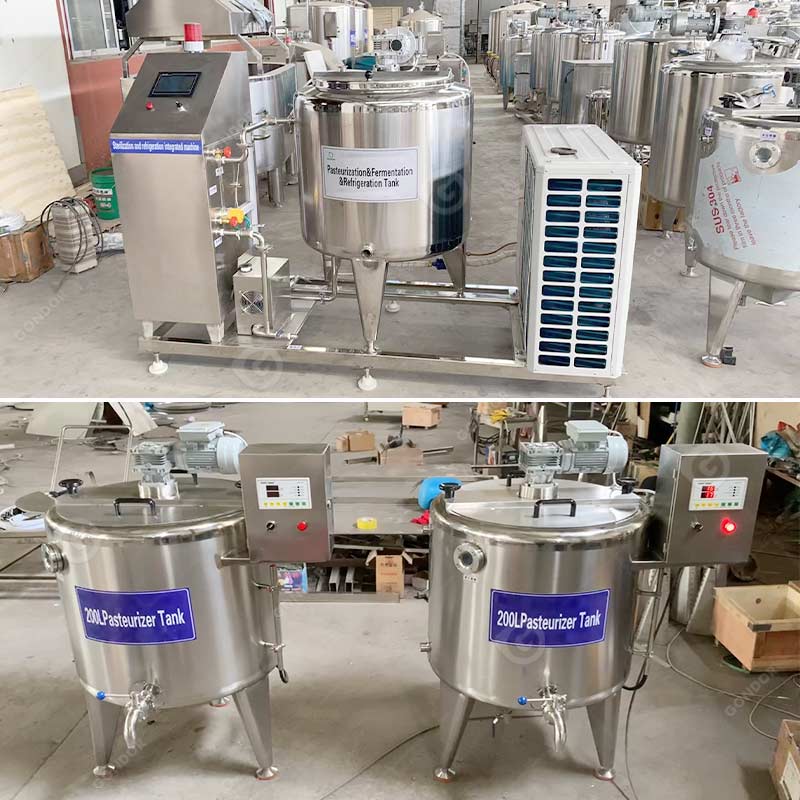
A 10-200 L batch water-bath pasteurizer with a settable heating curve, so farm-fresh milk can be processed and sold the same day.
Raw Milk Cannot Command a Price Until the Pasteurizer Step Is Right
Anyone running a fresh milk shop hits the same wall. Raw milk from the farm spoils within hours at room temperature, and whatever is not sold the same day is poured away or written off. Bacterial counts climb fast, and without a reliable killing step the business has a hard ceiling.
Pasteurization removes that ceiling. Heat the milk to a set temperature, hold it there for a defined time, then cool it down quickly. Pathogenic and most spoilage organisms are knocked down, shelf life stretches from hours to days, and the milk can go into a display fridge, onto a delivery route, or into a yogurt vat. For a milk bar, a farm gate shop or a small dairy room, a batch milk pasteurizer is the smallest investment that opens this door.
This pasteurizer runs as a batch unit from 10 L to 200 L in six sizes. A heated water jacket and a mechanical agitator do the work, temperature runs from ambient to 99 °C, and the holding time is set on the controller. One tank carries heating, holding and cooling, so the milk never changes vessels mid-process.
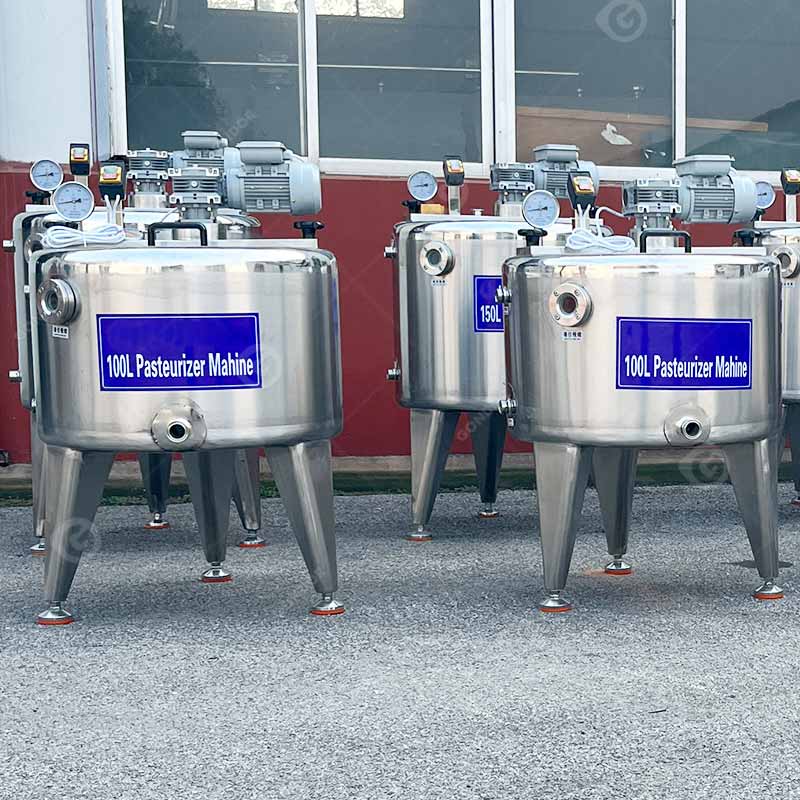
Milk Pasteurizer Machine Capacities, Holding Times and Utility Loads
Six sizes (per the official attribute table)
| Item | GD-10 | GD-30 | GD-50 | GD-75 | GD-100 | GD-200 |
|---|---|---|---|---|---|---|
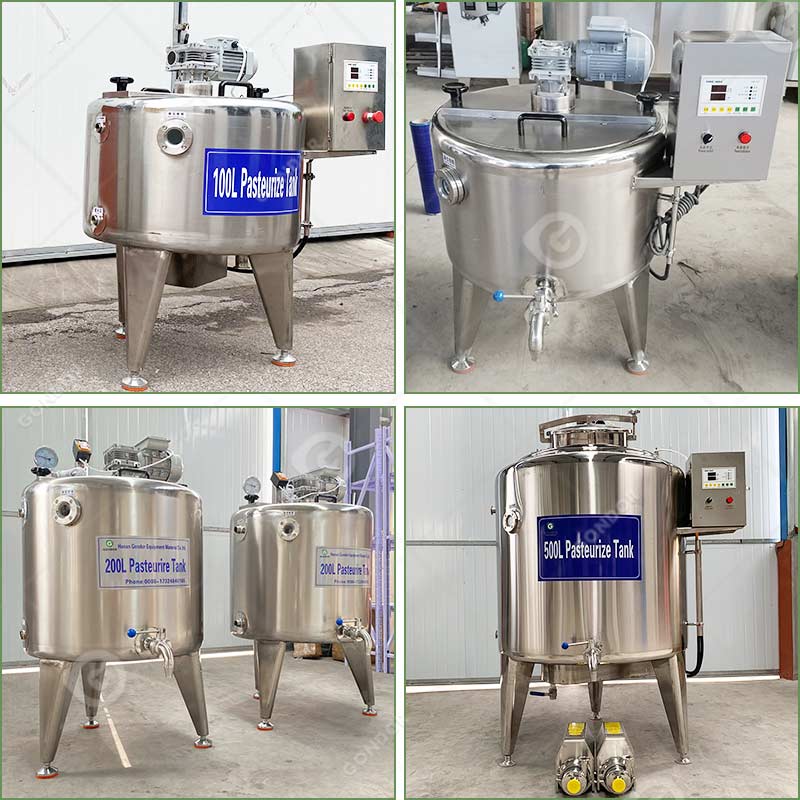
| Batch capacity | 10 L | 30 L | 50 L | 75 L | 100 L | 200 L |
| Typical use | Countertop shop | Milk bar | Milk bar / workshop | Workshop | Small dairy room | Small dairy room |
Note: power, weight and dimensions are configured by capacity tier. The source lists them as series tiers without a per-model split, so they are published below as tiers rather than inferred per model.
Series tiers and general parameters
| Item | Specification |
|---|---|
| Heating power | 6 kW (small tier) / 9 kW (large tier) |
| Voltage | 220 V / 380 V |
| Temperature range | Ambient to 99 °C, adjustable, settable holding time |
| Heating method | Electric jacket heating; steam or gas heating optional |
| Cooling method | Water cooling, jacket changeover |
| Agitation | Mechanically sealed paddle, continuous circulation |
| Machine weight | 65 kg / 75 kg / 85 kg (by tier) |
| Dimensions | 500×500×1100 mm / 550×550×1150 mm / 700×700×1200 mm (by tier) |
| Material | Food grade stainless steel, non-magnetic food-contact surfaces; grade customizable |
| Automation | Semi-automatic |
| Certification | ISO 9001, ISO 14001, ISO 45001, CE, BSCI, ETL |
| OEM / ODM | Accepted |
Wear Parts and Maintenance
| Part | What to check | Replace or service when | Note |
|---|---|---|---|
| Heating element | Normal heating, no tripping | Replace on slow or no heat-up | Consumable |
| Agitator shaft seal | Leakage at the seal | Tighten or replace on weeping | Mechanical seal |
| Gaskets | Ageing on cover and valve seats | Replace on poor sealing or weeping | Food contact areas |
| Butterfly valve | Smooth action, milk scale jamming | Strip and clean; replace worn seals | Key discharge part |
The points above are general guidance. The source gives no fixed service hours, so keep a per-shift log and use heat-up rate, weeping and sealing condition as the replacement signal.
Installation Requirements
- Power. 220 V or 380 V by model. The 9 kW tier needs a confirmed circuit capacity and breaker rating; do not share a lighting circuit.
- Water and drainage. A steady supply point and a drain point are required; cooling water discharges to drain, and the floor should be anti-slip with drainage.
- Working space. Leave room around the vessel for charging, discharge and cleaning, and clearance above the air outlet.
- Compliance note. Operators selling pasteurized milk to end consumers should confirm local registration and testing requirements for raw milk handling. The equipment provides process conditions and does not replace the test reports required by regulation.
Inside a Milk Pasteurizer Machine: Plate Path, Holding Tube, Return Valve
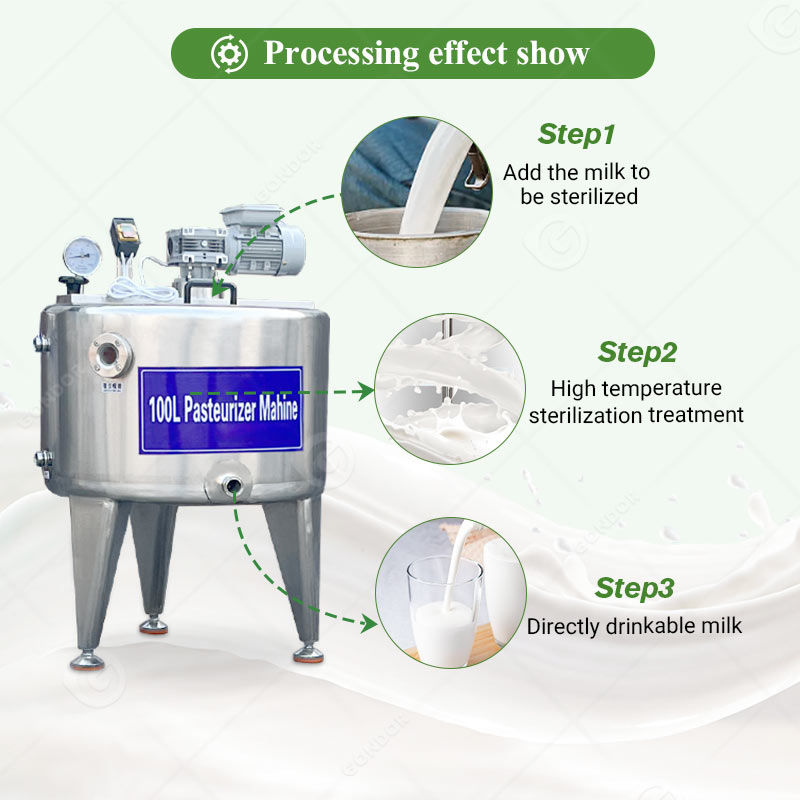
In short. The cycle is heat, hold, cool, all inside one vessel. Electric heating elements warm the water in the jacket, and that heat passes through the inner wall into the milk. Once the milk reaches the setpoint, it is held there for the programmed time. The jacket then switches to cooling water and pulls the temperature back down. Temperature and time decide the kill, and the agitator keeps both uniform through the tank.
01
Charging and heating
Raw milk enters through the feed port into the inner vessel, while the water jacket level shows on the indicator. Elements heat the jacket water, and heat crosses the inner wall into the milk. The agitator runs at low speed throughout, so milk near the wall never overheats. Because heat arrives indirectly, nothing burns onto a heating surface.
02
Holding at temperature
At the setpoint the heater stops, the controller maintains the temperature and counts down the programmed holding time. The exact temperature and time pair is chosen per product, and the 99 °C ceiling covers the common pasteurization range. This stage does the actual kill and is the reason the machine exists.
03
Water cooling
When the timer ends, the jacket switches to cooling water and the milk temperature drops quickly. Speed matters here as well: the longer the milk lingers warm, the wider the window for surviving organisms to recover. The cooling circuit uses less water than a once-through arrangement.
04
Discharge and transfer
Open the butterfly valve and the pasteurized milk flows out straight into a filling machine, a fermentation tank or a chilling tank. Killing, holding and cooling happen in one vessel with no intermediate transfers.
Product Performance Advantages
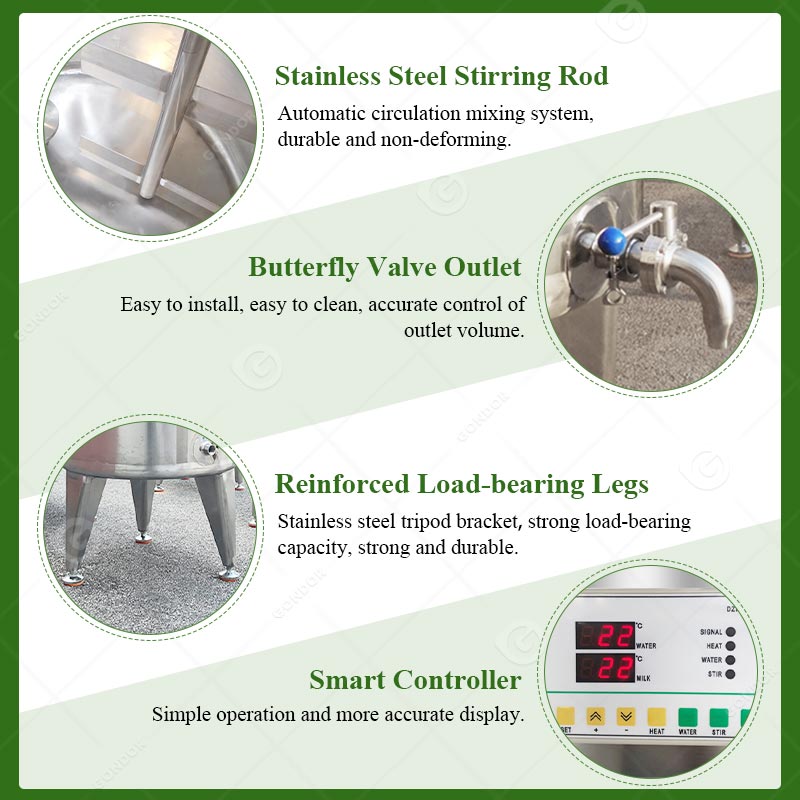
- Temperature and holding time are both programmable. From ambient to 99 °C, with a settable hold once the setpoint is reached. Pasteurized milk, yogurt pre-treatment and juice drinks each get their own curve, instead of an operator hovering over a pot.
- Agitation keeps the tank uniform and skin-free. A mechanically sealed paddle runs a continuous circulation, so every part of the milk sees the same temperature and no skin forms on the surface. Skin hurts appearance and bakes onto the wall during cleaning.
- Indirect water bath heating: no scorching, fast heat-up. Elements heat the water layer, not the milk directly, so nothing sticks to the bottom and clean-down does not involve scraping. The insulated jacket holds heat in during operation, which keeps power use below what an open direct-heated vat would draw.
- Fast water cooling with low water use. After the hold, the jacket switches to cooling water with no separate chiller. The circuit consumes less water than a straight-through setup, which matters in shops where drainage is limited.
- Heavy-gauge stainless steel, food-contact surfaces in non-magnetic grade. Milk-contact parts are food grade stainless, and the body is built heavy. It resists corrosion, wipes down in minutes, and the hygiene condition is visible at a glance.
- One vessel for killing, holding and cooling. The same machine sells as a batch pasteurizer for drinking milk and doubles as the pre-treatment and holding step before yogurt inoculation. Juice and beverage bases run on it too, so a small operator gets real utilization out of a single unit.
Engineering Design
Layered vessel. From outside in: insulation layer, water jacket, inner vessel. The jacket carries the heating and cooling medium, the inner vessel holds the milk, and the insulation pins the heat in. A level indicator shows the jacket water at a glance, the air outlet on top gives expanding water somewhere to go, and the overflow gap catches overfilling.
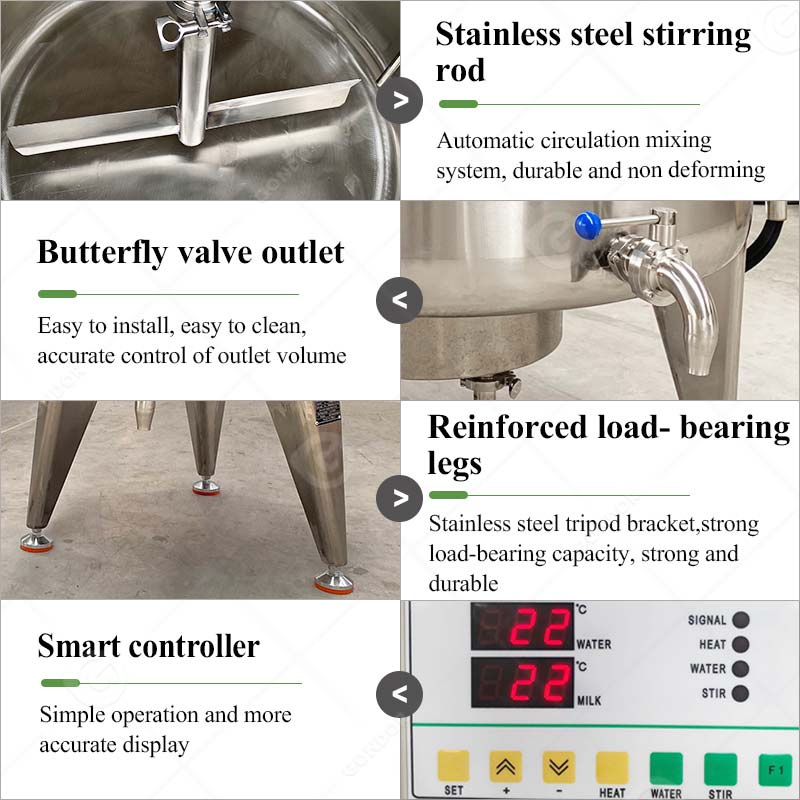
Ports and discharge. Water inlet and drain sit low on the vessel. The milk outlet carries a butterfly valve for controlled, metered discharge and quick strip-down. The drain port is separate, so cleaning water never crosses the milk path.
Agitation and sealing. A stainless paddle on a mechanical seal runs the circulation continuously. The agitator motor is one of the few parts that runs for the whole batch, so the shaft seal is a routine inspection item.
Support. The vessel sits on a reinforced stainless tripod. A full tank rides high, and leg geometry is what stops the unit from being knocked over, which happens more often with small equipment than people expect.
Structure breakdown
| No. | Part | Function |
|---|---|---|
| 1 | Water level indicator | Shows jacket water level |
| 2 | Air outlet | Vents expanded air from the jacket |
| 3 | Overflow gap | Prevents overfilling |
| 4 | Jacket water layer | Carries heating and cooling medium |
| 5 | Insulation layer | Cuts heat loss during operation |
| 6 | Water inlet | Filling and cooling water changeover |
| 7 | Water outlet | Jacket drainage |
| 8 | Milk outlet | Butterfly valve, controlled discharge |
| 9 | Drain | Cleaning discharge, separate from milk path |
| 10 | Sight glass | Milk level inside the vessel |
| 11 | Control box | Set and display temperature, run and stop |
| 12 | Motor and agitator | Continuous circulation for uniform temperature |
Operating Procedure
- Pre-start check. Jacket water at level, supply wired to the correct voltage (220 V or 380 V), valves closed, drain port sealed.
- Charging. Fill raw milk through the feed port and watch the level in the sight glass, keeping within the rated capacity.
- Parameter setting. Set the pasteurization temperature and the holding time on the controller.
- Heat and hold. Start heating and agitation. At the setpoint the unit holds and times the batch, with the agitator running throughout.
- Cooling. At the end of the hold, stop heating and switch the jacket to cooling water until the milk reaches transfer temperature.
- Discharge. Open the butterfly valve and run the milk into the filling machine, fermentation tank or chilling tank.
- Clean-down. Drain the remaining milk, rinse the inner vessel and agitator, open the drain, and change the jacket water as needed.
Where a Milk Pasteurizer Machine Sits in a Dairy Line
Milk bars and fresh milk shops. Milk pasteurized, chilled and shelved the same day, with unsold stock carried over in the fridge. Sizing follows daily turnover; a shop moving under 200 L a day fits GD-100 or below.
Farm gate sales and smallholders. Farmers pasteurize at the point of production and skip the collection station. The 10 L and 30 L sizes suit producers doing a few dozen litres a day for market or community sales.
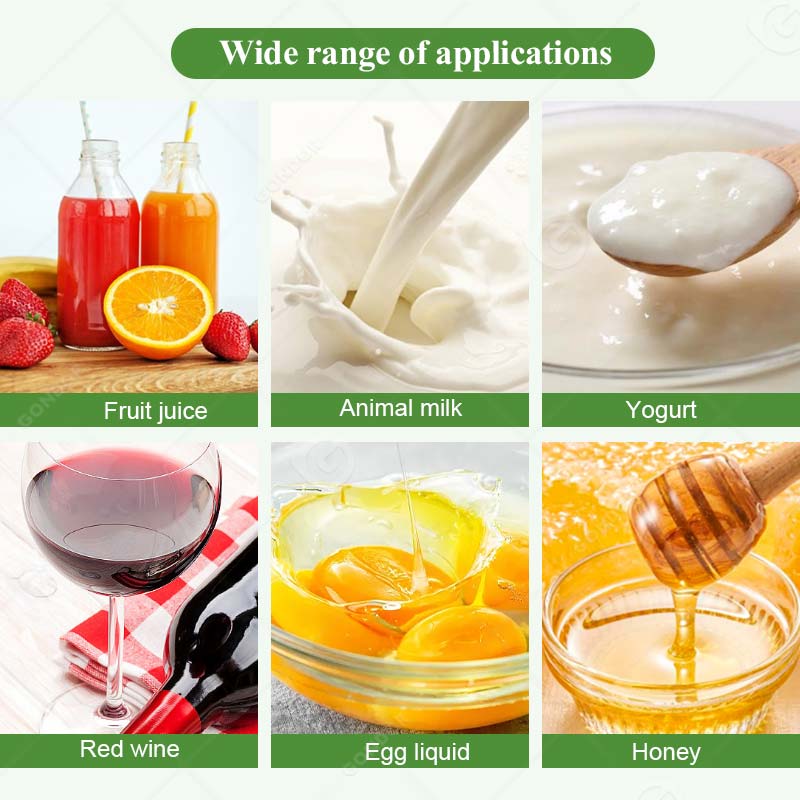
Yogurt workshop pre-treatment. The first step in yogurt is killing the milk and cooling it to inoculation temperature. One machine does both, with no transfer before the culture goes in. This is the most convenient use for a small workshop.
Community stores and market stalls. Individual operators run fresh-milk points in stores and wet markets. The machine takes less than a square metre and starts work once water and power are connected.
In-house dairy processing for restaurants and beverage shops. Milk tea shops, bakeries and restaurants that care about ingredient freshness pasteurize purchased raw milk themselves instead of relying on long-life stock.
Juice and beverage bases. Juice, wine and juice-drink bases run on the same unit, each with its own temperature and holding time.
Market Trends
Over the past decade, chilled pasteurized milk and fresh-made yogurt have grown faster than shelf-stable milk, and consumers pay more for freshness. Milk bars and made-to-order yogurt shops ride exactly this wave. Regulation has moved the same way: raw milk trading is being squeezed in many regions, and selling after pasteurization is becoming the default. For small operators this means the barrier to entry is no longer a factory-scale plant; a pasteurizer in the tens-of-litres range brings it down to a single machine.
How to Size a Milk Pasteurizer Machine Around Your Daily Intake
Three questions first: daily volume, product type, and power supply.
- Daily throughput. Match batch size to the volume you actually kill per day, and count heat-up, holding and cooling between batches. Under 100 L a day points to GD-10 or GD-30; 200 to 500 L points to GD-50 or GD-75; beyond that, GD-100 or GD-200.
- Product mix. Drinking milk alone needs killing and cooling only. Yogurt on the menu calls for the holding function and space to work at inoculation. Juices and beverages follow their own process temperatures.
- Electrical conditions. The 6 kW tier runs on ordinary power; the 9 kW tier wants 380 V. Confirm the incoming capacity before installation, especially in a shop sharing a circuit with air conditioning or ovens.
- Downstream connection. Planning a filler or fermentation tank? Choose 50 L or above and align the discharge height with the next machine’s inlet before ordering.
Limits worth stating plainly. This is a batch water-bath pasteurizer, not an HTST continuous line. Hourly output is bound by the batch cycle, so it will not serve a central kitchen at factory scale. The kill depends on the temperature and time pair plus operating discipline; the machine does not replace laboratory testing. Products with particles or high viscosity transfer heat differently from raw milk, so state the material when asking for a recommendation.
Customization
- OEM / ODM. Accepted, including private-label and neutral packing.
- Configurable items. Batch capacity beyond the standard 10 L to 200 L range by discussion; stainless steel grade; heating method (electric / steam / gas); voltage (220 V / 380 V).
- Tooling lead time. Planned against the drawing and confirmed with the offer.
- MOQ. One set, or one line for a complete system.
Business Terms
- MOQ. One set, or one line for a complete system.
- Lead time. Confirmed with the offer, in working days from deposit.
- Packing. The machine is wrapped in a waterproof film against dust and rain, then packed in a standard wooden case for long-haul ocean or inland transport.
- Trade terms. FOB, CIF or DAP as agreed.
- Port of shipment. Confirmed with the booking.
Quality Inspection and After-Sales
- Pre-shipment inspection. A video factory inspection can be arranged; a mechanical test report ships with each unit.
- Warranty. Core components carry a one-year warranty (pump, motor, PLC, gearbox and similar).
- Commissioning. Remote guidance is provided. Faults are diagnosed remotely first, with an engineer dispatched when needed; installation support and operator training can be arranged.
- Spare parts support. Part numbers ship with the manual, and spares stay available after the warranty.
Milk Pasteurizer Machine Questions Buyers Ask Before Ordering
1. What materials can this machine handle?
Raw milk is the main one. Juice, yogurt base, wine and juice-drink bases also run on it. Materials with large particles or high viscosity transfer heat more slowly and need a re-checked batch time.
2. How are temperature and time set?
Temperature is adjustable from ambient to 99 °C, and the holding time after reaching the setpoint is programmable. The exact pair follows the process for each product, which differs between dairy and beverages. The machine guarantees control of temperature and time; the parameters come from the process.
3. How long does one batch take?
It depends on capacity, initial milk temperature and the programmed parameters: heat-up lifts the milk from room temperature to the setpoint, holding follows the process timer, and cooling pulls it back down. The source gives no fixed cycle figure, so run one timed batch with your own material and record the three stages before planning production.
4. How do I use it for yogurt?
Kill the milk in this machine, hold it, and cool to inoculation temperature. Add the culture and move the milk to a fermentation tank. One vessel covers the pre-treatment, which saves a separate kettle.
5. Which voltage should I choose, 220 V or 380 V?
The small tier (6 kW) runs on either; the large tier (9 kW) wants 380 V. Confirm site voltage and circuit capacity when ordering, and do not share a circuit with air conditioning or other heavy loads.
6. What material contacts the milk?
The inner vessel, paddle and contact parts are food grade stainless steel, noted in the source as non-magnetic, with a heavy-gauge stainless body. The steel grade can be customized on request.
7. Can it be private-labeled or customized?
Yes. OEM and ODM are accepted. Capacity, voltage, heating method and steel grade are all adjustable. For export orders, state the certification requirements of the target market in advance.
8. How is after-sales handled?
Core components carry a one-year warranty, and each unit ships with a manual and a mechanical test report. Faults are diagnosed remotely first; when that fails, an engineer is dispatched. Installation and operator training can be arranged.
From Inquiry to Pasteurizer Commissioning
If daily volume, whether you are doing drinking milk or yogurt, and the site voltage are already clear on your side, send those three items and we will recommend a size tier, power configuration and quotation. To verify first, tell us about your material and we will advise parameters against the actual process.
Contact
Henan Gondor Machine Co., Ltd. Website inquiry form, WhatsApp or email. Replies within 24 hours on working days.
Related Equipment
- Liquid Filling Machine — takes the cooled milk straight from the pasteurizer outlet into bottles or cups.
Request Milk Pasteurizer Machine Pricing and Delivery Schedule
Send us the daily volume, the product and the container or pack format you are working with, and we will come back with a model recommendation, a utility list and a price.
Related guides
Related Products


Sizing equipment for your line?
Send the product, the batch size and the utilities you have. We reply with the model, the cycle time and what the cooling side needs.