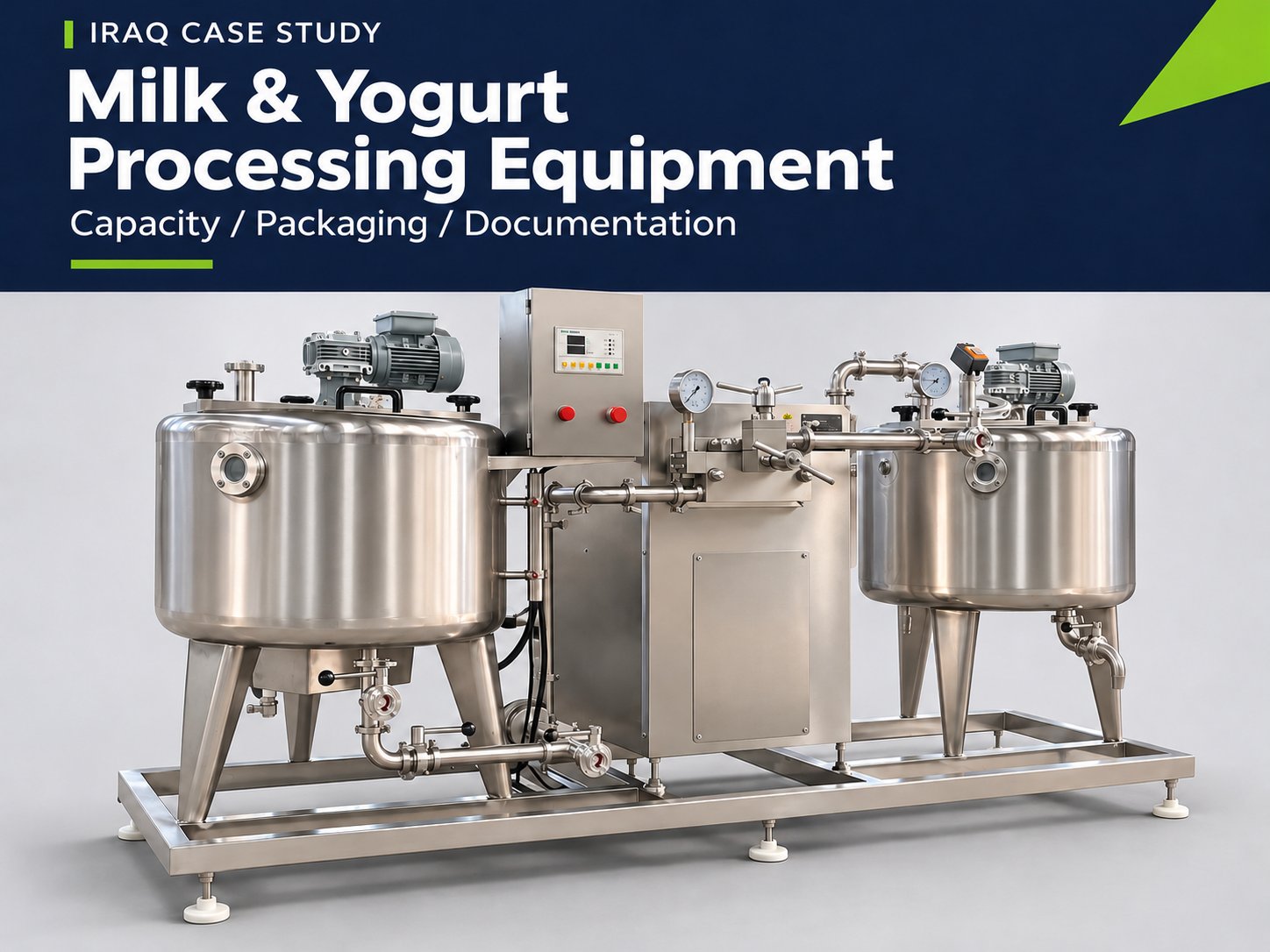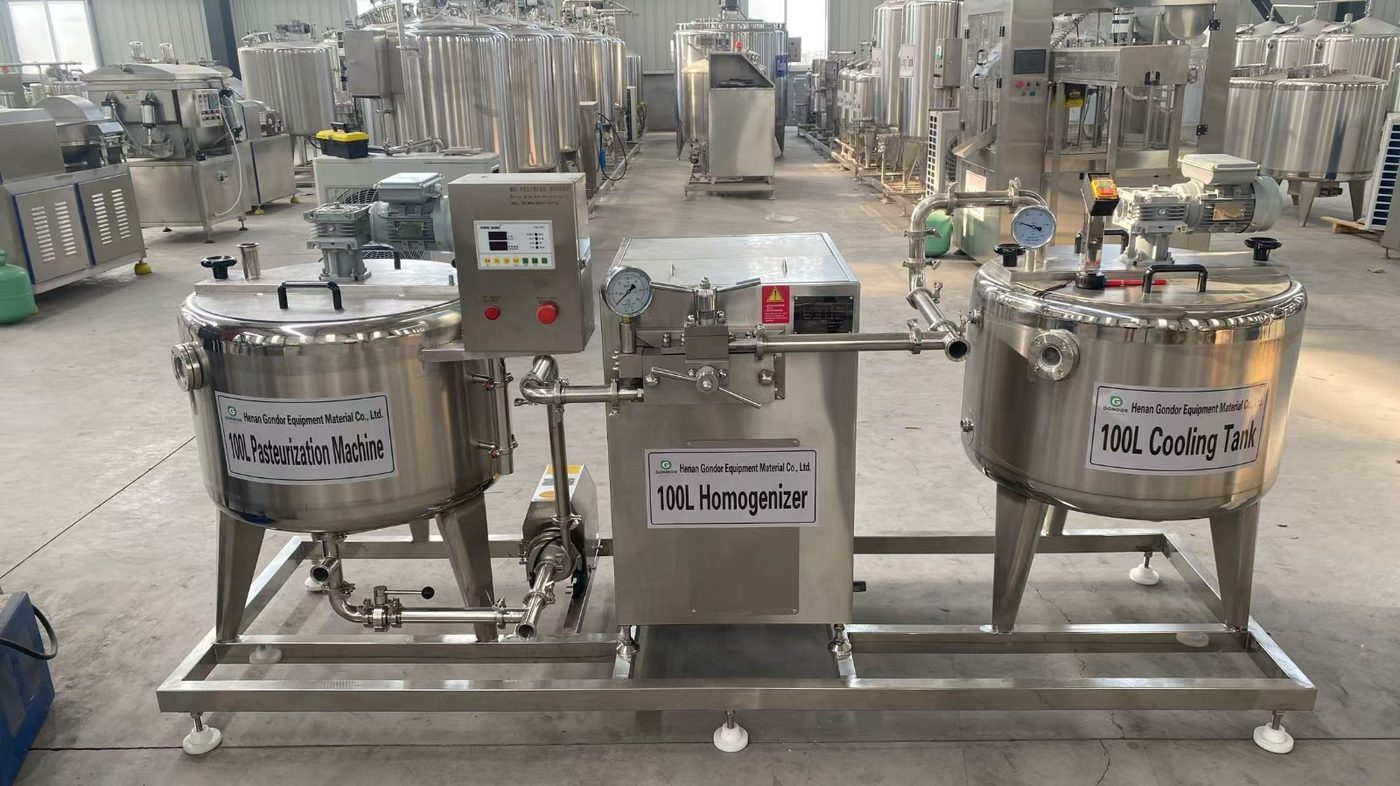
A returning buyer in the Philippines placed a second order with us in June 2026, this time for a 100L milk processing line rather than a set of separate machines. We had supplied the same customer with individual dairy units in 2024. What changed on the repeat order was the scope: the equipment was to arrive on a common base, with the connecting pipework already made.
The order brought together a batch pasteuriser, a homogeniser, a sanitary pump and a jacketed cooling tank. The specified supply was 220V, 60Hz, single phase. Before production began, we worked through the pipe routing, the boundary of the cooling tank supply and the delivery arrangements with the buyer.
From separate machines to a connected assembly
For the 2024 order the buyer had arranged the pipework between machines with their own technicians. The repeat order reversed that: we were asked to supply the piping from the pasteuriser to the pump, then on to the homogeniser and the cooling tank.
That decision changed what had to appear in the quotation and in the purchase order. Alongside the machines, the agreed scope listed the equipment base, stainless steel pipe, elbows and tees, clamps, sealing gaskets and manual clamp-type butterfly valves.
The buyer also confirmed that no extra pump was needed between the homogeniser and the cooling tank, which changed the connection plan we had drawn up. Working through that point also settled where our supply ended and what still had to be provided on site.
What the customer ordered
The purchase order of 8 June 2026 listed the following:
| Item | Order specification |
|---|---|
| Batch milk pasteuriser | One 100L unit; 9kW electric heating; 220V, 60Hz, single phase |
| Homogeniser | One unit rated at 100L/h; 220V, 60Hz, single phase |
| Sanitary transfer pump | One unit, supplied as part of the connected assembly |
| Cooling tank | One 100L, three-layer insulated stainless steel tank; no refrigeration unit included |
| Base and connections | Common base, stainless steel pipework, fittings, clamps, gaskets and manual valves |
The pasteuriser’s 100L figure describes its batch capacity. The homogeniser’s 100L/h figure is its rated output. Neither sets the hourly throughput of the complete process, which also depends on how long each batch takes to heat, hold and cool.
Confirming the pipe size before assembly
The buyer initially asked for 1-inch piping with clamp connections. Partway through production our team proposed 38mm outside diameter pipe instead, and put the change to the buyer rather than substituting it quietly. The buyer accepted the 38mm size on 27 June.
When the buyer asked for the installed footprint, we measured the assembly and replied with the unpacked dimensions: 2,650mm long, 940mm wide and 1,300mm high, so the space could be planned before arrival.
Production, payment and handover
We confirmed the advance payment on 22 June and kept production updates running. On 23 July we reported the equipment complete and sent photographs of the assembly.
The buyer then arranged the balance and supplied the transfer documentation. Shipment was coordinated with the buyer’s nominated forwarder in Yiwu, with the receiving instructions and the shipping mark checked before dispatch.
- 6 August: equipment dispatched to the forwarder.
- 10 August: equipment arrived at the forwarder’s address, which the buyer confirmed.
- 19 August: after checking with the forwarder, we advised that the goods had sailed on 18 August.
Controls and cooling, settled after handover
After the equipment reached the buyer’s forwarder in China, the buyer asked which machines ran from the control panel. The pasteuriser, transfer pump and homogeniser share one control arrangement; the cooling tank has its own power supply.
The tank was supplied with a jacket and insulation, without a refrigeration unit. In September the buyer asked about adding chilling for a 100L batch, targeting 8–10°C from a starting temperature of about 60°C. We discussed an external chiller and an insulated water tank for the cooling circuit, as a separate addition to the original order.
The repeat order covered the connected 100L equipment, the base and the fittings, handed over to the buyer’s forwarder. Electrical scope and active cooling were the two areas left open, and both were settled in writing afterwards.
Planning a similar dairy equipment order?
Send us the product, the batch volume, the voltage and frequency at your site, and the cooling you have available. Tell us whether you want separate machines or a connected assembly with piping and controls, and we will quote the equipment and the installation scope as separate lines.